

obituaries »
A Prayer For Leonard Cohen
George Robinson | New York Jewish Week
L
eonard Cohen wasn’t always clear
on when he began writing, but he
was utterly certain when asked
about the first poetry he remembers
reading.
About a third of the way into Leonard
Cohen: I’m Your Man, a 2005 film, he
says “The first poetry that affected me
was in the synagogue — the prayer
book and the Bible. That would send
shivers down my spine.”
Coming on the heels of Bob Dylan’s
Nobel Prize for Literature, Cohen’s death
Nov. 7, 2016, at age 82, suggests a vale-
dictory moment, a passing of the guard
in the Jewish singer-songwriter-prophet
division. Cohen’s music and poetry were
touchstones for so many musicians and
writers of a certain generation that it’s
hard to imagine a time when he wasn’t
around and creating.
Somehow, Cohen and Dylan just were
always there.
Of course, Cohen had perfected a
look that is now back in style, the bolo
ties, lounge-lizard shiny suit and stingy-
brim fedora, a “hipster” avant la lettre.
It announced him in the late-’50s and
even more in the ’60s as a man con-
sciously out of step with his times, the
sort of diaspora Jew who was at home
nowhere and, as a result, everywhere.
Perhaps it was a tribute to his father,
who died when Cohen was 9. Trained
as an engineer, the elder Cohen ended
up in the clothing business in Montreal
and, with his death, left his literary-
minded son with a small trust fund that
would enable Leonard to pursue his
adult ambitions, first as a poet then as
a novelist and, most famously, a singer-
songwriter.
Fittingly, the first writing of his that
Cohen remembered, according to the
2005 documentary, was a message he
enclosed in one of his father’s bow-
ties and buried in the backyard. “It
was some kind of a prayer, but I don’t
remember what I wrote,” he said.
That novice effort may be lost, and
Cohen was never that prolific; he leaves
a rich literary and musical legacy any-
way, with a long list of songs that have
been covered by a longer list of artists,
from his first, “Suzanne,” which was a
hit for Judy Collins.
It was Collins who encouraged him
to perform his own songs. In one of
his best, “Tower of Song,” he wryly
describes himself as “born with the gift
of a golden voice” although his quiver-
ing, croaking bass is more redolent of
silver and lead than gold.
As he aged, the instrument became
gravelly, his intonation a bit uncertain
but the deadpan tone was a marvelous
counterpoint to his words and themes,
which ranged from the intensely biblical
to the mordantly erotic.
Ron Kampeas rightly observes that
Cohen wrote for his own limited musi-
cal range. “[The songs] would have been
dirges but for their surprising lyrical
turns and their reckoning with joy in
unexpected places,” Kampeas wrote in
his obituary for Cohen published by the
Jewish Telegraphic Agency this week.
In that respect, Cohen had an affin-
ity with Dylan, to whom he was always
compared. Neither had a great voice by
conventional terms although Dylan’s
was, until recently, more flexible, dra-
matic and startlingly expressive. But
each brought an appropriate timbre and
solemnity (if occasionally feigned) to
mercurial materials, cadences redolent
of Torah and a desert-dry humor for
those willing to hear it.
Cohen’s compositions became ear-
candy for hundreds of more convention-
ally gifted interpreters with
one-tenth his writing talent.
His early songs include such
standards as “Bird on the
Wire,” “Sisters of Mercy,”
“Hey, That’s No Way to Say
Goodbye,” “Famous Blue
Raincoat.” As his career
proceeded in fits and starts,
stalled at times by battles
with depression and Cohen’s
reclusiveness, the songs
became fewer but the cover
versions proliferated: “Dance
Me to the End of Love,”
“I’m Your Man,” “Everybody
Knows” and “Tower of Song.”
But the earthquake epi-
center of all of these tributes,
homages and reinventions is
surely “Hallelujah,” of which
there are already more than
200 recordings by different
artists. The most famous of
these, Jeff Buckley’s 1991 ver-
sion, turns Cohen’s droll, dark
meditation on the need for
spiritual comfort in a wounded world
into a six-minute-long howl of despair.
It’s a transformation that points up
the shortcomings of most covers of
Cohen that turn nuanced, emotion-
ally complex numbers into vehicles
for unbridled emotions bordering on
the inchoate, with vocal pyrotech-
nics betraying their message. Still,
“Hallelujah” is a brilliant song, and if
you had to choose a “Stardust” or “Body
and Soul” for the 21st century, you
could do worse.
Cohen was raised in an Orthodox
home. His mother’s family included
prominent Litvish rabbis; and to the
end of his life, the writer was observant,
famously cancelling a series of U.K. con-
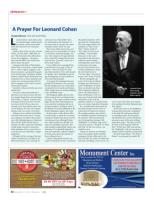
Leonard Cohen,
whose songs
inspired a nation,
died at age 82.
certs in 2013 when they were mistak-
enly scheduled for Rosh Hashanah and
Yom Kippur.
He became active in Zen Buddhism,
turning away from music completely
in the mid-’90s and being ordained
as a Buddhist monk. He remained a
self-identified Jew, and his Jewishness
permeates some of his most striking
and potent songs, “The Story of Isaac,”
the Days of Awe-inspired “Who By
Fire,” “If It Be Your Will” and, inevita-
bly, “Hallelujah,” with its invocation of
another Jewish troubadour, King David.
His final studio album, “You Want It
Darker,” was released last month.
*
Monument Center Inc.
“Same Location Over 80 Years”
Monuments and Markers
Bronze Markers
Memorial Duplicating
Cemetery Lettering & Cleaning
32418 Northwestern Hwy.,
Farmington Hills
248-862-5747
Mon-Thurs 10am-10pm,
Fri-Sat 10am-12mid,
Sun 11am-8pm
Featuring ~ Shiva Trays, Dairy Trays,
Deli Trays, Candy & Nut Trays,
Fruit Trays, Custom Specialty Trays
made upon request.
$5.00 OFF
on All Trays
(one coupon per order)
CORK & RYE LIQUOR
2117860
62 November 17 • 2016
Obituaries
www.MonumentCenterInc.com