

preview screening of Indignation presented by the
Los Angeles Jewish Film Festival.
Jonathan Kirsch: Has Philip Roth seen the
movie yet, and if so, how did he respond?
James Schamus: Yes, he has, and, thank the
Lord, he responded very well!
JK: What was the career path that led you from
your work with Ang Lee to writing, directing and
producing Indignation?
JS: Your question assumes that there is a path,
when it was more like stumbling through the
brush. We tend to think opportunistically in
terms of what’s stirring the imagination. I was at
an airport a number of years ago, and I picked up
a copy of Indignation, which had just been pub-
lished in a mass-market paperback edition. This
was a time when Wi-Fi was not available, and a
long flight was one of the few places left on the
Earth where I could really unplug. I just fell in
love with the characters, and I acquired the rights
to the book.
JK: Roth discloses a shocking fact about Marcus
Messner early in the novel. Based on my first view-
ing of the movie, it is not revealed until the end.
Am I right? And, if so, what was your reason for
delaying the disclosure?
JS: It is disclosed, but in a way that is not nec-
essary for you to register it consciously. I played
around a lot with when to disclose. And I am
playing with the audience a little bit in one scene,
where it is suggested in the lighting and the set.
Roth novels are notoriously difficult to adapt, and
I was trying to figure out a way to reproduce the
sense of what’s left at the end of the book, when
you know you have a consciousness who’s reach-
ing out from young adulthood. That’s where I cre-
ated the framing devices for the film, which are
not in the book.
JK: Your cast is deeply rooted in theater, and
especially the Broadway theater. Was that a prin-
ciple of selection in casting the film?
JS: It wasn’t a principle of selection. It was a
requirement of budget. But I knew I could get
actors who would precision-target that world and
just live it. Danny Burstein and Linda Emond are
theater royalty, and I think of Tracy Letts as the
king of American theater.
JK: One of the glories of your movie is the way
in which it conjures Jewish life in mid-century
America in such authentic detail. But the counter-
intuitive moment for me, both in the book and the
movie, is the scene in which Esther Messner objects
to her son’s romance with the gentile character
Olivia Hutton, a beautiful young blonde played by
the stunning Sarah Gadon. Esther notices the scars
on Olivia’s wrist and tells her son that he can date
or marry anyone he wants, even a non-Jew, as long
as it isn’t one who has tried to commit suicide.
JS: Clearly, Roth gave me the gift of this char-
acter, and it would have been a mistake to depict
her as a caricature of the Jewish mother. This is
a mother who knows what she’s doing. Esther
Messner is probably the first person in Olivia’s
entire life who gets her the minute she sees her.
Esther knows who Olivia is and what she’s gone
through. Nobody else gets it. But maybe Esther
is just thinking: Let’s solve the problem of Olivia
and move on. If there’s another battle to fight
later on, I’ll figure out the next move in my cam-
paign.
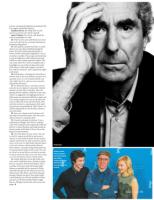
Philip Roth
Logan Lerman,
James Schamus
and Sarah Gadon
promoting
Indignation at the
66th Berlinale
International Film
Festival
*
August 11 • 2016
71