

arts & life
f i lm
Indignation
PHOTO BY GERHARD KASSNER
Industry veteran James Schamus makes his
directorial debut bringing a drama of ideas to life.
Jonathan Kirsch | Jewish Journal of Greater L.A.
I
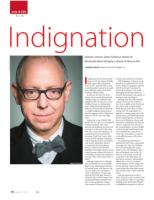
James Schamus
70 August 11 • 2016
ndignation, the new movie based
on a novel by the immortal Philip
Roth, opens with a skirmish in
Korea in 1951 and ends with a scene
so shocking that it cannot be revealed
here, although readers of the book
will know what’s coming.
In between, however, the movie
focuses on the sexual and emotional
coming-of-age of a troubled Jewish
adolescent from Newark, N.J., whose
childhood home is a battleground,
and a college deferment means the
difference between life and death. He
is a highly indignant young man, as
the title suggests, and his indignation
plays out in both comic and tragic
ways.
Indignation is one of Roth’s “late”
novels, but it is a gem. As re-imagined
by James Schamus, who wrote,
directed and produced the movie, life
in America in the early 1950s comes
fully alive, as does the experience of
a generation of Jewish Americans
for whom World War II was a fresh
wound, and the prospect of making
a life among the “goyim” is burdened
with anxiety and gloom. When it
is announced that young Marcus
Messner will leave Newark upon
graduation from high school to attend
a small, private college in the town of
Winesburg, a friend of the family frets
out loud: “How will he keep kosher in
Ohio?”
Although Indignation is Schamus’
directorial debut, he is a formidable
figure in the entertainment industry.
He worked closely with director Ang
Lee over many years, serving as a
writer and producer on films rang-
ing from Eat Drink Man Woman to
Crouching Tiger, Hidden Dragon, and
producing Brokeback Mountain. He
also oversaw production of many
other movies of distinction as the
founder and head of Focus Features.
With Indignation, Schamus reveals
himself to be a gifted director whose
work is elegant yet poignant, superbly
well observed and even painterly,
informed by Schamus’ own Jewish
upbringing and identity, driven by
powerful performances and capable of
moving us and surprising us.
Working from New York afforded
Schamus resources that would not
have been available on the West Coast
for a movie with a modest budget.
While the star of the show is Logan
Lerman (see “My Generation” on
page 68), a winning young actor who
already enjoys a fan following among
the 20-somethings, the cast also fea-
tures several Broadway veterans and
luminaries, including Danny Burstein
(who re-created the role of Tevye in
the recent Broadway revival of Fiddler
on the Roof) and Linda Emond (who
was nominated for a Tony for her
recent role on Broadway in Cabaret)
as the afflicted parents of the story’s
young hero.
An outstanding performance is
delivered by Tracy Letts, a playwright
and stage actor who won a Pulitzer
Prize for his Broadway hit August:
Osage County. Most filmgoers, how-
ever, will recognize him as the CIA
director in Homeland, and his role
as the dean of the Midwestern col-
lege Marcus attends is unforgettable.
Indeed, the on-screen encounters
between Marcus and his college dean
are the dramatic center of gravity in
a movie that offers one intense scene
after another, many of them explicitly
erotic.
I had the opportunity to talk to
James Schamus on two occasions, first
in his production office in a gentrified
building in the old Garment District
in Manhattan and again at a sold-out