

metro »
Divorcing The ‘Right Way’
Mediation lawyer helps couples during divorce.
Judy Greenwald | Contributing Writer
U
ntil death do us part. Though a
familiar phrase, its concept is one
not adhered to in Judaism. In fact,
if there is irreconcilable dissention between
marital partners, Jews are allowed to dissolve
the relationship rather than stay in a loveless
marriage.
Even with this affirmation, divorce is
never an easy solution. At best, spouses may
remain cordial; at worst — well, much has
been publicized about how painful the pro-
cess can be.
Barbara Smith is one lawyer, however, who
has built a practice seeking to ease this dif-
ficult undertaking. A graduate of Michigan
State University and Cooley Law School with
more than 30 years of professional experi-
ence, including serving as a district court
magistrate and administrative law judge,
she opened her own law office in Bloomfield
Hills about 10 years ago and has been named
a top lawyer in both family law/alternative
dispute resolution and in mediation.
“I started my own practice and found that
in addition to being a lawyer, I’m also a busi-
ness owner,” Smith said. “I wanted to focus
on mediation — primarily in the area of
family law. Mediation is a skill set. The skill
comes in how to mediate a resolution.”
Mediation is the process that comes at the
end of a divorce, Smith said. Each party has
an attorney, and as the last step before trial,
the attorneys will choose a mediator or the
court will appoint one from an approved list,
of which Smith is a part. The attorneys and
clients are in two rooms, and she goes back
and forth between them until an agreement
is reached.
Certain basic things must be determined
in Michigan during divorce: One, if there are
minor children, custody and support must
be taken care of; and the marital estate must
be divided. When after one or several ses-
sions these issues are resolved, the resolution
is presented in a judgment of divorce.
“What I decided to do, which I believe is
unique, is mediate cases without attorneys. I
have represented and continue to represent
people in divorce and know what that pro-
cess is. It’s adversarial, it can be very ugly and
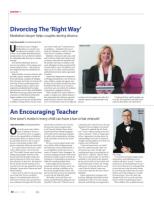
Barbara Smith
can leave a lot of wreckage in its wake. It’s a
horrible, expensive and emotionally costly
process.
An Encouraging Teacher
“I understood there could be another way
to do this. It’s important to note that I don’t
represent either party, and I don’t advise
Marcel
Cohen
One tutor’s motto is ‘every child can have a bar or bat mitzvah.’
Judy Greenwald | Contributing Writer
O
ne of the most iconic celebra-
tions in Judaism is the bar or
bat mitzvah, where a youngster
takes on the responsibilities of adulthood
and proclaims before an audience of fam-
ily and friends that he or she is ready to
become a functioning member of the
greater community within the Jewish faith.
As a teacher, Marcel Cohen has a motto:
“Every child can have a bar or bat mitz-
vah.” The friendly Toronto native has been
helping young people, both those with
special needs and the gifted, realize this
goal of achieving one of the most impor-
tant milestones in their lives. He launched
his bar and bat mitzvah tutoring service
more than 10 years ago, inclusively serving
Orthodox, Conservative, Reform and unaf-
filiated families.
Cohen, 48, lives with his wife and young
son in Oak Park. He has a bachelor’s
degree in arts administration from the
University of Toronto and a special educa-
tion certification through York University
22 July 21 • 2016
and the Mercaz L’Morim. He served for
the past nine years as program direc-
tor of Toronto’s Kadima Centre, based
at Beth Emeth Bais Yehuda Synagogue,
which offers Jewish education programs
for adults with exceptionalities, teaching
Torah, spirituality and about the Jewish
holidays.
The son of actress Juliette Jacobs (who
was a hidden child in Belgium during
the Holocaust), Cohen studied drama, is
an accomplished vocalist and serves as
cantor at Toronto’s Lodzer Synagogue. He
continues studying chazzanut with several
prominent Canadian cantors and feels by
teaching he is channeling his performance
skills into something kadosh (holy).
Cohen taught special education in
Jewish day schools in Ontario; and it was
his love for teaching, in addition to his
love for his younger brother Aaron, who
died in 2010, that served as his inspiration
to work with the differently abled.
“My brother Aaron had Down syn-
drome, and had limited reading and writ-
ing skills,” Cohen said. “When he was 32,
I asked him if he wanted to learn. He said,
‘Hopeless! It’ll never happen, my friend!’
“I learned in yeshivah that the Torah
says: ‘Teach a child according to his way,’”
Cohen continued. “That’s an integral part
of how I approached teaching Aaron, by
understanding if you teach to someone’s
strength, training children to be their own
teachers, they will flourish.
“I knew he loved movies, so I asked
him if he could look up the 1950s cast
of the Superman series. He did some
searching and came to me asking how to
spell ‘Reeves.’ I told him. Then he asked,
‘How do you spell George?’ So I got him a
notebook to write down all his inquiries.
By the end of his life, he had written and
learned thousands of words. His writing
ability grew to the point where he wrote
comic books for Marvel Comics and
even movie scripts that he sent to Steven
Spielberg.”
Cohen explained his technique with
learning-challenged individuals involves
breaking down the service into manage-
able parts and offering encouragement at
every stage.
“I use proven learning strategies along
with patience and enthusiasm so my
students will shine,” he said. “I want my
instruction to be the beginning of success
for the rest of their lives. I encourage them
to have fun but to take this study serious-
ly; and when they realize they can master
Hebrew and Torah reading, it’s a wonder-
ful achievement. These were kids who
thought they’d never succeed, and when
they do, it’s life-transforming for them.”
Those children who are gifted also pres-