

spirituality »
Get inspired.
Meet medical
specialists. Connect
with others. All at a
Novartis
MS Education
Link Event
Old New Haggadah
Medieval illuminated texts, art blend with Soloveitchik’s comments.
Louis Finkelman | Contributing Writer
T
(PLO\+RVOHU )13%&
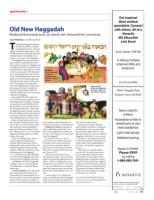
Photos Courtesy British Library
he Medieval Haggadah Anthology
by Rabbi David Holzer combines
two significant projects. It features
digitally remastered images from 35 medi-
eval illuminated texts along with transcripts
of Rabbi Joseph B. Soloveitchik’s com-
ments on every aspect of the Haggadah.
This Haggadah has spectacular illustra-
tions. Search the world’s libraries for the
most gorgeous example of a Haggadah, and
you might choose from among a few dozen
works produced in Spain, Italy or Germany
in the two centuries after 1250. Hand writ-
ten on animal parchment, these texts also
feature colorful illuminations. Some words
appear in vivid colored panels, glittering
with gold; fantastic creatures climb up the
sides of some pages; other pages depict
scenes from biblical history. Perhaps most
fascinating, some depict contemporary
Jews observing the holiday. Holzer has
hundreds of illustrations from these manu-
scripts in this Haggadah.
Solovietchik (1903-1993), called “the
Rav” by his thousands of students, was an
electrifying speaker in English, a language
he learned as an adult. He addressed the
general public in a personal and yet intel-
lectually sophisticated way. All the while,
he engaged in classical Talmudic teaching,
at first in Yiddish and later in the idiom of
the American yeshivah, English enriched
with Yiddish, Hebrew and Aramaic terms.
Holzer of Miami Beach served as the
Rav’s chauffeur and aide-de-camp, using
hours in the car to record answers to ques-
tions of all sorts. Holzer has published
transcripts of these conversations as the
“Rav Thinking Aloud” series. The Medieval
Haggadah Anthology appears as the fifth
volume of the series.
Holzer has a lifelong passion for the
research, editing and publication of
medieval Hebrew manuscripts. He has
published more than a dozen of these. The
Medieval Haggadah Anthology includes
hundreds of full-color images from medi-
eval manuscripts of the Haggadah.
In a world with more than 3,000 differ-
ent versions of the Haggadah, who would
want the Medieval Haggadah Anthology?
• Art lovers: The Medieval Haggadah
Anthology could serve as an introduction
to the illuminations of medieval Hebrew
manuscripts.
• Lovers of history: The realistic paint-
ings of medieval Jewish life provide the
best possible visual representations of our
ancestors. Holzer teases out the significance
of many of these images. For example, he
discovers an heirloom seed company photo
The family
seder: Ashkenazi
Haggadah,
Germany, 1460,
Yoel ben Shimon
Feibush.
Slaves at work:
Ashkenazi Haggadah,
Germany, 1460, Yoel
ben Shimon Feibush.
is talking multiple
sclerosis (MS) and
treatment.
DW 30
5XVW\ %XFNHW 5HVWDXUDQW DQG 7DYHUQ
7HOHJUDSK 5RDG
%LQJKDP )DUPV 0,
Save a seat for
a friend.
that resembles medieval illustrations of a
mysterious pointy lettuce as the bitter herb.
• Students of Torah: Any students of
Torah would relish seeing the Rav’s com-
ments on the Haggadah. For example, the
Rav asks, “Why, in fact, do we not eat until
we tell the Haggadah?”
The answer, the Rav says, “may be
rooted in the story of Eliezer, the servant
of Avraham.” Sent to find a wife for his
master’s son, he miraculously finds the
girl. Invited to eat at her parents’ home, he
refuses food. “I cannot eat until I have spo-
ken” (Genesis 24:33).
“When one is excited about having
witnessed a miraculous event, one cannot
imagine eating and then talking about it at
leisure …There is something much more
exciting that he must tell first.” At the seder,
“we show our children that our excitement
about the Exodus prevents us from eating
until we have finished telling it to them, as
well.”
A word of caution: The verbatim tran-
scripts occasionally reproduce the language
of the yeshivah. It takes some background
to deal with sentences that feature untrans-
lated Aramaic technical terms.
Another word of caution: Although
many of Holzer’s notes help us understand
the medieval artwork, some seem oddly
skewed. Holzer rightly points out, in the
illustration of the wise son in the Ashkenazi
Haggadah of 1460, that the wise son wears
a “talis katan,” a ritual garment often worn
by observant Jewish men. Holzer does not
mention that no other medieval illustra-
tion shows a Jewish male wearing such a
garment.
Holzer offers a few possible explana-
tions for why “the artists do not seem to
be concerned with showing how slaves
were actually dressed in Egypt, or with
building pyramids as opposed to modern
structures.” However, this feature applies to
nearly all medieval illustrations, which typ-
ically depict ancients in medieval clothing.
The pyramids, although completed long
before Israel went to Egypt, do not appear
in the Exodus story at all.
Accessible to folks in
wheelchairs or who
need assistance.
Light meal served.
Validated parking.
Space is limited.
Please RSVP
by calling
1-866-682-7491.
*
To purchase The Medieval Haggadah Anthology,
contact the author at www.MedievalHaggadah.com
or www.Holzerseforim.com.
Novartis Pharmaceuticals Corporation
East Hanover, New Jersey 07936-1080
© 2015 Novartis
12/15
T-XMG-1325053
0000000
April 7 • 2016
33