

to launch the book. They are
the type of partners who finish
each other’s sentences.
Solomonov is wearing a black
T-shirt, exposing a tattoo on
his muscular left upper arm of
a striking colorful rooster, with
the words of the Shema inside,
and “David” (his brother),
above it. He says that he likes
roosters (many chefs have pig
tattoos) and also has elephants
circling his right upper arm
(“from earlier days”) and robust
pomegranates on that forearm
(he quips that he’s working on
getting all of the seven species
of Israel).
Cook, the son of a Reform
rabbi who served in congrega-
tions around the country, did
a lot of cooking even while
working on Wall Street, before
leaving to open his first restau-
rant. Of the two men, he’s the
one who does Shabbat dinner
with his wife and children. For
Solomonov, Shabbat, “right now
involves lighting candles, saying
motzi, drinking grape juice and
then I go back to work.”
Solomonov explains that
the restaurant is “kosher-style
for the sake of the cuisine
and culture, not for religious
beliefs.” The owners neither
mix meat and milk, nor do they
serve pork or shellfish. They
understand the needs of some
customers who practice kashrut
and, for example, on request,
have served hummus at the bar
on a paper plate. By its nature,
Zahav, the book, is suitable for
kosher kitchens.
For Solomonov and Cook,
this cuisine is all about gen-
erosity and sharing. Over the
years, the menu at Zahav has
evolved, and they continue to
experiment, incorporating new
influences. The general man-
ager of the place is a Turkish
immigrant, who started there as
a busboy.
Their recipe for tehina
makes four cups of what they
call “Israel’s mother sauce.”
Tehina, a building block in
many recipes, as it can enrich
dishes without adding butter
or cream, “might be the least
sexy ingredient (it’s the color of
wet sand; it sticks to the roof of
your mouth), but I haven’t seen
many culinary problems that
tehina couldn’t solve.”
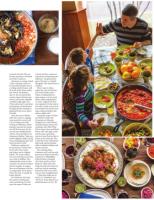
Among the recipes in Zahav
are Chicken Pastilla with
Cinnamon and Almonds,
Chopped Liver with Gribenes,
Yemenite Chicken Soup, Fried
Artichokes, Rice Pilaf, White
Fish in Grape Leaves and Mom’s
Honey Cake with Apple Confit
and the many small salads
served in Israel that they like to
feature in the restaurant. This
is food that works well both for
daily meals and the plentiful
tables of Shabbat, holidays and
special occasions.
Since opening Zahav,
Solomonov and Cook have also
partnered to build several other
restaurants in Philadelphia:
Federal Donuts, Dizengoff,
Abe Fisher and Percy Street
Barbecue. While many who
think and write about the food
world see food as something
beyond the stuff we eat, these
men are more straightforward.
“I think food might just be
food to us,” Solomonov says.
“We love it. It has allowed us to
afford businesses we love.”
*
March 3 • 2016
37