

arts & life
b ooks
Brotherly
Love
And a love
of Israeli cuisine.
Sandee Brawarsky | N.Y. Jewish Week
OPPOSITE PAGE, CLOCKWISE
FROM TOP: Twice-Cooked
Eggplant, to be used in the
gorgeous Fried Eggplant with
Tehina and Pomegranate Seeds.
“Sometimes I feel like my mission
in life is to make people fall in
love with eggplant,” Solomonov
writes in Zahav.
Shakshouka is served at a family
breakfast with Solomonov,
high-fiving his son, David, and
co-author Cook’s daughter, Sally.
Roast Chicken, pickled vegetables
and hummus
36 March 3 • 2016
T
here are memoirs with
recipes, and cookbooks
that also tell stories, but
few authentic cookbooks are so
anchored in powerful life events
as Zahav: A World of Israeli
Cooking by Michael Solomonov
and Steven Cook (Houghton
Mifflin Harcourt).
For Solomonov, his younger
brother’s death while serving in
the Israel Defense Forces pro-
pelled him in a new direction: He
found his way by exploring the
full range of Israeli cuisine and
developing it for an American
palate.
Zahav the book is named for
the award-winning Philadelphia
restaurant owned by the authors,
with Solomonov as executive chef
and Cook heading up the busi-
ness side. When Zahav (Hebrew
for “gold”) opened in 2008, it was
one of the first restaurants in the
U.S. to showcase the wide range
of Mediterranean, Middle Eastern
and immigrant cooking traditions
that are incorporated into mod-
ern Israeli cuisine.
Solomonov was born in Israel,
in a small town south of Tel
Aviv; his mother had grown up
in Ohio, the daughter of active
Zionists, and his father was born
in Bulgaria and came to Israel
with his parents as a 2-year-old.
When Solomonov was 2, his fam-
ily moved from Israel to the U.S.
and he grew up in Pittsburgh.
Back then, his favorite meal was
rice and peas, served on separate
plates.
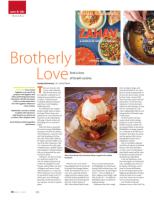
New-School Konafi with Chocolate Filling is topped with candied
kumquats.
When he was 15, he moved
(begrudgingly) back to Israel with
his parents and younger brother,
David. He returned to the U.S. as
soon as he could and attended
college and then cooking school,
while his brother graduated from
high school in Israel and entered
the army. In the summer of
2003, when Michael had a break
from a coveted restaurant job
in Philadelphia, he visited Israel
during David’s military leave. Just
a few weeks later, on Yom Kippur,
David — who was filling in so
that a religious army buddy could
take the day off — was killed by
Hezbollah snipers on a hill over-
looking Lebanon.
Solomonov then had a rough
time, turning to drugs, as he
mourned his brother. Two years
later, he seized an opportunity to
become the chef at a place owned
by Steve Cook, a former Wall
Street executive-turned-chef and
restaurateur. For the first time,
Solomonov “set free the Israeli
influences that had begun to seep
into my consciousness,” as he
writes, adding dishes like his own
interpretation of Yemenite soup,
to their menu.
He then became more pas-
sionate about Israeli cooking,
seeing it as a way to honor his
brother’s memory, and the two
men opened Zahav in downtown
Philadelphia, its design inspired
by a courtyard in the Old City of
Jerusalem. Since then, the restau-
rant has garnered fine reviews,
distinguished awards and an
enthusiastic clientele.
This is a beautiful cookbook,
with full-color photos by Michael
Persico of the flavorful dishes,
as well as views of multi-genera-
tional family meals and the color-
ful produce and spices that are
among the key ingredients.
Cook and Solomonov wrote
the book together in Solomonov’s
voice, including many stories of
his family, with lessons on rice
from his Persian half brother-
in-law and recipes based on his
Bulgarian grandmother’s borekas,
which she made in her toaster
oven when ovens were too expen-
sive for most Israeli homes.
Last October, Cook and
Solomonov were in New York City