

arts & life
architec ture
A Life In
Progress
Julie Edgar | Special to the Jewish News
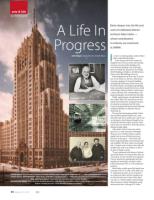
Albert Kahn, c. 1939
ALBERT KAHN AND ASSOCIATES, ARCHITECTS/ALBERT KAHN PAPERS, BENTLEY
HISTORICAL LIBRARY, U-M
ARCHIVES OF AMERICAN ART, SMITHSONIAN INSTITUTION
CENTER RIGHT: The Ford Motor Company Assembly Building under construction, Edgewater, N.J., c. 1930, photographed by Forster
Studio, Detroit. BOTTOM RIGHT: Albert Kahn, Frida Kahlo and Diego Rivera (c. 1940), who famously lived in Detroit from 1932-33
while painting his Detroit Industry murals (funded by Edsel Ford) for the DIA.
BACKGROUND IMAGE: When the Fisher Building opened in 1928, Kahn was awarded a medal from the Architectural League of New
York for creating the year’s “most beautiful commercial building.”
54 February 25 • 2016
Delve deeper into the life and
work of celebrated Detroit
architect Albert Kahn —
whose contributions
to industry are examined
at UMMA.
I
t is fair to say that legendary architect Albert
Kahn created Detroit’s skyline.
In the early part of the last century, he
designed some of its most iconic and stunning
structures, from the Fisher Building to the
General Motors Building to the Ford Rouge
plant to the Belle Isle Aquarium to the Temple
Beth El building in Midtown. All told, he had a
hand in some 900 buildings in the city.
Kahn’s fingerprints are all over the U-M cam-
pus in Ann Arbor, too. His firm, Albert Kahn
Associates, designed 14 university buildings,
including Hill Auditorium, Burton Tower, and
the Natural History and Engineering buildings.
Kahn, somewhat ironically, did not have a hand
in the Bentley Historical Library, which houses
a major collection of his correspondence, clip-
pings, photographs and architectural drawings.
Prolific, perfectionistic and well ahead of his
time, Kahn (1869-1942) stayed busy even dur-
ing the Great Depression, in large part because
of industrial commissions from the Soviet
Union (he designed 500 factories that ultimately
enabled the Russians to defeat the Nazis in
World War II).
The man had a fascinating portfolio (which
also included residential homes) and a work
ethic that made him a wealthy man. And he was
an elementary-school dropout (though he was
awarded the honorary degree of doctor of fine
arts by Syracuse University in 1942) who put his
siblings through college.
Albert Kahn: Under Construction, which
opens Feb. 27 at the University of Michigan
Museum of Art (UMMA), features a photo-
graphic look at some of Kahn’s most iconic
structures as they grew — from bricks and
beams to gleaming hulks of monumental scope
and sensibility. The show, which runs through
July 13, features some 150 pieces that reflect the
breadth of his work as an architect, as well as
the idea of change in action.
“If you’re interested in the history of technol-
ogy and the history of American labor, there are
a lot of clues as to the way labor was organized.
If you’re interested in photography, these pho-
tographs are fascinating,” says guest curator
Claire Zimmerman, Ph.D., a U-M architecture
professor.
Kahn’s father, a rabbi, moved the family from
Germany to the U.S. in 1881, when Albert was
11. Industrious by nature, he ran errands for
an architectural office and then enrolled in an
art school to learn how to draw. When Kahn
was only 15, a Detroit architect named George
Mason became a mentor, bringing the young
talent into his firm. At the age of 21, Kahn