

arts & life
b ooks
The World According To
Wouk
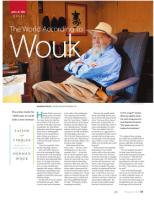
PHOTO BY STEPHANIE DIANI
Jonathan Kirsch | Jewish Journal of Greater LA
The writer marks his
100th year on earth
with a new memoir.
H
erman Wouk is one of our
living masters, the author
of Marjorie Morningstar,
The Caine Mutiny (for which he
won a Pulitzer), This Is My God
and other novels, plays and works
of nonfiction. Yet, when British
philosopher Isaiah Berlin suggested
Wouk write an autobiography,
Wouk’s wife encouraged him to
stick to fiction, as he writes in
Sailor and Fiddler: Reflections of
a 100-Year-Old Author (Simon &
Schuster).
“‘Dear,’ she responded, ‘you’re
not that interesting a person.’”
Sailor and Fiddler attests not
only to the interesting life Wouk
has led, but also to the remarkable
fact that he has reached the age of
100 with his storytelling skills fully
intact. At 139 pages, his memoir
may be brief, but it is full of adven-
ture, wit, color and detail, and
populated with savants, celebrities
and historical world figures rang-
ing from Kurt Weill and Charles
Laughton to David Ben-Gurion and
Menachem Begin.
The title refers to the two spheres
of Wouk’s life and work. “Sailor”
is how he sums up his adventures
in the wider world, including the
Navy experiences that resulted
in his most celebrated book and
play, The Caine Mutiny. “Fiddler,” a
nod in the direction of the famous
Broadway musical, alludes to his
own “spiritual journey” through
Judaism, which found its highest
expression in his little masterpiece
of Jewish religious observance,
This Is My God. Between these two
aspects of his work, Wouk declares
that This Is My God is likely to “out-
live all my other writings.”
Wouk reaches all the way
back to 1927 — “the year ‘Lucky’
Lindbergh flew over the ocean
nonstop to Paris” — to describe
how he was first inspired to pick
up a pen after reading a novelized
version of a movie that was, in fact,
borrowed without acknowledg-
ment from Moby Dick. And, as he
looks back over his 10 decades, he
always makes a journeyman’s dis-
tinction between literature and the
output of a working writer: “Young
aspirers to Literature who face the
stakes open-eyed, yet roll the dice,
have my grandfatherly blessing,”
he writes. “Writing for a living is
something else entirely.”
Thus does the proudly Jewish
Wouk acknowledge that his work
has not always been praised by the
critics. “For some of last century’s
literary elite, mostly Jewish, my
books were outside their ‘canon’ of
protest and alienation,” he writes.
“They were entitled.” After all,
he started out as a gag writer for
radio comedian Fred Allen, and he
concedes that his writing carries
the tool marks of his dues-paying
years: “If there is a trace of Fred
Allen’s art in my books, that is all to
the good.”
Yet the memoir has something
illuminating to say to Wouk’s
readers and to writers who aspire
to books of their own. He decon-
structs the novels that are arguably
his masterworks, The Winds of War
and War and Remembrance, and
shows us the moving parts and
how they fit together. Like many
novelists, he experienced the hard
work of writing as faintly miracu-
lous: “I woke from a seven-year
creative trance, as it were, to tell my
wife that it was time to submit the
manuscript for publication.” But
the sale of movie rights brought
him back to the here and now.
In 2012, at age 97, Herman
Wouk was asked by Vanity
Fair which living person he
most despised. His answer:
“The Jewish writer who
traduces his Jewishness.”
“The cushion of those earnings
has enabled me to publish books at
five-to-10-year intervals under no
pressure, right down to this book,
which I had better get on with,” he
cracks.
The most poignant moment in
the book comes when the cente-
narian author lays down his burden
in our presence. “With this book
I am free: from contracts, from
long-deferred to-do books, in short,
from producing any more words,”
he writes. “I have said my say, done
my work.”
These words literally brought
tears to my eyes. But all of his read-
ers will be comforted to know we
can reread his books, which are
now a part of our literary legacy, in
the light that he has cast on them
in the pages of his last book.
*
February 25 • 2016
53