

arts & life
fas h i on
&
Recycled
Radiant
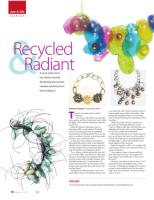
A local artist turns
her talents toward
designing spectacular,
standout jewelry from
found objects.
Suzanne Chessler | Contributing Writer
S
T
here are two artistic sides to Linda
Soberman.
Her serious side tackles issues through
p
prints,
photos and three-dimensional works, while
h lighter side transforms repurposed materials
her
i jewelry.
into
While the Holocaust Memorial Center in
F
Farmington
Hills recently showed The Empty
C
Chairs,
her haunting and creative installation
h
honoring
those lost during World War II, she also
w
works
on necklaces, bracelets and earrings made
o buttons, wires and found objects.
of
In both of her home studios (one located in
B
Bloomfield
Hills and the other in San Miguel de
A
Allende,
Mexico), Soberman organizes materials
a plans designs. She uses laser technology at a
and
s
shop
in Dearborn to put segments together.
“I’m a collector of beads and jewelry parts left
o from the 1980s,” says Soberman, whose past
over
f years of working on the repurposed line fol-
four
l
lows
her jewelry work for fashion designer Mary
M
McFadden
decades ago. “I combine those col-
l
lected
items with items I spot at hardware stores,
a
antiques
shops and other places that feature eye-
c
catching
objects.”
Inspiration for individual pieces comes from
m
many
different places. For example, during a visit
to an estate sale with a friend, Soberman noticed
unique napkin rings crafted out of rubber. After
buying and taking them home, she sliced them
with a knife and developed new groupings to form
a necklace.
“I think the people who buy my jewelry are
arty and want something different,” she says.
“They’re willing to take risks with what they wear.
Although each jewelry item is a little different,
they are all accessible and comfortable.”
Soberman’s jewelry pieces are usually large, but
they are not heavy and can be worn by people of
all sizes. The found pieces that make up her line
are lightweight, accented with inexpensive base
metals dipped in silver and gold.
Clasps are magnetic so there is no struggle with
small closures that have to be opened by means of
spring mechanisms.
“I saw magnetic clasps in Europe and liked
them right away,” she says. “Two magnets just
come together, and I think they are the wave of
the future.”
Soberman, who defines herself as always “arty,”
majored in history and political science at the
University of Michigan and taught relevant classes
for high-school students. In her 20s, she took a
batik course, decorated fabric and showcased her
work at art fairs.
details
For more information and to purchase work by Linda Soberman, visit lindasoberman.com.
48 February 4 • 2016