

arts & life
architecture
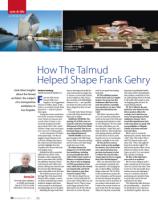
The Fondation
Louis Vuitton
A final-concept model for
the Quanzhou Museum of
Contemporary Art
I-low The Talmud
Helped Shape Frank Gehry
And other insights
about the famed
architect, the subject
of a retrospective
exhibition in
Los Angeles.
details
The Frank Gehry exhibition
at LACMA runs through
March 20, 2016. For ticket
information, visit lacma.org .
58
Barbara Isenberg
Jewish Journal of Greater L.A.
F
rom his Walt Disney
Concert Hall in Los
Angeles to his Guggenheim
Museum in Bilbao, Spain, Frank
Gehry is an architect people think
they know — until he surprises
them again.
Among his newest reveals have
been Paris' innovative Fondation
Louis Vuitton art museum and,
a touch closer to home, a new
Facebook headquarters build-
ing in Menlo Park, Calif., which
includes a large, open work space
and a nine-acre rooftop garden.
A career retrospective of Gehry's
work opened Sept. 13 at the Los
Angeles County Museum of Art
(LACMA), offering close looks at
the creative process behind these
and other highlights from the
Canadian-born, 86-year-old archi-
tect's lengthy career.
Exhibited last fall in somewhat
different form at Paris' Centre
Pompidou, which organized the
show in association with LACMA,
the exhibition chronicles Gehry's
work from the early 1960s to the
present, offering more than 60 mod-
els and more than 200 drawings,
many made public for the first time.
The architect's process starts in
the huge Playa Vista-based Gehry
Partners office complex, a cavern-
ous former industrial space where
architects, designers and others
work on projects in development
and taking shape all over the globe.
Inhabiting the large studio these
days are drawings and models for
such current projects as high-rises
in Toronto, a concert hall in Berlin,
an arts complex in Arles, France,
the renovation of the Philadelphia
Museum of Art — and a possible
new home for Gehry and his wife,
Berta, designed by their son Sam
Gehry.
I recently visited Gehry Partners
to chat with Gehry about the exhi-
bition and its subject.
BARBARA ISENBERG: The
opening of LACMies career ret-
rospective and your receiving the
third annual J. Paul Getty Medal
recently coincided. How do you
feel about being so celebrated in
your adopted hometown?
FRANK GEHRY: I had a very
good reception with Walt Disney
Concert Hall. It was pretty exciting,
and we've done a few other things
people here seem to like.
BI: Gehry Partners has
designed 11 of LACMNs exhibi-
tion installations, including
six you personally have done
with LACMA Senior Curator of
Modern Art Stephanie Barron.
Yet, when it came to designing
LACMAs presentation of your
work, which Barron also curated,
you stepped aside, and David
Nam, a partner in your firm,
oversaw it instead. Why?
FG: I did not design this one
because I cant go backwards. It's
nice to have a show, believe me. I'm
flattered. I love it. I'll go to events
and be happy and proud. But I
didn't spend a lot of time with the
show here or in Paris. My head
won't let me spend time looking
backwards.
BI: The exhibition includes
several of your early Los Angeles
projects. You set up your first
architecture office here in the
early '60s and have, essentially,
been based here ever since. What
impact has that had on your
work?
FG: When I opened my office
in LA, the American architectural
world was focused in New York and
not paying much attention to what
we were doing here. We were under
the radar, which allows you a lot
more freedom. I valued that, and I
think it's still true. Most people here
aren't getting attention, and there's
not much focus on the LA archi-
tectural scene. So, we can function
without a spotlight on our work.
BI: You, however, seem to
always wind up in the spotlight.
For instance, you've been in the
news a great deal about your
pro bono involvement in what
LA Mayor Eric Garcetti calls a
"master plan" for the Los Angeles
River. How did that happen?
FG: I was selected because they
were looking for somebody who
has experience with changing the
city, as I did in Bilbao, and doing
things at that scale. The LA River
is, first and foremost, a project for
water reclamation, and the amount
of water lost that goes through the
river into the ocean is enormous. If
you reclaim it and can later use it,
it reduces the amount of water we
need to take from the San Joaquin
Valley. It's a big deal, economically
important and politically feasible.
This study, which is formatting the
basic problem, would lead to a bet-
ter understanding of how to do that.
It will enable other people to work
on designing parks and such. It's
not precluding anybody.
BI: We've talked in the past
about how your interest in such
diverse projects reflects the
curiosity you've had since you
were a boy growing up as Frank
Goldberg in Toronto. You've
traced that inquisitiveness back
to the many hours you spent with
your grandfather, a Talmudic
scholar, in his home and hard-
ware store there.
FG: It seems to me that the
Talmud spurs curiosity. That's what
"why?" does: Why is this? Why is
that? The Passover seder is also
about why: "Why is this night dif-
ferent from all other nights?" It's
built into the Jewish culture. I'm an
atheist, but I believe in the culture.
I grew up with it. So it was natural
that I question everything.
BI: How is that reflected in
your work as an architect?
FG: I'm never willing to settle. I
make a model, look at it, find some
value in it and save that value. Then
I move on to the next model. It's an
iterative process and, ultimately, I
come to a conclusion. But all the
questioning and constantly trying
to up the ante result in the best
expression for the client.
The Talmud also talks about peo-
ple and relationships — about how
we should talk to each other, how
we should live together, why it has