
book fair
A Cookbook In A Memoir's Clothing
Sandee Brawarsky I New York Jewish Week
A brain aneurysm
survivor cooks
through her recovery.
i
essica Fechtor came close to
death as a 28-year-old when
an aneurysm erupted in her
brain. At the time, people would
offer comments like "Everything
happens for a reason:' But she
doesn't believe that
"I think that everything happens
and then other things happen:' says
Fechtor, who will appear at Book
Fair at 11:30 a.m., Friday, Nov. 6.
"You take what happens and you
make something with it. It's about
what we do with it:'
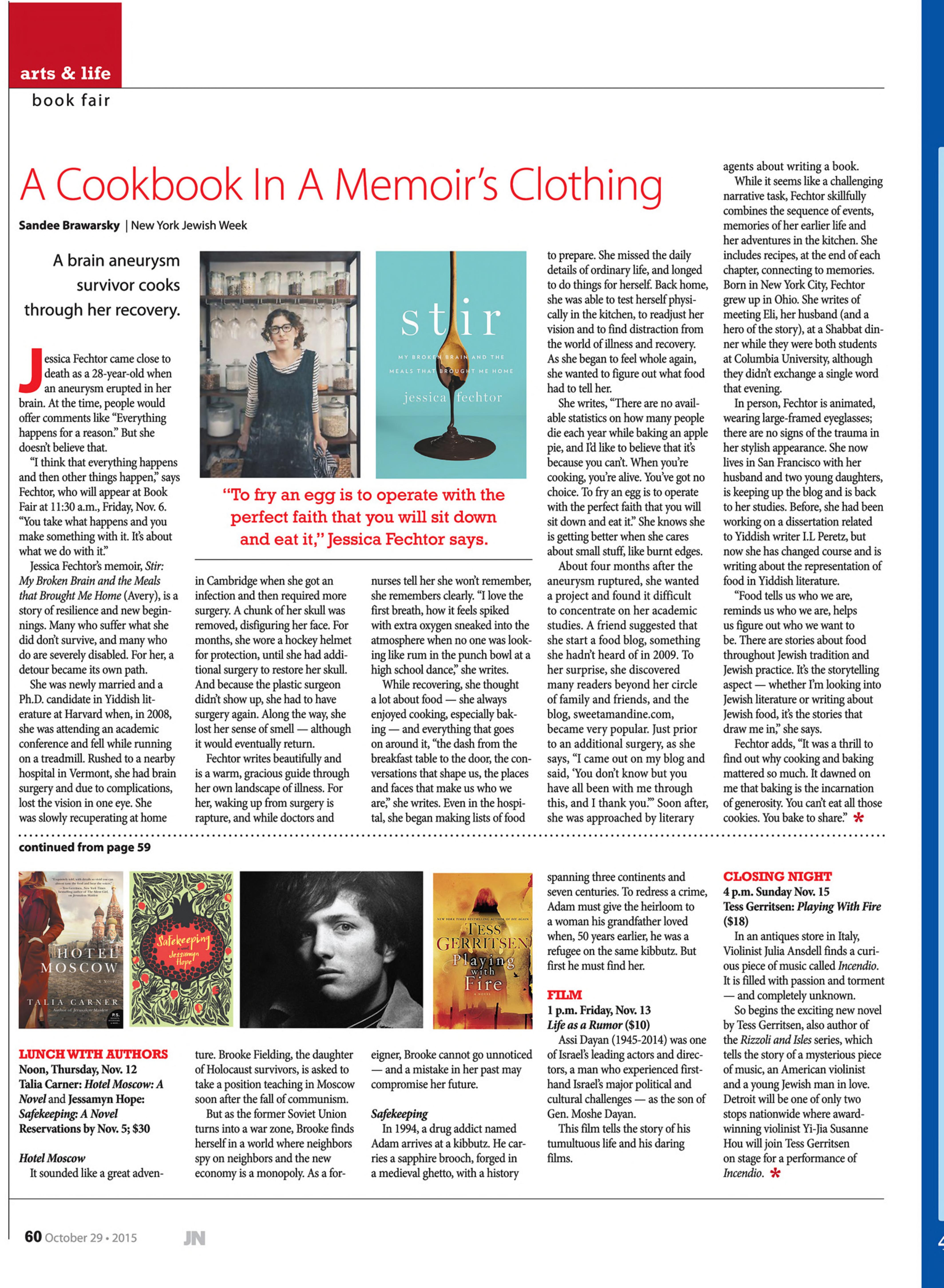
Jessica Fechtor's memoir, Stir:
My Broken Brain and the Meals
that Brought Me Home (Avery), is a
story of resilience and new begin-
nings. Many who suffer what she
did don't survive, and many who
do are severely disabled. For her, a
detour became its own path.
She was newly married and a
Ph.D. candidate in Yiddish lit-
erature at Harvard when, in 2008,
she was attending an academic
conference and fell while running
on a treadmill. Rushed to a nearby
hospital in Vermont, she had brain
surgery and due to complications,
lost the vision in one eye. She
was slowly recuperating at home
MY BROKEN BRAIN AND THE
MEALS THAT BROUGHT ME HOME
jessica fechto -
"To fry an egg is to operate with the
perfect faith that you will sit down
and eat it," Jessica Fechtor says.
in Cambridge when she got an
infection and then required more
surgery. A chunk of her skull was
removed, disfiguring her face. For
months, she wore a hockey helmet
for protection, until she had addi-
tional surgery to restore her skull.
And because the plastic surgeon
didn't show up, she had to have
surgery again. Along the way, she
lost her sense of smell — although
it would eventually return.
Fechtor writes beautifully and
is a warm, gracious guide through
her own landscape of illness. For
her, waking up from surgery is
rapture, and while doctors and
nurses tell her she won't remember,
she remembers clearly. "I love the
first breath, how it feels spiked
with extra oxygen sneaked into the
atmosphere when no one was look-
ing like rum in the punch bowl at a
high school dance she writes.
While recovering, she thought
a lot about food — she always
enjoyed cooking, especially bak-
ing — and everything that goes
on around it, "the dash from the
breakfast table to the door, the con-
versations that shape us, the places
and faces that make us who we
are she writes. Even in the hospi-
tal, she began making lists of food
to prepare. She missed the daily
details of ordinary life, and longed
to do things for herself. Back home,
she was able to test herself physi-
cally in the kitchen, to readjust her
vision and to fmd distraction from
the world of illness and recovery.
As she began to feel whole again,
she wanted to figure out what food
had to tell her.
She writes, "There are no avail-
able statistics on how many people
die each year while baking an apple
pie, and I'd like to believe that it's
because you can't When you're
cooking, you're alive. You've got no
choice. To fry an egg is to operate
with the perfect faith that you will
sit down and eat She knows she
is getting better when she cares
about small stuff, like burnt edges.
About four months after the
aneurysm ruptured, she wanted
a project and found it difficult
to concentrate on her academic
studies. A friend suggested that
she start a food blog, something
she hadn't heard of in 2009. To
her surprise, she discovered
many readers beyond her circle
of family and friends, and the
blog, sweetamandine.com,
became very popular. Just prior
to an additional surgery, as she
says, "I came out on my blog and
said, 'You don't know but you
have all been with me through
this, and I thank you."' Soon after,
she was approached by literary
agents about writing a book.
While it seems like a challenging
narrative task, Fechtor skillfully
combines the sequence of events,
memories of her earlier life and
her adventures in the kitchen. She
includes recipes, at the end of each
chapter, connecting to memories.
Born in New York City, Fechtor
grew up in Ohio. She writes of
meeting Eli, her husband (and a
hero of the story), at a Shabbat din-
ner while they were both students
at Columbia University, although
they didn't exchange a single word
that evening.
In person, Fechtor is animated,
wearing large-framed eyeglasses;
there are no signs of the trauma in
her stylish appearance. She now
lives in San Francisco with her
husband and two young daughters,
is keeping up the blog and is back
to her studies. Before, she had been
working on a dissertation related
to Yiddish writer I.L Peretz, but
now she has changed course and is
writing about the representation of
food in Yiddish literature.
"Food tells us who we are,
reminds us who we are, helps
us figure out who we want to
be. There are stories about food
throughout Jewish tradition and
Jewish practice. It's the storytelling
aspect — whether I'm looking into
Jewish literature or writing about
Jewish food, it's the stories that
draw me in," she says.
Fechtor adds, "It was a thrill to
fmd out why cooking and baking
mattered so much. It dawned on
me that baking is the incarnation
of generosity. You can't eat all those
cookies. You bake to share:' *
continued from page 59
spanning three continents and
seven centuries. To redress a crime,
Adam must give the heirloom to
a woman his grandfather loved
when, 50 years earlier, he was a
refugee on the same kibbutz. But
first he must fmd her.
LUNCH WITH AUTHORS
Noon, Thursday, Nov. 12
Talia Carner: Hotel Moscow: A
Novel and Jessamyn Hope:
Safekeeping A Novel
Reservations by Nov. 5; $30
Hotel Moscow
It sounded like a great adven-
60 October 29 2015
ture. Brooke Fielding, the daughter
of Holocaust survivors, is asked to
take a position teaching in Moscow
soon after the fall of communism.
But as the former Soviet Union
turns into a war zone, Brooke finds
herself in a world where neighbors
spy on neighbors and the new
economy is a monopoly. As a for-
eigner, Brooke cannot go unnoticed
— and a mistake in her past may
compromise her future.
Safekeeping
In 1994, a drug addict named
Adam arrives at a kibbutz. He car-
ries a sapphire brooch, forged in
a medieval ghetto, with a history
FILM
1 p.m. Friday, Nov. 13
Life as a Rumor ($10)
Assi Dayan (1945-2014) was one
of Israel's leading actors and direc-
tors, a man who experienced first-
hand Israel's major political and
cultural challenges — as the son of
Gen. Moshe Dayan.
This film tells the story of his
tumultuous life and his daring
films.
CLOSING NIGHT
4 p.m. Sunday Nov. 15
Tess Gerritsen: Playing With Fire
($18)
In an antiques store in Italy,
Violinist Julia Ansdell finds a curi-
ous piece of music called Incendio.
It is filled with passion and torment
— and completely unknown.
So begins the exciting new novel
by Tess Gerritsen, also author of
the Rizzoli and Isles series, which
tells the story of a mysterious piece
of music, an American violinist
and a young Jewish man in love.
Detroit will be one of only two
stops nationwide where award-
winning violinist Yi Jia Susanne
Hou will join Tess Gerritsen
on stage for a performance of
Incendio. *
-