

IDF soldiers on leave — who join
the trip for about five days. Selected
specially for our medical Birthright
trip, we were joined by IDF medics,
an IDF physician and one post-IDF
Hebrew University medical student.
This not only gave our students the
opportunity to ask many questions
about everyday life and the military
experience in Israel, but the five
days of camaraderie also allowed
them to establish a more personal
connection to Israel and Israelis.
This connection was made jar-
ringly real during our visit to Mount
Herzl, Israel's military cemetery
While we were all moved by reading
grave marker after marker docu-
menting the tragic losses of so many
young lives, the students were taken
aback by two of the more recent
graves, on which family members
had placed meaningful memora-
bilia from the lives of their deceased
sons, including Birthright name
tags with their names on them, in-
dicating that they had accompanied
Birthright groups at some point.
This observation, combined with
their new friendships with current
IDF soldiers, suddenly put a very
personal face on the stories they
hear about Israel, war and terror-
ism.
For the first time, and for the
foreseeable future, these students
now "have skin in the game," and
will feel a much more personal and
emotional connection to the news
stories they watch on TV and the
Internet.
JEWISH AND PROFESSIONAL
While not traipsing around Is-
rael on Birthright trips, I serve
as associate dean and director of
graduate medical education at
Beaumont and the Oakland Uni-
versity William Beaumont School
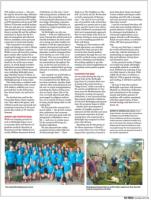
The medical Birthright group in Israel
of Medicine. In this role, I work
with young interns, residents and
fellows as they transition from
newly graduated physicians to their
next stage of learning, experienc-
ing and forging their identities as
medical or surgical specialists and
subspecialists.
On Birthright, my role was
similar — with one additional ele-
ment. During this critical period of
identify formation for these medi-
cal, nursing and other health care
students, I had the opportunity to
explain, demonstrate and model
how one's professional identity as a
physician could be integrated into
one's identity as a Jew with a love
of Israel. This was accomplished
through a series of several 10-min-
ute presentations throughout the
trip, on the bus and at meals, on
topics that combined their growing
interests in medicine, Judaism and
Israel.
One example was a brief talk on
communal responsibility, citing
two examples from the Bible and
two from medicine. Another dealt
with the often-misunderstood Jew-
ish view on organ transplantation,
including the status of this proce-
dure in Israel, where, like in the
U.S., it is both allowed and often
encouraged by religious authori-
ties, yet a scarcity of donors results
in many people dying while on the
waiting list.
We discussed the concept of pi-
kuach nefesh — the Jewish concept
that a physician (and everyone
else!) can and must push aside the
stringencies of Shabbat to save a
life — and even, in certain cases,
for the mental well-being of a
stricken individual.
We also discussed the widely
accepted, but less-often followed
Jewish principle that "... Thou
Shalt Love Thy Neighbor as Thy-
self" (Leviticus 19:18). We focused
on both components of that pre-
cept — the need to love and take
care of oneself in order to function
optimally as a person and as a phy-
sician, and the need to love others,
which, if followed, necessitates the
kind and compassionate approach
that we must adopt with all of our
patients, leaving no stone unturned
as we do everything possible for
their well-being.
During our conversations with
Israeli physicians, our students
learned how that precept is fol-
lowed by their Israeli medical
counterparts through the care ren-
dered by medical teams consisting
of Jews, Christians and Muslims,
all working together to provide
medical care and lovingkindness to
a similarly mixed patient popula-
tion.
PLANTING THE SEED
At one point during the trip, we
joined with all the Birthright
trips from 10 countries that were
in Israel at the same time for a
"Mega-Event," which was held in
the ancient amphitheater in Cae-
sarea near the Mediterranean Sea.
During the evening of song and
celebration, it was announced that
this summer attained a milestone
of 500,000 Birthright participants
since the program began in 1999.
Studies have demonstrated a
number of tangible markers of
enhanced Jewish identity and sense
of personal connection to Israel
among those who experienced a
Birthright trip compared to their
peers who did not.
Speaking only for the group of
38 whose experience I shared, I
am certain that every one of them
enjoyed the experience, learned a
great deal about Israel, developed
a more realistic and deeper under-
standing, and left with a stronger
and more personal connection than
when they arrived.
I am less convinced that they will
retain that same feeling without re-
peated infusions of input, whether
by subsequent participation in
communal organizations, syna-
gogues, formal or self-education,
Israeli art and culture, or activities
of the APF that sponsored their
trip.
For my very first time, I entered
the world of Facebook just prior
to the trip, with the intention of
maintaining an ongoing relation-
ship and influence during these
next formative years.
In the prescient words of Hagai,
our Israeli tour guide, Birthright
successfully planted a wonderful
seed. Without any watering, it has
very little chance to develop. With
a little bit of water, it will grow a
little bit. With repeated watering
and tending, it will thrive and blos-
som.
My hope is that this medical
Birthright experience will promote
lifestyles in which their dedication
and commitment to the compas-
sionate and tireless practice of
medicine will combine seamlessly
with their appreciation of their
Jewish heritage and their love of
Israel. RT
JEFFREY M. DEVRIES, M.D., M.P.H, of Hun-
tington Woods is associate dean and professor
at Oakland University William Beaumont
School of Medicine and director of graduate
medical education at Beaumont Health. He is
also on the board of the American Healthcare
Professionals & Friends for Medicine in Israel
(www.apfmed.org ).The views expressed here
are his own, and do not represent the views of
any of these organizations.
Birthright participants listen to an IDF soldier explain how they deal with
medical emergencies in the field.
RED THREAD I October 2015 49