

...
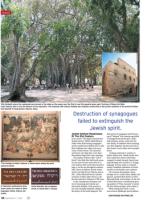
Villa Garibaldi, where the condemned were burned at the stake on the square near the Steri is now this peaceful green park. Courtesy of Bianca Del Bello.
Inset: Palazzo Steri is now the Museum of the Inquisition. This imposing 14th-century building was originally constructed as the private residence of the powerful Sicilian
lord Manfredi III Chiaramonte. Palermo, Sicily.
Destruction of synagogues
failed to extinguish the
Jewish spirit.
"-INU -Mt7 "1 1'l
In Palermian multicultural style,
street names are shown in three
languages: Italian, Hebrew and
Arabic.
36
VICOLO MESCHITA
;wpm
1z. 21-1 71
Vicolo Meschita, the synagogue
street, is named after a mosque.
Photo by Alex S ha lan d
VIA DEI CARTARI
Photo by A lex S ha lan d
"The Triumph of Death" features a Jewish figure among the pious
spared by Death.
Jewish Cultural Renaissance
Of The 21st Century
In her article "The Italian Anousim that
Nobody Knows" (2009), Rabbi Barbara
Aiello writes that burning synagogues
and the neofiti forced Italian Jews to take
their traditions into cellars and secret
rooms of their homes. The memories
and stories were kept alive, even when
descendants forgot their exact meaning.
The number of those with a "call of
blood," who think they had Jewish ances-
try and want to learn more about it or
even embrace their newly discovered her-
itage, is on the rise throughout southern
Italy. Classes in Hebrew, Jewish culture
and art are held all over Palermo and, in
2011, Aiello officiated the bar mitzvah
ceremony of Salvo Asher Parrucca, the
first bar mitzvah in Palermo in 500 years.
In the contemporary European con-
text of increasing anti-Semitic and
anti-Israeli attitudes, Sicily presents a
new and unusually optimistic chapter in
the history of the Jewish diaspora. The
destruction of synagogues and the burn-
ing of "Judaizes" five centuries ago failed
to extinguish the Jewish spirit. Aiello
told numerous stories, some from her
own family, of traditions whose meaning
was often forgotten, but that survived in
their homes' secret cellars and in people's
hearts.
Cooking continued to conform to
kosher dietary laws. Family burials were
done outside the church with bodies
wrapped in simple shrouds. Special mar-
riage blessings were recited in a "strange
language" at home under a crocheted
canopy. Deathbed confessions of Jewish
ancestry to the families were common.
The Anousim descendants, whose
heritage was so cruelly stolen, hidden and
ignored, sustained their history in their
flesh and blood. And perhaps it is the call
of blood that drives a continuously grow-
ing number of "B'nei Anousim" to search
for their historical legacy and reclaim it.
While writing this article, I came
across Steven Spielberg's speech address-
CONTINUED ON PAGE 38
September 17 • 2015