
for college students by college students
Closer Look from page 117
Interfaith from page 117
Emotional Outpouring
Aronoff opened the forum by speaking about current
anti-Semitism in the world and the importance of
this event. I spoke about my experience and then
was followed by every student voluntarily coming
up one-by-one and speaking in front of the group.
Even my brother, Troy, an MSU freshman, shared an
experience he had with his suite-mate. It was a very
powerful program, and many students were brought
to tears from reliving their own experience or hear-
ing that of another's.
Afterward, students filled out a quick survey I
created to document the different ages and majors of
students and what they had experienced. The most
common form of anti-Semitism encountered by
students of all ages and majors was "anti-Semitism
from an individual:' which 11 of the 21 who filled out
the survey selected.
From the information gathered, it seems that
most anti-Semitic instances happen in private
conversations with peers where they can be played
off as jokes, or else behind the security of computer
screens where they can be sent anonymously. To our
surprise, a lot of this was Holocaust-related — jokes
about Auschwitz, jokes about Hitler leaving some
Jews alive so people could know what it was all about.
Less prevalent were examples involving faculty or
administrative personnel concerning Israel and Gaza,
or Israel and curriculum. In a few locations on cam-
pus, selected faculty are biased against Israel or seek
to exclude attention to the Jewish State from campus
co-curricular events. Some students also shared a
sense that the university (or the colleges of their ma-
jors) were not as respectful and considerate toward
Jewish holidays, as university policy demands, and
refuse to give students leeway in missing classes.
These are all very unfortunate events, but serve to
teach us as a university what we can do in moving
forward. Though the surveys and forum cannot
speak for all Jews on campus, it reveals that my expe-
rience was not isolated, and there are many Jews who
have encountered similarities.
Riley from the Office of Inclusion encouraged
everyone there to report future incidents to their
office and explained how accessible they are to talk to
and file an investigation. Hopefully, students will feel
more inclined to report anti-Semitism knowing there
will be action taken by the university.
Hughey and the professors at this forum met a few
weeks ago at the Office of Inclusion to discuss report-
ing mechanisms and further ideas.
Now that there is a wider sense of the environ-
ment on campus, I am seeking to coordinate another
forum on anti-Semitism, but open to the entire
university in order for the non-Jewish students to
become more aware as well. Also, work is being done
to ensure that anti-Semitism is included in diversity
training around campus.
The issue of anti-Semitism is renewed each
generation and, though it may never be completely
eradicated, it is just as important now as ever that we
take steps to root it out and diminish its presence in
our everyday lives and communities. @
In response to the Charlie Hebdo shooting in France, members
of multiple faith-based student groups came together for an event
called We Are One, which focused on the necessity of all religious
groups finding unity in the face of acts of hatred against humanity.
The interfaith dialogue continued at GVSU with events like
Hummus Not Hate: Dialogue Not Debate, a ball pit for students to
enjoy on the interfaith-focused Better Together Day.
One of the most popular interfaith events at GVSU is an annual
joint Shabbat dinner with Hillel and the Muslim Student Association.
The event, called Avi Shabbat, is put on in memory of Avi Schaefer, a
Jewish American who advocated for peace but was tragically killed
in a car accident at age 21.
"[These] events help people from different backgrounds come to
understand each other by choosing to not only learn about similari-
ties but also differences," said Amina Mohamed, a member of the
Muslim Student Association. "By learning about those who are dif-
ferent, we become more accepting. I've come to learn to have an
open mind on the diversity of possibilities in terms of faith and non-
faith practices."
While there aren't many students at GVSU who are part of a reli-
gious minority, those who are have found fulfillment participating in
interfaith events and actively seek out opportunities to work together
with other faiths.
"All religions share common goals: to be better human beings
and to help those around us," Miller said. "All religions must work
together in order for the world to be healthy and truly function to its
full potential. It's not just a single religion that has more power or
weight than the others; we are all equal in our ability to serve this
world and its citizens." @
Brad lsakson of Hartland is a junior at Michigan State
Audra Gamble of Canton is a sophomore at Grand Valley State
University and an intern in the Jewish Studies program.
University.
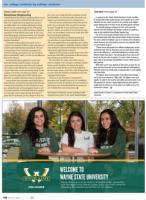
WELCOME TO
WAYNE STATE UNIVERSITY
AIM HIGHER
118
May 21 • 2015
JN
Wayne State is one of the nation's 50 largest public universities,
with Michigan's most diverse student body. You'll feel a sense of
belonging the moment you set foot on our campus.
Scanned image of the page. Keyboard directions: use + to zoom in, - to zoom out, arrow keys to pan inside the viewer.
May 21, 2015 - Image 118
- Resource type:
- Text
- Publication:
- The Detroit Jewish News, 2015-05-21
Disclaimer: Computer generated plain text may have errors. Read more about this.