
Jewish
edu
for college students by college students
May 21, 2015 / 3 SIVAN 5775
VOLUME 6, NO. 2
Interfaith Work
On a campus with very little diversity,
GVSU Hillel works to build bridges.
Audra Gamble } jewish@edu writer
G
rand Valley State University in Allendale is not known for
being diverse. In fact, only 15.6 percent of the student body
4*n,
• ■■ t
is an ethnic minority. Not only is the student body fairly
ethnically homogenous, it is also fairly religiously homogenous. West
Michigan is known for being a dominantly Christian area, and the GVSU
population reflects that.
However, for those involved in religious life at GVSU, a strong emphasis
is placed on interfaith events and cooperation among the various religious
student groups on campus. Hillel at GVSU is an important part of that
interfaith cooperation, participating in and hosting multiple interfaith
events each school year.
The emphasis on interfaith events and discussions is deliberate and
aided by the presence of the Kaufman Interfaith Institute housed at the
university.
"In a school that's predominantly Christian, it's good to see the other
religions talk and discuss the similarities and differences between the dif-
ferent faiths," said Gabe Hessenthaler, a member of Hillel at GVSU.
One of the newer events that Hillel hosted this past school year was
a Passover seder with a United Methodist Christian group on campus,
Wesley Fellowship.
"It brought the Jewish and Christian faiths together for one night to
commemorate an event that happened in both of our religious histories,"
said Will Miller, a member of Wesley Fellowship. "This event was so amaz-
ing because it made me realize that these two religions are connected
in so many ways. Though their belief systems may alter from each other,
there are so many historical connections and values that we share as
Christians and Jews."
Other interfaith events put on throughout the year included dinners,
dialogues, a candlelight vigil and more.
In the fall, Hillel hosted a challah-making event with Peace M.E.ans, a
student organization focused on the Israeli-Palestinian conflict. The Jewish
students taught their guests how to make challah, then all participants sat
down for a discussion about assumptions individuals make when they do
not take the time to get to know others.
Interfaith on page 118
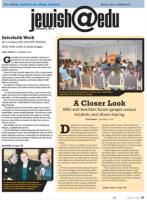
Senior Natalie Gallagher of Lexington;
sophomore Audra Gamble of Canton; and
freshman Shelby Miller of Huntington
Woods enjoy Avi Shabbat together.
Professor Yael Aronoff speaks at a gathering at MSU Hillel
regarding anti-Semitism on campus.
A Closer Look
MSU anti-Semitism forum gauges campus
incidents and allows sharing.
Brad Isakson } jewish@edu writer
uring this time of growing anti-
Semitism on American campuses, it
is pertinent to examine the situation
here at Michigan State University. I
am a junior majoring in international relations and
history, and an intern in the Jewish Studies program.
I have witnessed anti-Semitism firsthand on my
campus.
On Feb. 23, 2015, as my political science lecture
ended and we filed out, some of the friends I sat next
to discovered I had driven to class that day. They
began asking for rides, and I told them I could not
drive them because I lived in the opposite direction.
One student I know was visibly upset over this and,
as he walked away, muttered under his breath that
he would "save a spot on a train to Auschwitz" for
me.
Everyone in earshot instantly dropped their jaws.
This was a real dagger to me because this student
knew that my grandfather survived the Holocaust. I
was shocked and did not know how to react.
Ironically, the very next day, my supervisor and
professor, Dr. Yael Aronoff, came to me with a survey
that had polled Jews across campuses nationwide
and found that more than 50 percent had experi-
enced anti-Semitism. She asked me if I had seen
anything on MSU's campus. What I told her sur-
prised her. We instantly wanted to address the issue
of anti-Semitism on campus, but had to be careful
with how we proceeded because of the risk of creat-
ing a bigger problem than what it might actually be.
We wanted to find out whether MSU had an issue
with anti-Semitism or if my instance was an isolated
one. The first step was to create a forum to be held
at the MSU Hillel to gauge the level of anti-Semitism
on campus based on student experiences.
I helped organize and coordinate an anti-Sem-
itism forum April 13 with help from MSU Hillel,
the Jewish Studies program and the MSU Office of
Inclusion and Intercultural Initiatives. This program
was designed to provide a comfortable, safe place for
Jewish students to come and share experiences they
otherwise would not have talked about.
We had a great turnout of nearly 30 attendees,
including students and faculty members. Cindy
Hughey and Robyn Berkowitz Hughey of Hillel were
there, along with Professors Ken Waltzer, Aronoff
and Kirsten Fermaglich and Cat Riley, a representa-
tive from the Office of Inclusion.
Closer Look on page 118
May 21 • 2015
117
Scanned image of the page. Keyboard directions: use + to zoom in, - to zoom out, arrow keys to pan inside the viewer.
May 21, 2015 - Image 117
- Resource type:
- Text
- Publication:
- The Detroit Jewish News, 2015-05-21
Disclaimer: Computer generated plain text may have errors. Read more about this.