

world
Clinton And Israel
Presidential candidate has a long
track record on Mideast matters.
Yitzhak Benhorin
Ynet News
A
fter months of anticipa-
tion, Hillary Clinton finally
announced Sunday she is run-
ning for president.
With her experience as first lady, U.S.
senator and secretary of state, Clinton has
had countless hours of meetings with Israeli
leaders like Yitzhak Rabin, Shimon Peres,
Ehud Barak and Benjamin Netanyahu under
her belt and has also been at the forefront of
pro-Israel legislation in the Senate.
She understands Israel's complex reality
better than most contemporary American
politicians — possibly even better than her
husband, former President Bill Clinton.
However, while Mrs. Clinton is perceived
as a longtime Israel supporter, there were
some controversial moments throughout her
career which have cast doubt on the firmness
of her position.
First Lady (1993 - 2001)
One of those instances occurred in 1999
when she accompanied the then-president
for a visit in the Gaza Strip. During their stay,
Mrs. Clinton joined Suha Arafat, the widow
of PLO Chairman Yasser Arafat, where she
listened to Mrs. Arafat openly accuse Israel
of fouling the drinking water supply for
Palestinians with uranium.
After the remarks, Mrs. Clinton embraced
her and kissed her on the cheeks, a photo
that made headlines around the world. Her
official condemnation of Arafat's remarks
was made only on the subsequent day,
prompting the left wing in Israel to accuse
her of support of the Palestinians.
In 1999, when she was running for sena-
tor, Clinton told Jewish leaders she considers
Jerusalem "the eternal and indivisible capi-
tal" of Israel — a statement she later partially
backtracked on — adding that she will advo-
cate moving the U.S. Embassy from Tel Aviv
to Jerusalem.
U.S. Senator (2001 - 2009)
Clinton visited Israel again in 2005, this time
as a senator of heavily Jewish New York
During a trip to the West Bank, she voiced
her support of Israel's separation barrier,
saying: "This is not against the Palestinian
people. This is against the terrorists. The
Palestinian people have to help to prevent
terrorism. They have to change the attitudes
about terrorism:'
In 2006, Clinton spoke at a pro-Israel rally
outside of the United Nations headquarters
38 April 16 • 2015
JN
in New York City and expressed her sup-
port for Israel's retaliation efforts in the
2006 Israel-Lebanon conflict. The senator
condemned Hamas and Hezbollah, saying:
"We are here to show solidarity and support
for Israel. We will stand with Israel because
Israel is standing for American values as well
as Israeli ones:'
Clinton also condemned Palestinian
textbooks, saying they indoctrinate children
towards incitement and fail to provide them
with an education.
"I believe that education is one of the keys
to lasting peace in the Middle East ... there
still has not been an adequate repudiation
of incitement by the Palestinian Authority.
It is even more disturbing that the problem
appears to have gotten worse. These text-
books don't give Palestinian children an
education; they give them an indoctrination,"
she said.
attempting to explain that a two-state solu-
tion was the only solution for Israel's future.
Alongside heartfelt conclusions of friendly
ties with Israel, Clinton spared no criticism
of Israeli diplomacy, saying that nothing
will ensure the future of Israel than peace:
"Without peace, Israel will be forced to build
ever more powerful defenses against ever
more dangerous rockets.
And without peace, the inexorable math
of demographics will, one day, force Israelis
to choose between preserving their democ-
racy and remaining a Jewish homeland.
Secretary Of State
(2009-2013)
After failing to win the Democratic nomina-
tion, losing out to now-President Obama,
Clinton was appointed secretary of state,
during which time she attempted to restart
peace talks and embraced the standard
American position toward Israel, but taking a
hard line against settlements.
Nonetheless, Clinton made it clear in 2009
that a halt on settlement construction in the
West Bank was not a precondition for the
resumption of talks between Israel and the
Palestinians.
In 2011, Clinton made comments showing
a shift on her stance on Israel's capital when
she was senator, warning against American
action toward recognizing Jerusalem as the
capital of Israel, saying that it would jeopar-
dize the peace process.
Also in 2011, Clinton repeated the U.S.
view that the Palestinians should not seek
full membership in the United Nations but
instead should resume direct talks with
the Israelis.
In 2012, she reiterated her stance that the
Palestinian Authority "took a step in the
wrong direction" with its U.N. bid, but also
called on Israel to make efforts to advance
peace talks.
That year, she also warned Israel that
it could not use the protection of the Iron
Dome as a long-term solution.
"A strong Israeli military is always essen-
tial, but no defense is perfect. And over the
long run, nothing would do more to secure
Israel's future as a Jewish, democratic state
than a comprehensive peace," Clinton said,
In 2013, her successor at the State
Department, John Kerry, delivered a
stinging rebuke to Netanyahu for his gov-
ernment's announcement of new Jewish
housing in east Jerusalem. In an interview
with CNN, Clinton said the move was
"insulting" to the U.S. "We have to make
clear to our Israeli friends and partner that
the two-state solution which we support,
which the prime minister himself said he
supports, requires confidence-building
measures on both sides:' she said.
Clinton sat down for another interview
with CNN in 2014 in which she criticized
Israel's settlement activity, saying it is her
"biggest complaint with the Israeli govern-
ment:'
"I am a strong supporter of Israel, strong
supporter of their right to defend them-
selves. But the continuing settlements
which have been denounced by successive
American administrations on both sides of
the aisle are clearly a terrible signal to send
if, at the same time, you claim you're look-
ing for a two-state solution.
Later that year, Clinton recapped her years
as secretary of state in an informal farewell
party by Israeli American businessman Haim
Saban, where she spoke with affection of
Israel, saying that defending Israel was not
only a policy issue but also a personal one.
"Protecting Israel's future is not simply a
question of policy for me, it's personal. I've
talked with some of you I've known for a
while about the first trip Bill and I took to
Israel so many years ago, shortly after our
daughter was born.
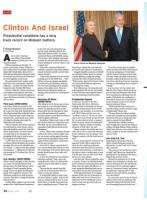
Hillary Clinton and Benjamin Netanyahu
Presidential Hopeful
"And I have seen the great accomplish-
ments; the pride of the desert blooming and
the startups springing up. I've held hands
with the victims of terrorism in their hospi-
tal rooms, visited a bombed-out pizzeria in
Jerusalem, walked along the fence near Gllo.
And I know with all my heart how important
it is that our relationship go from strength to
strength:'
In an interview with the Atlantic pub-
lished in 2014, Clinton offered strong sup-
port for Israel and Netanyahu after Israel
drew international condemnation for the
deaths of Palestinian non-combatants in
Gaza and the destruction of thousands of
homes during its month of war with the
Islamist movement Hamas.
"I think Israel did what it had to do to
respond to Hamas rockets. Israel has a right
to defend itself' Clinton said.
"The steps Hamas has taken to embed
rockets and command and control facilities
and tunnel entrances in civilian areas, this
makes a response by Israel difficult:"
Questioned about whether Israel has
taken enough steps to prevent the deaths of
civilians including children, Clinton said the
United States also tries to be careful to avoid
civilian casualties in war but sometimes mis-
takes are made.
Iran And U.S. Ties
Regarding the nuclear deal with Iran,
Clinton echoed Netanyahu, saying she
believes that "no deal" with Iran "is better
than a bad deal:'
"The onus is on Iran and the bar must be
set high:' said Clinton, who helped lay the
groundwork for the diplomacy with Iran as
Obamis first secretary of state.
Clinton's first comments on U.S.-Israel
relations since Netanyahu's re-election were
made in late March 2015. She said that rela-
tions between the U.S. and Israel ought to
return to "constructive footing" and stressed
the importance of getting back to "basic
shared concerns and interests, including a
two-state solution:'
The comments came at a time of strained
relations between the U.S. and Israel, with
Netanyahu feuding with the White House
over an emerging nuclear deal with Iran.
❑