

From Detroi
Algonquin Park
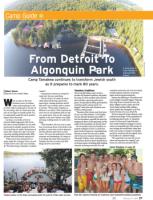
A drone photo of
Camp Tamakwa in
Algonquin Park,
Ontario
Camp Tamakwa continues to transform Jewish youth
as it prepares to mark 80 years.
Robert Sarner
Special
to the Jewish News
I
hen it comes to the trans-
formative power of summer
camp, some people get it, oth-
ers don't. Mike Levinsky gets it. It's part of
his very being. After 41 consecutive sum-
mers at 10 camps in Canada and the U.S.,
he understands camp life and its positive
impact better than most.
Last June, as Levinsky arrived at
Ontario's fabled Algonquin Park for his
first stint at Camp Tamakwa, he was look-
ing forward to another summer far from
his normal big-city reality. Having been at
many other camps since age 5, he wasn't
expecting anything fundamentally differ-
ent from what he'd already experienced.
"When you've been immersed in so
many camps for as long as I have, you sort
of think you've seen it all:' says Levinsky,
46. "But after being at Tamakwa, I realized
W
I hadn't:'
Coming from someone so steeped in
camp lore, that says something.
"On the surface, all camps are about
child safety, kids having a good time,
supervision, creating memories and all
that stuff' says Levinsky, who's a teacher
in Toronto. "What makes Tamakwa so
different is its culture. What surprised me
most were its rich traditions that are still
very much intact. The way the camp gets
together at the end of almost every night
and sings, holding hands; it's really some-
thing.
"Until Tamakwa, I'd never seen a camp
have everyone go down to the docks to say
goodbye to canoe trips on their departure
and then likewise greet them on their
return. The tears and authenticity of those
moments are breathtaking. All camps try
to do things that make them special, but
Tamakwa just does so many neat little
things I'd never seen before:'
Campers gather on the Slope overlooking South Tea Lake for Friday night services.
Tamakwa Traditions
Those neat little things, many rooted in
decades-old Tamakwa traditions, help define
the camp. For all its excellent water and land
sport activities, canoe trips and arts pro-
grams, it's especially the folksy, good-spirited,
sometimes goofy customs and its "un-
plugged" nature that make Tamakwa more
inclusive, setting it apart.
"Tamakwa is like a home away from home
for me:' says Abby Seifman, 14, of Franklin,
who has attended Tamakwa since 2008. "I
love the atmosphere, especially the spirit, the
singing and cheers of each age group, and the
quality of the friendships you develop there:'
For two months every year, Tamakwa is a
separate civilization of sorts. Located three
hours north of Toronto on a stunningly beau-
tiful site on South Tea Lake and accessible
only by boat, it's a temporary home to about
450 people. Within a rustic, technology-free
environment, there's an almost timeless focus
on living in nature, developing skills, building
character and being resourceful. It's a self-
contained community, rich in its own rituals,
symbols, legends, mysteries, ceremonies,
spirits, lexicon and governing body.
Mention the following to a Tamakwan and
see the delight it instantly triggers: Wakonda,
Dirty Dog, Beaver Council, how-how, the
Slope, Alligator Anchor, schlect, Eye-Full
Tower, liquid sunshine, Biffy, pulling a
shreck, golden day, Tamagama, Lone Pine,
Tootsie-Frootsie, Unca Lou, Peach Pie.
The list is long and, if space allowed, could
easily be much longer. To the uninitiated, it's
bewildering, almost exotic. To Tamakwa's
owners Vic Norris and Craig Perlmutter,
these insider traditions and gags are second
nature, an inseparable part of the camp's cul-
ture, heritage and overall shtick. Many date
back to the camp's co-founder Lou Handler,
and all are consistent with his original vision
for Tamakwa as a children's village.
"We consciously try to stay true to Lou's
values and his passion for camping; says
Norris, 64, who's been involved with Ta-
Camp Tamakwa on page 28
Color War captains following the traditional water-boiling/fire-building competition
February 5 • 2015
27