

arts & entertainment
Exodus: Gods and Kings
Film is a testosterone-fueled journey to ancient Egypt.
Michael Fox
Special to the Jewish News
M
oses, as best I recall from
Hebrew school and The Ten
Commandments (1956), was a
reluctant prophet with a speech impedi-
ment who was ultimately persuaded by the
unspeakable, unceasing suffering of his
people — and God's fearsome support — to
confront Pharaoh and lead the Hebrews out
of slavery from Egypt.
How (biblical) times have changed. The
much-anticipated Hollywood epic Exodus:
Gods and Kings reinvents the saga of a
people's miraculous liberation as one rug-
ged individualist's journey of self-discovery,
identity and profound purpose.
The fundamental matter of spirituality,
which might be defined in this context as
the courage and power of faith, comes up
in conversation a few times but not in ways
that impact the moviegoer's experience.
Your post-film repartee is more likely to
center on the curious and disconcerting
form in which God (or is it an angel acting
as his emissary?) appears.
Exodus: Gods and Kings, which opens on
Friday, Dec. 12, is a sun-blistered chunk of
glowering, male-centric mythmaking.
Aside from its oddly anti-climactic end-
ing — recognizing that it's a tough call how
many desert miles and years to continue
the tale after the Red Sea — this is a well-
paced, continuously engaging piece of
mainstream entertainment with the requi-
site amount of impressive visual effects (in
3D).
Just don't go expecting to be awed or to
have a religious encounter.
Title cards inform us at the outset that
the year is 1300 B.C.E., and the Hebrews
have been slaves in Egypt for four centuries.
However, "God has not forgotten them:'
Omitting the standard baby, basket and
bulrushes, director Ridley Scott and screen-
writer Steven Zailian (Schindler's List) intro-
duce Moses (Christian Bale) as a general
and Ramses II (Joel Edgerton) as his best
friend since childhood and heir to Pharaoh's
throne.
Exodus immediately launches into a full-
scale, screen-filling battle scene — a pre-
emptive attack that might be construed as a
comment on the Iraq War — in which the
seed of Ramses II's paranoia and jealousy of
Moses is planted.
This section is designed to excite male
viewers but also to inoculate them against
the ensuing hours of banter, revelation, wil-
derness wandering and domesticity before
the warrior hero returns to Egypt to blow
things up real good (Exodus boasts fiery
explosions like any other self-respecting,
would-be action movie).
Even if he was raised as a prince of Egypt,
the portrayal of Moses as self-confident and
militarily adept takes some getting used to.
It does explain, however, his disbelief when
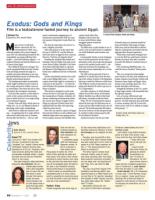
A scene from
a gutsy Jewish elder (Ben
Kingsley) informs him that
he was a lowly Hebrew infant
smuggled upriver toward the
Pharaoh's palace.
The Bible story is quite familiar to us, of
course, even if creative license is employed
via verbal flashbacks and narrative com-
pression.
Consequently, Exodus is most intriguing
from a Jewish perspective for the ways it
alternately evokes and evades the dominant
events in the modern Jewish world — the
Holocaust and Israel (its founding, exis-
tence and current relationship vis-a-vis the
Palestinians).
The 20th-century genocide of Jews is
alluded to in myriad ways, from the burn-
ing of the corpses of slaves to the Egyptians
lined up to insult the Hebrews as they leave.
(The Hebrews' exodus is presented as com-
plying with Ramses II's order to get out, so
it is a deportation.)
An earlier sequence, in which Ramses'
soldiers knock down doors and brutalize
Hebrew families in an effort to find (and
kill) Moses, inevitably recalls the Nazis.
When The Ten Commandments opened
almost 60 years ago, the Holocaust was so
recent, and raw, that it didn't need to be ref-
erenced. The horrific genocide did inform
the movie, however, in that the general pub-
lic needed no help rooting unequivocally
for the Hebrews' freedom.
Another key factor was the new State
Exodus: Gods and Kings
of Israel's status as a universal symbol of
hope and rebirth. That image no longer
holds sway, and the filmmakers acknowl-
edge the contemporary perception that the
oppressed have become oppressors.
While Moses and Joshua strategize how
to cross the Red Sea, and Ramses' chariots
thunder in pursuit, they take a moment
to ponder the Hebrews' eventual return to
Canaan.
Now numbering 400,000 people, "we
would be seen as invaders:' Moses points
out.
This is an unexpected acknowledge-
ment of power, one that Arab audiences (in
Jordan, Lebanon, Iraq, Kuwait, United Arab
Emirates, Oman, Qatar and Egypt, where
Exodus: Gods and Kings opens Dec. 25 or
shortly thereafter) will welcome.
Evangelical Christians in the U.S., anoth-
er large target market, will presumably have
the opposite response.
Jews, of course, will interpret and
respond to the film from yet another per-
spective. The Old Testament does lend itself
to various readings, after all. So does this
robust movie, even if it is unlikely to inspire
study groups.
❑
Exodus: Gods and Kings opens on
Friday, Dec.12.
w s
yla
emi Nate Bloom
161 Special to the Jewish News
Good TV
41) I am sorry I didn't clue readers into
the Dec. 2 premiere of the new
"scripted" (vs. "reality") Bravo series
a Girlfriends' Guide to Divorce. New
episodes air at 10 p.m. Tuesdays, with
many encores during the week and
all episodes available online. I caught
the pilot and can tell you firsthand
that it is very good.
The lead character, Abby McCarthy,
played by Lisa Edelstein, 49, is a
middle-aged woman
with a teen daughter
and a 5-year-old son.
She earns a good
income from advice
books she pens,
which include a lot
of stuff about what a
Edelstein
good marriage she's
in. The problem is
V
66
December 11 • 2014
that she and her
husband, played by
Paul Adelstein, 45,
have long been on
the rocks.
I completely agree
with this Hollywood
Reporter review: "A
Adelstein
bit of a shocker is
that almost every-
thing about it works; for a first
effort, that's defying the odds and
then some. This series is the closest
anything in recent memory has come
to Sex and the City when that series
was at its zeitgeisty best. Of particu-
lar note is star Edelstein (House),
whose performance is exceptional
– there's really no overselling how
outstanding she is in every scene,
which is essential to convincing view-
ers that the show is not only worth a
look but a full commitment."
Father Time
People magazine had some egg on
its face when the publication acci-
dentally posted an obituary of actor
Kirk Douglas on its website on Nov.
30.
Douglas, who turned 98 on Dec.
9, quoted Mark Twain (whose death
was also reported in error) when he
spoke to a USA Today reporter on
Dec. 1: "The announcement of my
death is premature."
The false report created much
Internet chatter, some of which
was fairly amusing. New York Daily
News website comments included, "I
am not dead, and I am Spartacus!"
and "Hey, Kirk, say hello to Abe
Vigoda!"
You may recall that Vigoda (The
Godfather and Barney Miller) was
reported dead in a 1982 People arti-
cle and that a TV reporter repeated
the mistake in 1987. Vigoda, now 93,
has often joked about his "death"
with TV hosts.
Meanwhile, hitting the cen-
tury mark in 2014 were comedian
Professor Irwin Corey and actor
Norman Lloyd.
Just before a big 100th birthday
party at a New York actors' club,
Corey told the New York Daily News:
"I hope they give
me an 18-year-old
girl!"
Lloyd is prob-
ably best known for
playing Dr. Daniel
Auschlander on
the TV show St.
Elsewhere. He still
Lloyd
plays tennis twice a
week and has a biggish supporting
role in Trainwreck, a Judd Apatow
film that will open in July 2015.
Howie Mandel, 59, a St. Elsewhere
co-star, said: "I love Norman Lloyd.
He is a legend. I have spent hours
[feeling] like a little kid while he
regaled us with stories of Hitchcock.
He teaches; he entertains. He is a
legend!"
❑