

metro
Reunited from page 8
anyone speak about it afterward. Bass
himself did not talk about it for 25 years,
and his own parents died never knowing
what their son had experienced.
"But what I witnessed there made
me know I did have something to fight
for," Bass says. "On that day, my vision
broadened. I now understood that
human suffering was not relegated to
just me. Pain and suffering is universal,
and it can touch all of us:'
In Motion
In 1985, Shulman and his wife, Passie,
who live in West Bloomfield, flew to
New York City to attend a reunion of
Buchenwald survivors. Among the
attendees was the Jewish chaplain who
arranged for Shulman to be transported
to a hospital in Paris — along with eight
of Shulman's friends because he wouldn't
go otherwise. An uncle in Detroit spon-
sored him to settle here, and he arrived
at an orphanage a year to the month
after liberation.
Also among the guests was Leon Bass
and his wife, Mary. Bass and Shulman
spoke briefly, as everyone did, had their
photo snapped and moved on.
"I had no idea who he was, other than
one of the hundreds of soldiers who had
been in the area at that time," Shulman
recalls.
Last year, a friend sent a YouTube
video to Shulman's wife, Passie, thinking
she might find it interesting because it
talked about Buchenwald. She watched
the video, becoming more excited as it
went on, and called her husband in to
watch with her. The video showed Dr.
Leon Bass, a now-retired high school
principal in Philadelphia, speaking
about racism, anti-Semitism and the
Holocaust.
"As he was telling his story of his bat-
talion liberating Buchenwald, it was as
if it was the other side of Perry's story,"
Passie says. "It was a complete parallel:'
Says Shulman, "I knew immediately
that this was the American soldier I had
seen walking toward us, coming to save
us."
He also recognized his face as the one
he had met at the reunion almost 30
years ago. He pulled out his scrapbook,
and there was a photo of him with his
arms around Mary Bass on one side, and
Leon Bass on the other. Shulman called
his son, Greg.
"My dad said he wanted to get in con-
tact with Leon Bass," says Greg Shulman,
who lives in Farmington Hills. "So I put
into play the ultimate game of Jewish
geography:'
He discovered that Bass lectured
around the country about his experienc-
es and contacted a synagogue in Ohio
where Bass had spoken. He contacted
the Anti-Defamation League, which
often invited Bass to speak.
10
October 16 • 2014
to love the unlovable:" Bass recalls.
"After the war, for many years, I tried.
Oh, it was so hard:'
Then he heard Martin Luther King Jr.
speak about his dream on the Mall in
Washington, D.C.
"He was a little guy," Bass says, 'but
when he spoke, he became a giant. And
I realized again that my mom was right.
It was a daily struggle, but change starts
with yourself. Mr. Shulman and I both
have learned that we can't make change
with hate:'
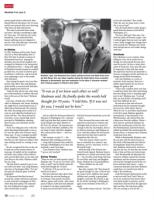
Shulman, right, and Romanian-born author, political activist and Nobel Prize laure-
ate Elie Wiese!, left, were likely together during the Death March from Auschwitz-
Birkenau to Buchenwald, and were bunkmates in the latter. A character modeled
after Shulman appears in Wiesel's book Night.
"It was as if we knew each other so well,"
Shulman said. He finally spoke the words he'd
thought for 70 years. "I told him, 'If it was not
for you, I would not be here.
And he called the Holocaust Memorial
Museum in Washington, D.C.; someone
told Greg that Bass had written a book,
Good Enough: One Man's Memoir on
the Price of a Dream. The museum put
him in touch with Bass' publisher, who
put Greg in touch with Bass' daughter,
who contacted her father — who was
thrilled.
This summer, on July 27 — the
Shulman's 56th wedding anniversary
— Greg told his parents they would be
driving to Philadelphia over Labor Day
weekend to meet Leon Bass.
"I just looked at him," Shulman says.
"I was so very touched:'
Giving Thanks
"When we met, we both started crying:'
Shulman says. "It was as if we knew each
other so well:' And he finally spoke the
words he'd thought for 70 years.
"I told him, 'If it was not for you, I
would not be here:"
The men told each other about their
lives before the war and leading up
to Germany. They pored over photo
albums, papers and articles. After many
years of silence, both men had ultimate-
ly realized it was their responsibility
to speak out and tell their stories, and
both had lectured extensively across the
country.
They discussed the many traits and
experiences they had in common, the
ideologies that served as a source for
courage in the face of prejudice, Bass as
an African-American, and Shulman as
a Jew. And they talked, like old friends,
about the lives they had created for
themselves after the war.
"The only reason I had to survive
was to eventually be a witness:' says
Shulman, now 85. "And then, to live a
life worth living:'
With the help of the Detroit-area
United Jewish Appeal, Shulman found a
profession as a jeweler and raised a fam-
ily — his own life worth living. Between
his sons Marc and Greg, and daughter
Renea, Shulman has six grandchildren.
"Those children are my soul,"
Shulman says.
Bass also created a life "that showed I
am good enough," he says. A life of mor-
als, respect, love, children, four grand-
children and, recently, a great-grand-
daughter. And later this month, at age
89, he will be traveling to Washington,
again at the invitation of the ADL, to
speak.
"My mother always told me, 'You have
Gratitude
Perry Shulman is very cautious when
telling his story. He is careful not to
divulge too many details because they
must be precise. He has so many thou-
sands of memories, every day still, and
it's important to him that they mesh.
His experience has been documented in
lectures, newspaper articles and hours of
footage by the Shoah Foundation.
Life, says Shulman, is a series of
moments. Each moment, there are a
million opportunities for our lives to
change, for good or bad.
"There were a million times over that
I could have died, that others died doing
the same things I was or standing right
next to me," Shulman says. "A second
later, an inch further. Everything could
have been different for me:'
He marvels at this and will never
understand why his moments brought
him survival, while others' did not.
When he was 12, just before deportation
to his first camp, Shulman appealed,
miraculously, to the humanity of an
Oberlieutenant, who shoved him into
a shop away from the soldiers. When a
Nazi came in and found Shulman, he
raised his machine gun at the boy. But
the Oberlieutenant, named Dormeyer,
walked up behind him and knocked the
firearm down. A moment later, Shulman
would have been shot.
While at Buchenwald, Shulman came
face-to-face with Ilse Koch, known as
the Witch of Buchenwald and collector
of lampshades made from prisoners'
skin. Shulman stared at her, not know-
ing who she was. On that day, she stared
back at him and then just turned away.
After Buchenwald was liberated, the
American soldiers opened the German
warehouse and the ravenous prisoners
who had the strength devoured the raw
bacon and ham they found — many
contracted dysentery and died. Shulman
would have, too, had he been able to
walk to the warehouse.
And if he had not disobeyed his moth-
er and not read Uncle Tom's Cabin in
secret, he would not have known there
were black people in America, and he
would have retracted from the approach-
ing Leon Bass, the American soldier
who was coming to save his life.
❑