

arts & entertainment
No Couch Potato
Knish expert Laura Silver, who took a
global journey for 'Jewish soul food'
book, will appear at Temple Israel.
Robert Gluck
JNS.org
I
T
he history of the knish repre-
sents more than just the lineage
of a fried, dumpling-like food.
It demonstrates the often-central role of
food in communities and cultural legacies.
Laura Silver knows that all too well. She
has consumed knishes on three different
continents, and her exhaustive research on
the iconic potato treat has resulted in her
book, Knish: In Search of the Jewish Soul
Food (Brandeis), which was released in
early May.
When she started
her knish book
project, Silver had
no plans for an inter-
continental journey,
though she did plan
to go to Vineland,
N.J., home of the Pasta
Factory, the company
that purchased the
famous knish recipes of
the Mrs. Stahl's bakery.
As a young girl from
the New York borough
of Queens, Silver viv-
idly remembers heading
to Mrs. Stahl's in the
Brighton Beach section of
Brooklyn for knishes.
"Mrs. Stahl's was our go-to place, but
there were certainly knishes in other
places:' she told JNS.org.
"When I grew up in Queens, there were
many Jewish delis around.
"Mrs. Fanny Stahl was born with the
Yiddish name of Feige. She was an immi-
grant who supported her five children by
doing many jobs, including cooking.
"She started the knish shop and ran it
until her death. She was very active in the
Brooklyn chapter of Hadassah (the wom-
en's Zionist organization), and she knitted
sweaters for the people of Palestine before
Israel was a state. She was an entrepreneur
par excellence. She worked very hard:'
The book follows Silver as she traces
her roots from New York to the town of
Knyszyn, Poland.
She is considered the world's fore-
most expert on the knish. But can she
definitively say where the first knish came
from?
"I don't think it's possible to know
exactly who made the first knish:' she
said. "But it was before 1614, the first
recorded history of the knish, which is in
72
October 2 • 2014
JN
a poem in the Polish language.
"It comes from a town called
Krakowiec, which is in modern-day
Ukraine in what would be the Pale of
Settlement"
The knish undoubtedly has links to
Knyszyn, said Silver. But before setting
out on her quest, she had no idea that she
might be related to direct descendants of
the knish's pioneers from that very town.
"I didn't realize I was on a quest until
I was in Poland with my family, and we
learned that our great-aunt was from
Knyszyn," she said.
"That's what tipped
me off that I might be
a direct descendant of
the knish, which I am,
in fact. It was beshert
(meant to be):'
According to David
Sax, author of Save
the Deli: In Search
of Perfect Pastrami,
Crusty Rye and the
Heart of Jewish
Delicatessen, Silver's
knish book is a lov-
ingly researched
volume that elevates
the knish — argu-
ably the humblest of
Jewish foods — into a weighty symbol
of history, identity and family.
"Knishes haven't met anything this good
for them since the invention of mustard:'
Sax told JNS.org, referring to Silver's book.
"The knish is ripe for the spotlight
Laura has shone upon it. Just look at the
lineup for Black Seed, the new Montreal
bagel place in New York, and you'll see
that the revived interest in Jewish soul
food is only growing. I bet we'll see some
amazing knishes in the years to come:'
Arthur Schwartz, author of Arthur
Schwartz's Jewish Home Cooking: Yiddish
Recipes Revisited, said the knish "has
never been put to better use" than it is in
Silver's book.
"Laura Silver's at-times poetic medita-
tion on knishes is not only a cultural his-
tory of this filled lump of dough, as metic-
ulously researched as any doctoral thesis,
but also a Proustian personal memoir that
hints of James Joyce, no less, in the way
Silver intones and uses the rhythms of
Aramaic Jewish liturgy, Yiddishkeit and
Yiddish humor to tell her story:' Schwartz
said on the book's website.
During her research, Silver discovered
that the knish has connections to sources
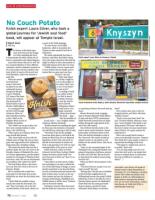
Knish expert Laura Silver in Knyszyn, Poland
Yonah Schimmel Knish Bakery, where Eleanor Roosevelt reportedly sampled knishes
as surprising as Eleanor Roosevelt and rap
music.
Eleanor Roosevelt made campaign
stops at Yonah Schimmel's Knish Bakery,
it's said, and then-NYPD commissioner
Teddy Roosevelt chowed down on kasha
knishes during late-night patrols at the
end of the 19th century.
One of Silver's favorite stories in the
book is about Gussie Schwebel, a former
knish maker on Houston Street in New
York, who had the chutzpah to write to
Mrs. Roosevelt. She wanted to help her
adopted country so she asked to cook
knishes for the Armed Forces. That was in
the 1940s.
"Later on, she was quoted again in the
Washington Post, saying that knishes were
going to bring about world peace and put
an end to the Cold War. She saw food as
an instrument for political maneuvering.
Good for her:'
Where are Silver's favorite places to buy
a knish?
"The best knish you can get is one you
make yourself:' she said.
"Barring that, I like the one at Gottlieb's
in [the Brooklyn neighborhood of]
Williamsburg because they speak Yiddish
behind the counter. I also like the ones at
Pastrami Queen uptown [in Manhattan].
Knish Nosh also has some good knish
shops in Queens, and there's Yonah
Schimmel's Knish Bakery on Houston
Street."
Every culture does seem to have its
wrapped pastries, and Silver calls them
"knishin' cousins:'
"Food is never just about food:' she
said. "It's about identity, otherness, same-
ness. I never thought of the knish as any-
thing unusual. The more I talk about it,
the more I realize everyone doesn't know
what a knish is. It's a great moment for
knish literacy:'
Silver was recently hired to teach a
course at the Brooklyn Greenery, "Improve
Your Knish IQ," to give people a chance to
expand their knowledge of the food.
"The knish is a simple food, and it is
accessible Silver said.
"It is one that people yearn for even
when they don't need to eat simple food
because it reminds them of connections
that may be difficult to maintain, or
obtain:'
❑
Journalist Laura Silver will speak at
Temple Israel in West Bloomfield on
Thursday, Oct. 23, following a strolling
dinner with coffee and dessert that
begins at 6:30 p.m. $25 per/person.
Reservations requested by Monday,
Oct. 20. For more information, contact
Kate Boman at (248) 661-5700 or
kate@temple-israel.org .