

Biblical Wild MD In Israel
Hai Bar Carmel in northwest Israel
provides spectacular viewing.
Israel Nature and Parks Authority
t Hai Bar Carmel in northwest Israel,
.ti visitors enjoy the sight of a grace-
ul herd of Persian fallow deer,
the males with their noble antlers and the
dappled young "Bambis" resting in the shade
with their moms. At Hai Bar Yotvata, the
ostriches gather curiously around your car
and the oryx nuzzle each other companion-
ably. But these are no ordinary zoos. You are
seeing biblical wildlife that has returned to
thrive in this land after a long absence.
Persian fallow deer, Armenian wild sheep,
gazelles, oryx, addaxes, wild asses, as well
as birds like vultures, owls and ostriches,
all mentioned in the Bible, were part of the
scenery in Israel until World War I. It was
then that the widespread use of firearms to
hunt these magnificent creatures brought
many to extinction.
In the late 1960s, the Israel Nature and
Parks Authority (INPA) decided to embark on
its wildlife restoration project by reintroduc-
ing the Persian fallow deer. Just before the
fi
Iranian revolution, the Shah had agreed
to give Israel a number of these beautiful
animals from his own breeding program. In
a dramatic airlift after the fall of the Shah, Is-
rael managed to get four of the deer aboard
the last El Al flight out of Tehran.
Persian fallow deer are still among the
animals protected and nurtured at Hai Bar
Carmel, nestled among Carmel's wooded
hills. From here, some are gradually released
to the wild in the Upper Galilee and the
Jerusalem Mountains, wearing special radio
collars so experts, assisted by volunteers, can
keep tabs on their welfare and progress.
Visitors to the nature reserve begin with a
beautiful overview of the pastoral surround-
ings from the roof of a small visitor center,
which showcases the
INPA's animal reintroduction efforts. Then
it's time to explore the reserve: Visitors walk
down the mountain along an 800-yard paved
trail.
From wooden balconies they can easily
spy the residents — roe deer, mentioned in
the Song of Songs, wild goats, gazelles and
wooly Armenian sheep. Signs explain about
each animal and its habits. At the end of
the walk, visitors find the enclosures for
the fallow deer and the magnificent Griffon
vultures, which are also fostered here.
Hai Bar Yotvata is 30 minutes north of
Eilat. Here, visitors drive the few miles
through the reserve seeing animals along the
way — the oryx (believed to be the origin of
the unicorn myth, since in profile their pair
of scimitar-shaped horns appear as one) So-
mali wild asses, addaxes, ostriches and more.
Visitors can rent a CD, which describes
the animals and tells unusual stories about
their habits and even the idiosyncrasies
of some individuals, to play in the car. The
tour ends with a visit to the Night Life Room
where dimly lit enclosures reveal the desert's
nocturnal denizens, and the predator center,
home to spotted leopards, wolves, the giant-
eared caracal, snakes and more.
❑
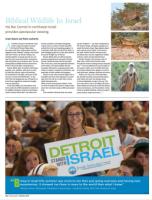
eing in Israel this summer was more to me than just going overseas and having new
experiences. It showed me there is more to the world than what I knew."
Melissa Porlick, Participant, Federation's Sue & Alan J. Kaufman Family 2014 Teen Mission to Israel
42
I
Chai Israel • October 2014