

The fact that Schneiderman is the
son of divorced parents who them-
selves were newly observant made it
hard for him to have the support he
needed at home. He said some of his
friends' parents judged him because
of his broken home and refused to let
him play with their children.
When he chewed his stick of gum,
"the fact that a bolt of lightning didn't
come out of the sky immediately made
it easier," Schneiderman said.
"The fact that you don't immediately
die from your sins made it easier to
continue on the path of trying new
things," he said.
Josh turned on the light switch on
Shabbat and then let go of most other
commandments.
"Turning on that light switch was a
turning point in my life," he said.
Finding The Way Back
Today, however, Cohen, Schneiderman
and Josh are all Orthodox. They all
found God again.
"It wasn't the religion I came back
to," explained Cohen. "It was Jewish
spirituality and a relationship with
God"
Cohen said he always had "spiritual
tendencies" as a child that he wasn't
able to tap into. But once he experi-
enced God himself, he felt compelled
to return.
"It was going off for a run one day
and seeing the sun set and saying [the
verse], 'Ma rabu ma'asecha HaShem
kulam be'chochma asisah (How many
are your works, they are all made with
wisdom). That little spark started
something in me," he said.
Cohen said he often thinks about
the "what ifs": What if he had done
something that tremendously impact-
ed his relationship with his parents or
community? What if he had fathered
a child with a non-Jewish woman or
gotten tattoos? Would returning have
been harder?
Rabbi Avraham Arieh Trugman,
who runs the Ohr Chadash outreach
organization in Israel, said becoming
observant is much harder for someone
who chose to leave than it is for some-
one discovering a religious connection
for the first time.
"When [secular people] discover
the beauty of Torah and Judaism and
Shabbos and the holidays and mitzvot,
they realize this is something they
were missing," said Trugman. "If they
had no idea how beautiful and rich
Judaism is, there is a tremendous
incentive to pursue that knowledge.
For someone who was brought up
religious, whatever made them walk
away may still make a strong and emo-
tional impression that is not easy to
overcome:'
But no matter how off the path a
person goes, the Jewish spark in his
or her soul never dies, according to
Trugman.
Doing Teshuvah
"One can always get closer to HaShem.
... One can always do teshuvah," he
said.
"There is a concept in Judaism that
someone who commits a sin thinking
he will just repent for it later cannot
receive forgiveness. They don't allow
him to teshuvah," said Josh, explain-
ing that this idea weighed on him
during his journey back to faith. But
he said he learned that it is not that
one cannot repent, but rather that
repentance itself cannot come with-
out effort.
Menken said the process of doing
teshuvah, as described succinctly in
an article he has read on the Aish
HaTorah website, is as follows: stop,
regret, verbalize, make a plan to
never do the sin again.
Trugman defined teshuvah as
"retuning to the natural state of the
Jewish soul!" He said anyone can do
teshuvah, not just those who have
sinned, but those who want to get
closer to God.
One should start each day saying,
"HaShem, if I would have known yes-
terday what I know about You today,
I would have served You better," he
said.
Trugman, through Ohr Chadash, has
hosted more than 10,000 people for
Shabbat. He said he always tells visitors
to take teshuvah one day at a time.
"The secret of teshuvah is never
to be satisfied in a spiritual sense
with what we think we have accom-
plished," he said.
Schneiderman was diagnosed with
cancer while he started his journey
back to observance. He said read-
ing the book The Garden of Emunah
by Rabbi Shalom Arush helped him
realize that God "is more patient
than anyone," and that he had time
to complete his journey back. Today
Schneiderman is married with two
children and described himself as "a
master returner:'
"I have to constantly be recharging
and renewing my relationship with
God," he said.
"I have learned that God forgives,"
said Cohen, who today is married
with children and living in Israel. "He
gives us chance after chance after
chance. I think going off the derech
has made me a stronger Jew:'
❑
Maayan Jaffe is a freelance writer in
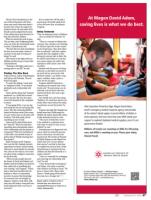
After Operation Protective Edge, Magen David Adorn,
Israel's emergency medical response agency and provider
of the nation's blood supply, incurred millions of dollars in
extra expenses. And now more than ever, MDA needs your
support to replenish depleted medical supplies, since it's not
government-funded.
Millions of Israelis are counting on MDA for lifesaving
care, and MDA is counting on you. Please give today.
Shanah Tovah.
AMERICAN FRIENDS OF
MAGEN DAVID ADOM
Dr. John J. Mames Chapter — Michigan Region
Manny Charach, Chair • Cari Margulis Immerman, Director
23215 Commerce Park Road, Suite 306, Beachwood, OH 44122
Toll-Free 877.405.3913 • central@afmda.org
www.afmda.org
Overland Park, Kan. Reach her at
maayanjaffe@icloud.com or follow her on
Twitter, ®MaayanJaffe.
iN
September 18 • 2014
67