
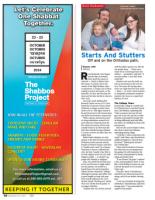

Rosh Hashanah
Yissachar "Jason"
Schneiderman and his family
23 - 25
OCTOBER
OCTOBRE
1211071N
OCTUBRE
Starts And Stutters
Off and on the Orthodox path.
OKTII6pb
2014
#ShabbosProject
The
Shabbos
Project
I KEEPING IT TOGETHER I
JOIN IN ALL THE FESTIVITIES:
THURSDAY NIGHT - CHALLAH
MAKE AND TAKE
SHABBAT - FOOD, FESTIVITIES
FRIENDS AND FAMILY
SATURDAY NIGHT - HAVDALA
CONCERT!
OPEN TO OUR ENTIRE COMMUNIT
ore information, email us a
MiShabbosProject@gmail. corn,
or call us at 248-583-2476 ext. 26
KEEPING IT TOGETHER
66 September 18 • 2014
Maayan Jaffe
JNS.org
I
osh Hashanah, Yom Kippur
and the days in between
them mark the season of
teshuvah — which in Hebrew liter-
ally means "to return," but in the
context of the High Holidays refers
to repentance. A unique case of those
seeking to return and repent, or "do
teshuvah," are Jews who become less
observant but later decide to return to
their roots.
Last year's much-debated Pew
Research Center survey of U.S. Jews
found that 52 percent of Jews raised
Orthodox no longer consider them-
selves to be so. That figure stands at
64 and 45 percent in the Conservative
and Reform movements, respectively.
While a gloom-and-doom picture
of rising assimilation seemed to be
most observers' takeaway from the
Pew study, the journey of Jews who
actually return to an observant life-
style after initially leaving it behind
is a more common storyline than one
might think.
Rabbi Yaakov Menken, an early
pioneer in the field of Internet-based
Orthodox Jewish outreach and the
founder of Project Genesis, said there
is "usually some cause" for someone
Orthodox to choose a different life-
style, but that "usually it has little to
do with religion and a lot to do with
religious people — or should I say,
people who identify as religious:'
Josh, who asked that his full name
not be used because it might embar-
rass his parents, was raised in a
haredi home. He said he found his
Atlanta Jewish community "stifling:'
Although his parents and rabbis went
to great lengths to keep Josh away
from outside influences, by 13 he
already started "checking out" and by
18 he was "off the derech (path):' or
no longer Orthodox.
"Judaism then was all this external
R
stuff that didn't speak to me, like the
way people dress. ... There was a
major focus on learning Torah, but
without ... spirituality," said Josh. "It
was just routine, a very dull, dead-
ended life:'
Menken said cases like Josh's are
not too uncommon in the 21st cen-
tury. The causes for leaving obser-
vance can range from the most awful
— abuse — to overly critical teachers
or misguided community members/
mentors who focus on a superficial
Judaism, he said.
The College Years
In particular, college is a trendy time
for Orthodox Jews to test their bound-
aries, said Menken, explaining that
"when a person is just over 18 and
goes out on his own and has to make
decisions surrounded by people who
do things differently and with differ-
ent values:' he will likely be faced with
peer pressure.
This was the case for Yaakov Cohen,
who chose to leave his Orthodox
upbringing during college.
"I was like, 'I want to experience the
world;' said Cohen, who described his
childhood Judaism as "shoved down
his throat:' "following the motions"
and "zombie-like:'
Cohen said his decision to become
less observant was not spontaneous,
but gradual. He still remembers the
first Torah commandment he broke:
eating non-kosher food.
"It was Chester Cab pizza. I ordered
a slice and just gulped it down. It was
like a weird feeling overcame me, and
I just ate that pizza in two seconds:'
Cohen said.
Yissachar "Jason" Schneiderman
started his non-observant journey by
eating a stick of non-kosher chewing
gum.
"I was very frustrated at being frum
[Orthodox]; Schneiderman said of his
teenage years. "I was surrounded by
negative frum people:'