

A Man Of
Contradictions
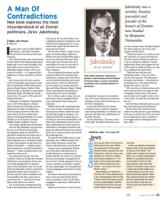
Jabotinsky was a
novelist, Russian
journalist and
founder of the
branch of Zionism
now headed
by Benjamin
Netanyahu.
New book explores the most
misunderstood of all Zionist
politicians, Ze'ev Jabotinsky.
Rabbi Jack Riemer
JNS.org
I
confess that I came to Hillel Halkin's
Jabotinsky: A Life (Yale University
Press/Jewish Lives Series) with some
suspicion.
First, Daniel Gordis wrote a book about
former Israeli Prime Minister Menachem
Begin with a rave review by Halkin, and
then Halkin wrote a book about Ze'ev
Jabotinsky, Begin's mentor, with a rave
review by Gordis — so I suspected that
Halkin's new volume would be a work of
fluff.
But it turns out to be both a serious
work of scholarship and an honest evalu-
ation of Jabotinsky (1880-1940) and his
place in Zionist history. (Editor's Note:
Daniel Gordis is scheduled to speak about
Menachem Begin: The Battle for Israel's
Soul on Nov. 13 as part of this year's JCC
Jewish Book Fair.)
Jabotinsky (ne Vladimir Zhabotinsky)
was a controversial figure in Zionist
affairs, demonized by the left and wor-
shipped by the right, yet Halkin has
drawn an honest portrait of the man,
warts and all. He has tracked down
almost everything Jabotinsky ever wrote,
whether it was in Russian, German,
Yiddish, Italian, English or French.
Four things emerge from this portrait:
One was that Jabotinsky was prescient.
He was one of the first to anticipate
that England would win World War I
and that it would drive the Turks out of
Palestine, and therefore that Zionism's
future depended on it. He foresaw ahead
of others that England would betray the
Balfour Declaration — a British expres-
sion of support for a Jewish homeland in
Palestine — unless enough pressure was
exerted on them not to.
He understood from the start that
socialism could not develop the economy
of Palestine soon enough to attract mas-
sive Jewish immigration. He grasped
early on that European Jewry was on the
brink of catastrophe. And he understood
long before others that the interest of
the Jews and the Arabs in Palestine were
irreconcilable, that they could only be
resolved by war — and that in the end
there could only be one winner.
The second truth emerging from this
book is that Jabotinsky never had much
real success. He was never able to win
a significant number of delegates to the
World Zionist Organization or to com-
mand much respect for the break-off
no way to peace except through strength,
group that he formed.
but what would you say if you could
He was able to form a couple of com-
speak to Israelis today?
panies of Jewish soldiers within the
"Would you advise us to hold on to all
British army, but they had little impact
the territories or to give them back for
on the war and none afterward. Most
the sake of peace? Would you advise us
of his plans were fantasies that never
to go on ruling over millions of Arabs
materialized. He was not even able to
against their wishes and against the will
control his own people in Palestine
of the world or would you tell us to work
HILLEL HALKIN
from a distance.
for a settlement of some kind?"
His one lasting achievement was the
"Make the best deal you can;'
creation of Betar, the movement that
Jabotinsky
replies. "I am sorry that I
Hillel Halkin addresses Jabotinsky's
centered on creating a new kind of Jew,
can't
be
more
specific. The settlements,
position, unique among the great figures
one who had self-discipline and a deep
Jerusalem,
the
borders — the details are
of Zionist history, as both a territorial
sense of honor. There are still streets
everything,
but
I can't speak about the
maximalist and a principled believer in
in every large city in Israel named for
details
from
where
I am now.
democracy.
him, and Prime Ministers Begin, Yitzhak
"All I can tell you is that you have to be
Shamir and Benjamin Netanyahu are
smart and you have to be tough in order
each in their own way his disciples.
to negotiate, and you have to be smart
But it is Betar, and its vision of a new
cal adulation. Instead, he has analyzed
and you have to be tough in order to live
kind of Jew who has sloughed off the
one of the most romantic and controver-
in this world. So make the best deal that
sial figures in the entire Zionist story, in
ways of the ghetto, that remains his
you can:'
memorial.
all of his complexities.
And with that, Jabotinsky gets up, pays
Halkin's third truth is that Jabotinsky
At the end of the book, he relays a
the waiter and goes back into history.
wonderful scene in which he imagines
was a man of many contradictions. He
The last lines with which he leaves
had enormous literary talent but never
interviewing Jabotinsky in a Parisian cafe, readers not only provide a good summary
sat still long enough to develop it. He
some 60 years after the establishment of
of the way he tried to live in his own time
dedicated himself to a people and to a
the State of Israel.
but are important words to consider as
land that he never felt comfortable in. He
He tells Jabotinsky: "You were a man
we struggle with the challenges Israel
believed in individualism, but he devel-
of the right. You believed that there was
faces today.
oped a philosophy that called upon the
individual to subordinate himself to the
group. He abhorred fascism, but created a
Celebrity Jews from page 58
party and a youth movement that had all
the trimmings of it.
The fourth truth Halkin learns is that
Jabotinsky was a different kind of Jew
than Chaim Weizmann, David Ben-
very young. When she moved to
care less.
•
ow,. Hollywood in the early 1940s,
As her son Stephen Humphrey
Gurion and other heroes of early Israel.
16 she acquiesced to filmmaker
Bogart wrote in his book, Bogart:
He grew up in cosmopolitan Odessa,
Howard Hawk's request that she
In Search of My Father. "My
not in the shtetl, and had almost no
change her name to Lauren and
mother was a lapsed Jew, and my
Jewish education or involvement in
adopted her mother's maiden
father was a lapsed Episcopalian.
Jewish tradition. He could very well have
1 ■ 1 name, Bacal (adding an "I" to
Neither of my parents had any
become a participant in the general cul-
make it more pronounceable),
strong belief in God, but, like
ture and not a Jewish spokesman. He was
never telling Hawks she was
many parents, they sent their
a poet, a novelist, a journalist, a transla-
Jewish – as a sign of the anti-
children to Sunday school, out of
tor and a playwright, who was proficient
in many languages and at home in many
Semitic times.
a vague sense that religion was
Nevertheless, as reported in
a good thing for a kid. We were
cultures.
the New York Times, Bacall wrote
being raised Episcopalian rather
The tension between his Jewish patrio-
in her autobiography that she felt
than Jewish because my mother
tism on the one hand and his attach-
"totally Jewish and always would" felt that would make life easier
ment to European culture on the other
struggled for supremacy within him for
and once asked Bogart whether
for [my sister] Leslie and me
all his life.
it mattered to him that she was
during those post-World War II
Jewish. Bogart said he couldn't
years."
Halkin has not done a work of uncriti-
❑
Jews
xi
CD
GO
ci)
❑
August 21 • 2014
61