

arts & entertainment
Hello ... I Do!
Modern-day matchmakers introduce
arranged marriage to reality TV.
Hannah Dreyfus
New York Jewish Week
R
eality TV seems to be learning a
thing or two from haredi dating.
In the new FYI reality show
Married at First Sight, six singles agree
to be set up by a team of four profes-
sional matchmakers — and legally
marry their selected mate upon first
meeting.
The professionals — a sociologist, a
psychologist, a sexologist and a spiritual
adviser — claim to use "scientific meth-
ods" to find three compatible couples
from a pool of 50 singles. And while
none of the participants is Jewish, three
out of the four matchmakers are.
"Can it just be a coincidence that
we're all Jewish?" said Greg Epstein, the
show's "spiritual adviser:'
"Probably not," he laughed.
Epstein, 37, who grew up attending a
Reform synagogue in Flushing, Queens,
N.Y., also goes by "Rabbi" — he received
his ordination as a Humanist rabbi in
2005 and today serves as the Humanist
chaplain at Harvard University. He
doesn't usually use his rabbi title and
felt 'spiritual adviser' was a safer bet for
the show.
Matchmaking is well-entrenched in
Jewish culture. Even today, most haredi
communities use matchmakers to medi-
ate between young couples.
"Shidduch resumes" — documents
that include information about the indi-
vidual's family, education and values,
along with references and photographs
— are traded between matchmakers and
then given to eligible singles. Once both
sides have agreed upon the match, the
couple goes out. Depending on the com-
munity, the courtship can last between
one date and several months.
Married at First Sight, which pre-
miered July 8 on A&E's FYI Network,
takes these minimalistic dating practices
to a new level by eliminating dating
completely. Though each couple is given
the option of getting a legal divorce at
the show's close, it is clear from the epi-
sodes thus far that each couple is com-
mitted to the long term.
"Putting marriage first actu-
ally increases the likelihood that these
couples will succeed," said sociologist
Dr. Pepper Schwartz, one of the show's
40
August 7 • 2014
JN
matchmakers.
"With marriage comes an immediate
commitment to try and make things
work, no matter what," said Schwartz.
Dating, on the other hand, leaves much
more room to back out when confronted
with any hurdle, she said.
"It's all about the mindset going into a
relationship. If you start at the altar, you
go in ready to compromise and deter-
mined to work through differences."
Married at First Sight, which is slated
for a 10-episode run, is not the only
reality dating show that skips the usual
stages of courtship. VH1's new series
Dating Naked introduces two complete
strangers to one another — minus their
clothing. Both shows take the fast track
to intimacy, leaving the treacherous dat-
ing scene in the dust.
And modern-day matchmaking is not
exclusive to the Jewish community.
In Singapore, the government pro-
vides matchmaking services to all citi-
zens, making the role of matchmaker
into an institutionalized position. In
India, classified ads are filled with par-
ents looking to marry off their children.
But, thanks to Fiddler on the Roof,
Jewish matchmaking has a particularly
strong resonance in the American cul-
tural landscape.
"We come from a minority commu-
nity, where there has historically been
a strong focus on whomever you're dat-
ing, and whomever you're not dating,"
said Epstein. "For centuries, Jews didn't
have the liberty to date outside the fold.
Matchmakers flourished within small,
insular communities:'
It's not just the Jewish people's history
of persecution that has given countless
yentas jobs over the years. According to
the show's sexologist, Dr. Logan Levkoff,
matchmaking is rooted in the Jewish
view of sexuality.
"Sexuality was never prohibited or
looked down upon in Judaism," said
Levkoff, who comes from a "proud"
Jewish background. "That's why
matchmaking was always encouraged.
Marriage and sex are praised and made
priorities:'
Raised on Long Island with a strong
sense of Jewish identity, Levkoff had
always envisioned a unique career path
for herself. "As a Jewish woman, I was
always taught the importance of giving
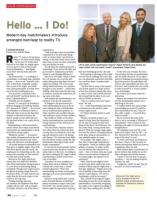
Left to right: Jewish matchmaking "experts" Pepper Schwartz, Greg Epstein and
Logan Levkoff, with non-Jewish "expert" psychologist Joseph Cilona.
back and challenging norms," she said.
Participating in Marriage at First Sight
was one way to challenge the norm. She,
too, was pleasantly surprised to find that
two out of her three co-professionals
were Jewish.
"The fact that so many of the experts
were Jewish speaks to a larger picture
of how Jews embrace taking risks when
it comes to love," said Levkoff. However
she stressed that the show is not mod-
eled on Fiddler on the Roof
"This is a modern-day social experi-
ment," she said.
So — could matchmaking experience
a renaissance in the modern, main-
stream singles scene?
Dr. Pepper Schwartz thinks it could
happen.
"People are already trying to use
experts to help them find somebody —
it's not such a far jump to what we're
doing on the show:' said Schwartz, who
also comes from a strong Jewish back-
ground. While the average single might
not want the "drama" of meeting directly
at the altar, using an intermediary is a
very palatable option for many.
For example, "the singles scene in
New York is downright intimidating,"
said Epstein. "There are millions upon
millions of options. In today's world,
you can literally date whomever you
want — man or woman, from any racial,
ethnic or socioeconomic background.
For many singles, the options can be
paralyzing:'
When cultural and religious barri-
ers don't exist, there needs to be some
method of discerning Mr. Right from a
first-date nightmare. "Singles need some
sort of method of narrowing down the
options," said Schwartz. "For some, a
matchmaker could be the answer:'
Still, Levkoff warned against singles
depending too heavily on the shadchan
(matchmaker). Successfully navigating
the singles scene requires knowledge of
self, more than anything else, she said.
"In the best-case scenario, this show
will introduce the idea of matchmaking
into the public discourse. It's an oppor-
tunity to challenge preconceived notions
about the practice. But individuals still
need to take responsibility for their own
love lives," said Levkoff, who was careful
to refer to herself as a "social scientist:'
not a matchmaker.
But viewers don't always make the
distinction.
Epstein, for example, has been flood-
ed with matchmaking requests since
appearing on the show.
"I couldn't believe how many people
were emailing me to ask if I could be
their matchmaker," he said. "Gay cou-
ples, older couples — I received thou-
sands of emails."
But, he stressed, the point of the
show is not to encourage a "diffusion of
responsibility" when it comes to rela-
tionships, but rather to "promote radical
thoughtfulness:'
"It's tempting to put your life in the
hands of an 'expert' and say, 'OK — fix
this. Find me love: But that is not the
point of the show," he said.
"If viewers take away one thing from
this show, I hope it is the necessity of
intense introspection before you look for
a significant other," he said.
While Epstein plays a matchmaker by
day, he stresses that neither he nor his
three colleagues have all the answers.
"I prefer it be clear that I'm just giv-
ing advice — I'm not making foolproof
matches," he said.
"I might be a rabbi," he said, "but I'm
not privy to Divine information:'
❑
Married at First Sight airs at
9 p.m. Tuesdays on the FYI
Network. Catch up with previous
episodes On Demand or online at
www.fyi.tv.