

arts & entertainment
Life After Death
New book on grieving offers suggestions for integrating
a loved one's spirit and values into our own lives.
Gail Zimmerman
Arts Editor
T
he Jewish holiday of Tisha B'Av
(the 9th of Av), beginning this
year on Monday evening, Aug. 4,
is said to be the saddest day on the Jewish
calendar. The fast day commemorates
the destruction of the First and Second
Temples in Jerusalem and the exile of the
Jews from the Land of Israel that followed.
It also remembers other tragedies that
befell the Jewish people on the same day.
Thus it is a day of profound grief.
At some point in our lives, all of us are
members of the community of grief. But
after the obituaries, the funeral, the shivah
and the accolades, the long-term impact of
grief on those who are left behind is rarely
discussed.
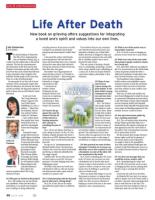
In the new book
The Living Memories
Project: Legacies That
Last (Little Miami
Publishing Co.), the co-
authors — Meryl Ain;
her husband, Stewart
Ain; and her brother,
Arthur M. Fischman
Meryl Ain
— have written about
how people have trans-
formed the power of
grief into meaningful
action and living lega-
cies.
Among the many
people interviewed are
public figures including
Robert Meeropol (son
Arthur M.
of convicted spies Julius
Fischman
and Ethel Rosenberg),
actor Jack Klugman,
genealogist Arthur
Kurzweil, journalist
Nick Clooney (father
of George) and Lynda
Johnson Robb (daugh-
ter of President Lyndon
Baines Johnson and
Stewart Ain
Lady Bird Johnson).
Here, Meryl Ain
answers question about The Living
Memories Project:
JN: What got you started on this project?
M.A.: My mother was my best friend
and confidante. When she died after a
brief illness, I was bereft and wondered
how I could go on living without the
60
July 31 • 2014
everyday presence of my mom in my life.
If you believe that you can communi-
I looked for an optimistic book about
cate with the deceased, this book is not
going beyond mourning but couldn't find
intended to disabuse you of that belief.
one.
Rather, this book is designed to help any-
I discussed this subject with friends
one incorporate memories into one's daily
and acquaintances who had also had
life as a healthy, positive way to move
losses and found that there were a myriad
beyond the pain of loss.
of proactive ways others had embraced
This can consist of starting a founda-
to keep the memories of their loved ones
tion or a scholarship, producing a creative
alive after they were gone.
work, using a family recipe, embarking on
My mother was a big proponent of
a career, etc. It does not require belief in
always having a project, so I decided to
a particular religion, philosophy or phe-
make this my project — discovering how
nomenon.
to go beyond that wrenching, painful
heartache to a happy
JN: Many of your
and productive life.
interviewees
I convinced my
express strong reli-
brother (Arthur
gious beliefs. Is reli-
Fischman) and my
gious belief a strong
husband (Stewart Ain)
component of what
to join me in exploring
you and your inter-
this phenomenon in
viewees are recom-
a book project. Thus,
mending?
4, Legacies That Last
The Living Memories
M.A.: We believe
Project was conceived.
that people should
use whatever works
JN: Doesn't this go
best for them. Many
against the need for
people find comfort
in religious belief in
closure? Doesn't all
of this interest in
times of stress and
keeping memories
sorrow as do many
' , 44,741
alive amount to
of our interviewees,
extending the pain of
but just as many of
loss?
our interviewees do
not mention religion or spirituality in
M.A.: We do not believe that there is
such a thing as closure. In fact, Dr. Dan
general. The experiences of our inter-
Gottlieb, a family therapist who hosts a
viewees reflect an approach to loss that
radio show on NPR, dismissed the notion
has application across a wide range of
of closure when we interviewed him for
orientations to religion and eschatology.
the book.
He says it is a "misinterpretation of
JN: How practical are some of these
Elisabeth Kubler-Ross:' the famed psy-
strategies? Certainly not everyone can
chiatrist who wrote the classic book Death afford the cost or time required to start
and Dying, in which she identified the
a foundation or some of the other trib-
five stages of grief.
utes mentioned in the book?
M.A: There's something here for every-
Gottlieb said: "It's not what she meant.
You have issues in your life. You have
body. Of course not everyone can start
memories. You have longings and aches.
a foundation, but it doesn't take much
Nothing goes away:'
money or time to look at photos or write
We believe that since our loved ones
a poem or follow a recipe or wear a par-
will always be with us, why not incorpo-
ticular item of clothing or a particular
rate that person's values, spirit and per-
color at a family event.
sonality in a positive way?
There are many little things we can do
that preserve memory. As long as these
JN: Is communicating with the deceased reflect the kind of person the deceased
part of what you're writing about?
really was, they are just as effective in
M.A: No, it isn't, but we do realize
helping us recover from loss as the more
that different people believe in different
expensive, time-consuming ones.
things.
IVING
E
RIES
JN: What is one of the easiest ways to
memorialize someone?
M.A.: It can be as easy as hanging up
pictures of your loved one in your home.
JN: What were some of the most ambi-
tious projects people created to remem-
ber a loved one?
M.A: After Peter Alderman was killed in
the 9-11 terrorist attack on the World Trade
Center, his parents created the Peter C.
Alderman Foundation to help others who
have survived terrorism, war or torture.
The foundation trains indigenous
health workers and establishes trauma
treatment systems to heal the emotional
wounds of these survivors of terrorism
and mass violence in post-conflict coun-
tries worldwide.
After her son Koby and another boy
were found bludgeoned to death by stones
in a presumed Palestinian terrorist attack
in the West Bank of Israel, Sherri Mandell
and her husband, Rabbi Seth Mandell,
created the Koby Mandell Foundation that
runs camps and healing programs for the
families of terror victims in Israel.
JN: You interviewed some public fig-
ures. Anything surprising?
M.A: Yes, we learned some interesting
things! Yankee great Babe Ruth was a
humanitarian who signed a full-page ad
that appeared in the New York Times in
December 1942 criticizing Nazi Germany
for its persecution of Jews.
We also learned that George Clooney's
human rights work had its genesis in
the lessons about social responsibil-
ity taught to him by his grandfather.
And, that Lynda Johnson Robb gave her
mother's (Lady Bird Johnson's) scarves to
her mother's favorite friends to share her
memory.
IN: Are there any messages that you
would like to leave readers with?
M.A.: Remembering the values and
zest for life of a loved one can be as easy
as hanging up their picture, playing their
favorite song or wearing their favorite
scarf.
Loved ones die only if you let them.
As Malachy McCourt puts it so memo-
rably in chapter one of our book, Death is
not fatal. A person's values and goals don't
have to end when he or she dies. The
loved ones they leave behind are here to
build upon and carry on their work.
❑