

world >> analysis
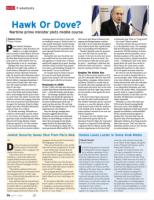
Benjamin
Netanyahu
Hawk
AP*
Dove'
Wartime prime minister plots middle course.
Raphael Ahren
I Times of Israel
rime Minister Benjamin
Netanyahu is often described, and
rightly so, as a right-wing hawk,
and he recently revealed that he will never
agree to full Palestinian sovereignty over
the West Bank despite the lip service he's
paid to the two-state solution. But one
thing Netanyahu is not is a warmonger.
Heading what some observers have
called the most right-wing coalition in
Israel's history, Netanyahu was extremely
hesitant to launch Operation Protective
Edge. He issued several ultimatums before
he was left with no choice and ordered a
limited military campaign attempting to
restore calm to Israeli cities, after more
than 200 rockets had fallen within the
span of a few days.
Even perennial critics from Israel's left
such as Yossi Beilin and Gershon Baskin
had to acknowledge that the prime minis-
ter acted wisely. The relative restraint with
which he reacted to the ongoing rocket fire
from Gaza secured him broad internation-
al support for Operation Protective Edge,
despite more than 190 killed Palestinians,
many of whom were civilians.
On Tuesday morning, Netanyahu suc-
ceeded in convincing his security cabinet
to vote in favor of an Egyptian cease-fire
agreement (only Economy Minister Naftali
Bennett and Foreign Minister Avigdor
Liberman opposed it). For that moment,
for the second time in his premiership,
Israel decided to end an extensive military
p
campaign against terrorists in Gaza with-
out sending in troops to "finish the job:' as
some Israelis demanded. Just like during
the 2012 Operation Pillar of Defense, the
Israeli government had repeatedly threat-
ened a ground invasion, but never went
through with it.
During this mini-war, the prime min-
ister would have had even more reasons
and legitimacy to invade Gaza, as Hamas
significantly stepped up its game, shooting
countless rockets at Israel's main popula-
tion centers, and attempting "strategic ter-
rorist attacks" via sea, air and land.
On Tuesday, however, Hamas rejected
the cease-fire and Israeli operations
against Gaza resumed. The more hawkish
Liberman again called for an invasion.
Netanyahu In 2009
On Feb. 3, 2009, a few days after then-prime
minister Ehud Olmert ended Operation Cast
Lead — which did include a ground opera-
tion — by declaring a unilateral cease-fire,
Netanyahu, who headed the opposition at
the time, declared that if he were in charge,
the army would have gone all the way. "I
want to say here and now: We won't stop
the IDE We will complete the work. We will
topple the terror rule of Hamas."
Just a few days ago, messages from
Jerusalem suggested that this time,
Netanyahu was serious about destroying
Hamas, or at least hitting it so hard as to
deter it from resuming terrorist attacks
against Israel for the foreseeable future.
"We're not interested in a Band-Aid:' a
senior government official said July 10. "We
don't want to give Hamas a timeout to rest,
regroup and recharge batteries, and then
next week or in two weeks they start again to
shoot rockets at Israel. Such a quick-fix solu-
tion is not something we're interested in:'
Tuesday's Egyptian cease-fire proposal
was a sure-fire recipe for exactly that
scenario. To be sure, its terms were worse
for Hamas than they are for Israel. The
terrorist group would only receive quiet
for quiet — something it could have had
before the whole crisis started — and per-
haps the opening of border crossings.
Keeping The Status Quo
The fact is that as prime minister in 2012
and 2014, Netanyahu offered to end week-
long military campaigns without destroy-
ing Hamas. Hesitant to actually step up
an entirely safe aerial campaign and send
Israeli troops into harm's way, he has twice
refused the call of his right-wing constitu-
ency for harsher action against the terror-
ists in Gaza.
In the hours before Egypt announced
the cease-fire offer, Israeli pundits said
that whether Netanyahu opts for a ground
invasion or a cease-fire depends on how
many Knesset seats he fears he would lose
to his hawkish rivals. It appears that the
prime minister's wariness of war won over
political expediency.
It remains to be seen whether Israel
fully achieved the goal it had set for
Operation Protective Edge: the "restoration
of quiet for a long period while inflicting
a significant blow on Hamas and the other
terrorist organizations in the Gaza Strip,"
as Netanyahu said. What is a "long period"
— four years? Fifteen months?
The prime minister did succeed, howev-
er, in the diplomatic arena. The campaign
had the full backing of the international
community. With his hesitance to launch
the operation and his immediate, uncon-
ditional acceptance of the cease-fire, he
scored major points in capitals around the
world — including the Arab world, where
people slowly but surely have started to
blame Hamas for Gaza's misery, under-
standing that Israel had no other choice
but to act against incessant rocket fire.
But whoever says that Netanyahu is not
keen on war needs to mention that he is
no peacemonger, either. While supporting
a two-state solution in principle, he on
Friday indicated that under his leadership
Jerusalem would never be able to agree
to an independent Palestinian state with
control of the Jordan Valley. Citing Israel's
security needs in a region troubled by
Islamist extremism, he said that even if it's
desirable, full Palestinian sovereignty is
simply impossible.
Netanyahu is a man of the status quo.
With terrorist threats looming literally
from every corner of the Middle East,
Netanyahu's skepticism of bold steps toward
regional reconciliation is understandable.
But his constant pessimism appears to
paralyze him. It prevents him from tak-
ing active steps, from launching his own
diplomatic initiatives, from being proactive
rather than reactive. That's why under his
leadership, Israel has seen no wars, but also
no serious attempt at peace.
❑
Jewish Security Saves Shul From Paris Mob Hamas Loses Luster In Some Arab Media
JTA
D
ozens of young men protesting
Israel's actions in Gaza briefly
besieged a Paris synagogue and
clashed with security.
At least three Jews were taken to the
hospital as a result of the clashes that
erupted Sunday between the protesters
and young Jewish men who guarded the
Don Isaac Abravanel Synagogue in Paris, a
witness told JTA.
"The attackers splintered off an anti-
Israel demonstration and advanced toward
the synagogue when it was full," Alain
Azria, a French Jewish journalist who cov-
ered the event told JTA.
Azria said that when the demonstrators
arrived at the central Paris synagogue, the
five police officers on guard blocked the
entrance as the protesters chanted anti-
Semitic slogans and hurled objects at the
36 July 17 • 2014
JN
synagogue and the guards. He said nearly
200 congregants were inside.
"They were determined to enter and the
police did not have enough forces:' he said.
Azria said the mob was kept away by
men from the SPCJ Jewish security unit,
the Jewish Defense League and Beitar, who
engaged the attackers in what turned into
a street brawl.
"Thank God they were there because
the protesters had murder on their minds
and it took a while before police reinforce-
ments arrived:' he added.
The synagogue attack followed several
anti-Semitic incidents that coincided with
Israel's offensive in Gaza, which began on
July 8.
In one attack in Belleville, north of the
French capital, a firebomb was hurled at
a synagogue, causing minor damage. In
another attack, a man pepper-sprayed the
face of a 17-year-old girl. ❑
Daniel Siryoti
Israel Hayom
I
srael has long grown accustomed
to widespread criticism triggered
by its military operations in the
Gaza Strip, but this time, Operation
Protective Edge has been character-
ized by biting criticism of Hamas as
well. Figures in the Arabic press have
said that Hamas is culpable for the
recent escalation of violence and the
suffering of the more than one million
Palestinians who live in Gaza.
The criticism of Hamas has been
expressed through various editorials
and commentaries across the popular
Arabic press, as well as by senior com-
mentators on Arabic news programs
covering the Gaza violence.
Hamas is at its lowest point with
regard to its image since at least 20
years ago, with criticism mounting
across Saudi Arabia, Egypt, among the
emirs of Persian Gulf nations, and in
Jordan and Lebanon, too.
In Egypt, one anchorwoman said,
"the ones accountable for the mas-
sacre Israel is carrying out against
Palestinian citizens in the Gaza Strip
is Hamas, which went out of its way to
bring about the escalation with Israel,
inviting Israeli aggressiveness, simply
to pressure the Egyptian government to
open the Rafah border crossing:'
In Saudi Arabian newspaper Al
Watan, an editorial was published
slamming both Israel and Hamas.
"Hamas is more isolated than ever.
The organization is revolting against
the legitimate Palestinian leadership,
while it is perceived globally as a crimi-
nal organization raining rockets down
onto Israel."
❑