

health & wellness
>> on the cover
Jewish Vegetarians
Health and ethical reasons draw locals to meat-free diets.
Ruthan Brodsky I Contributing Writer
CONTINUED FROM PAGE 1
It was also an easy decision for Marisa,
who never was a big fan of meat.
"Being vegetarian made keeping kosher
very easy for us as a young couple because
there never was meat or poultry in the
house she says. "We only needed one set
of dishes:'
A few years later, the LaKinds adopted
a vegan lifestyle omitting fish and dairy
products from their menu. This decision
was based on medical data demonstrating
that a plant-based diet is healthier and
improves longevity. It was also an exten-
sion of their commitment to animal rights.
Interestingly, a major part of what Gary
does in his work as medical director for
Ford Motor Company is promoting pre-
ventive health.
"This often includes adding a vegetarian
diet as an option for employees:' he says.
"When someone is interested in becom-
ing a vegetarian or a vegan, I recommend
they work it out in stages, first eliminating
meat, and then deciding how far they want
to go:'
When Shayah was born Marisa nursed
him for 31/2 years.
"He had enough natural cholesterol to
last him a lifetime Gary says. "He was
raised on a vegan diet of fruits and veg-
etables, whole grains, beans, legumes,
nuts plus fortified cereals with B-12 and a
chewable multi-vitamin without any fish
products. His growth has been very even,
and he never needed a pacifier. Today he
drinks soy and almond milk:'
Shayah attends Hillel Day School in
Farmington Hills and brings his own
lunch. It always contains a special treat
that serves as an alternative to a cookie or
cupcake that someone may offer him.
"When he's offered something to eat, he
always asks if the food is vegan:' Marisa
says. "If it's not or the person doesn't know,
he won't touch it. We never gave him any
rules. He's simply learned to eat as a vegan
and loves his vegetables:'
Gary says, "I admit our lifestyle would
have been much more difficult to achieve
10-15 years ago. Today, markets carry a
large variety of vegetarian products, many
of which are produced locally:'
Varying Motivations
People are motivated to become vegetar-
ians for multiple reasons.
Janet Gumenick of West Bloomfield
became a vegetarian to achieve a health
Major vegetarian
categories include:
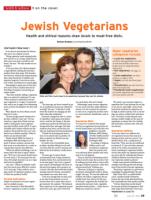
Emily and Peter Levin chose to be vegetarians because they care for animals.
goal.
"Ten years ago, my doctor wanted to put
me on medication because my cholesterol
was high:' she says. "I told him I would
lower the numbers by changing my diet
rather than take medication:'
Gumenick changed her diet to a menu
of vegetables, whole grains and salmon
twice a week for the Omega-3. She also
avoided processed foods and foods con-
taining white flour and sugar. Her lipid
numbers went down, and she does not
take any cholesterol-lowering medications.
"I found that by keeping my food as
close to its natural state as possible, I'm
able to maintain my lifestyle and stay
healthy:' she says.
Dr. Emily Levin of Southfield chose
to adopt a meatless lifestyle for the ethi-
cal reason that she cared for animals and
believed the food industry cruelly abuses
them.
"Six years ago, I read an Oprah-
recommended book, Eating Animals by
Jonathan Safran Foer, and decided never
to eat meat again:' says Levin, a general
and cosmetic dermatologist who does eat
fish and local organic dairy products on
occasion. She later discovered that poultry
and pigs raised for human consumption
were treated even worse than cows.
"I feel very strongly that we don't need
to eat other living animals to survive
because there are so many other ways to
get nutrients:' she explains. "My husband,
Peter, joined me on my vegetarian journey
about three years ago, and we both feel
very good about what we're doing:'
Interestingly, many become vegetarian
for one reason and later adopt additional
reasons. It is also common for someone
to start out as a vegetarian and then move
to a more restrictive classification, such as
vegan.
Vegetarian Diets
"It is easy to be confused when people
say they are vegetarians because there are
several classifications, each with their own
guidelines:' says Julie
Feldman, MPH (Master
of Public Health) and RD
(Registered Dietitian) in
Farmington Hills.
According to Feldman,
children can be well
nourished on vegetarian
Julie Feldman
diets, but parents need
to be informed about nutrition and meals
need to be well planned.
"Keep in mind that eliminating animal
products doesn't mean that a person won't
be making poor food choices, such as add-
ing sugar, artificial sweeteners, white flour
and processed food:' Feldman says.
"Moreover, sticking to a vegetarian
diet doesn't automatically result in losing
weight:' she says. "It's true that adults and
children who follow a vegetarian diet are
usually leaner than others, but this may
be because a vegetarian diet includes less
saturated fat and more fruits, vegetables
and plant-based proteins — foods that are
filling and contain less calories:'
• Lacto-ovo vegetarian:
eats dairy and egg products, no meat
(a term that describes what most
people mean by calling themselves
vegetarians)
• Ovo-vegetarian: eats eggs, no
meat
• Lacto-vegetarian: eats dairy
products, no eggs or meat
• Vegan: eats only food from plant
sources
• Pescetarians: eats only food from
plant sources plus fish
• Flexitarian (semi-vegetarian):
eats mostly vegetarian, but occasionally
eats meat, poultry and fish.
The point is you can gain weight on a
vegetarian diet if your portions are too big
or you eat too many high- caloric foods.
Some foods marketed as vegetarian can
be high in calories and fat, such as soy hot
dogs, soy cheese, refried beans and snack
bars. The basics of achieving and main-
taining a healthy weight are the same for
vegetarians as anyone else: Eat a healthy
diet and balance calories eaten with calo-
ries burned.
Vegetarian Children
"I am wary when I see children who
are vegetarians because they may lack
adequate protein and iron sources:' says
Ayesha Fatima, M.D., a pediatrician in
Royal Oak. "They may also be insufficient
in vitamin B 12, zinc and other minerals,
which is why I often recommend nutri-
tional counseling for vegetarian families.
On the other hand, my vegetarian patients
are at less risk for cardiovascular disease,
childhood diabetes and obesity than my
non-vegetarian pediatric patients:'
Fatima warns parents of adolescents to
carefully watch their growth and develop-
ment if they decide to become vegetarians.
"Becoming a vegetarian is a good way to
camouflage an eating disorder," she says.
Kelly Victor, Ph.D., a certified health
coach, considers herself a flexitarian
because she eats mostly plant-based food,
but occasionally eats meat, poultry and fish.
"I tell my clients that one diet doesn't
fit everyone and that it's important to find
what makes them feel better; Victor says.
Vegetarians on page 50
-
June 26 • 2014
49