

arts & entertainment
Movies At
Dara Friedman's films explore people's
multifaceted responses to a central idea.
I
Suzanne Chessler
Contributing Writer
D
ara Friedman entered Vassar
College interested in studying
German philosophy but unsure of
career goals. She graduated with a major
in her initial field but with ambitions to
pursue artistic filmmaking.
That pursuit took her to teachers in
Germany, Austria and England as she
developed her own style of structuralism
in depicting everyday life.
The filmmaker brings three recent pro-
ductions to the Museum of Contemporary
Art Detroit (MOCAD), where they will
be on view May 16-July 27 in the exhibit
"Dara Friedman: Projecting:"
Two other solo exhibits, Jose Lerma's
installation "La Bella Crisis" and Steven
Locke's paintings in "There Is No One Left
to Blame will be displayed during the
same timeframe with a shared opening-
night reception featuring the music of
Passalacqua, supported by DJ Hugh
Whitaker.
"Each film in the trilogy — Musical (48
minutes), Dancer (23 minutes), Play (46
minutes) — explores the single purpose
of watching various responses to a central
idea; says Friedman in a phone conversa-
tion from her Florida home.
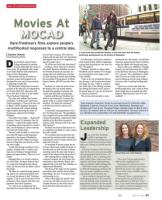
"Musical, made in 2008, is a work with
more than 60 singers performing spon-
taneously on the streets of Manhattan.
Dancer, made in 2011 Miami, has many
dancers setting their movements as if the
city were a stage.
"I made Play during a residency in Los
Angeles, working with 17 couples creat-
ing scenes of intimacy through theater
games and improvisation. There is a lot of
nudity:'
Although there is no Jewish content in
any of her films, Friedman believes there
is a connection through Jewish culture,
which she learned from her father's side of
the family.
"My films are created through question-
ing, and it's my understanding that there
is a certain Jewishness to that:' Friedman
explains. "I ask a series of questions of the
performers. They respond, and then I ask
questions about their responses.
"In a way, it's an exchange and not a
hierarchical structure, where I'm the direc-
tor and what I say goes. The works are
dealing with the idea that we're individuals
and singular and yet in our singularity, we
also have many voices.
"It's all like one body with many heads:"
Friedman, whose work can be found in
New York's Museum of Modern Art and
the Whitney Museum of American Art
among other arts institutions, is having
her first showing in Detroit and attributes
her local debut to being known by Elysia
Borowy-Reeder, MOCAD executive direc-
tor.
Friedman, 45, takes her artistry from
the family of her non-Jewish mother,
Gundula Thormaehlen Friedman, who
creates land labyrinths and paintings.
Gundula and Norman Friedman met
while he was stationed in Germany dur-
ing the 1960s as a military dentist from
Brooklyn. The family has continued
to divide time between America and
Germany.
"I come from many generations of art-
ists:' the filmmaker says. "My grandfather
was a sculptor and a poet, and his brother,
Ludwig Thormaehlen, curated early Berlin
exhibits of the Blue Rider (a group of
German artists showing work in the early
20th century):'
Friedman was lured to film because of
its complexity and ability to create a portal
into other worlds.
"It's a medium that can deal with emo-
tions and the irrational while technically
requiring the artist to remain rational and
observant:' she says.
"In moments of surreal ecstasy, the art-
ist has to detach and twiddle the knobs. It
was this push me-pull me state of letting
oneself go and at the same time being in
control of the situation that attracted me:'
After making films in college during
a summer program, she met painter and
performance artist Herman Nitsch, who
suggested she work with Peter Kubelka, an
experimental filmmaker.
"The focus of the study was the material
and subjects that could be found within
filmmaking," she says. "It seemed to have
real meaning for me.
"Film is about light and shadow, what
you can see and what you can't see. It's
complex because it's one of the only art
forms that deals with more than one
sense."
A scene from Dara Friedman's Musical, a work with more than 60 singers
performing spontaneously on the streets of Manhattan
The filmmaker moved from student to
artist during the late 1990s by organizing
a group show featuring her own work in a
New York gallery.
Friedman, married to sculptor Mark
Handforth and the mother of two daugh-
ters entering their teens, keeps a strict
work schedule.
"I have to be very disciplined with my
time because I can't be away from home
very long:' she says. "I film in a week or
two weeks tops, so the filming is intense.
The editing and related work is done in
90-minute spans so I can rest my brain for
15 minutes in between:'
The cinema artist currently is in pre-
production for a film about a sacred Native
American spring near her home in Miami,
where she relaxes with kung fu and yoga.
"I have a film in an exhibition, "Damage
Control: Art and Destruction Since 1950,"
at the Hirshhorn Museum in Washington,
D.C.," she says. "My contribution is called
Total. It has me in a hotel room smash-
ing everything up, but the work is played
in reverse with everything building itself
again.
"I grew up in a house that had been
bombed eight times, and I really do think
about things that are smashed and what
happens when the pieces have to be reas-
sembled:'
❑
"Dara Friedman: Projecting" will be on view May 16-July 27 at MOCAD, 4454
Woodward, in Detroit. Hours are 11 a.m.-5 p.m. Wednesdays, Saturdays and
Sundays, and 11 a.m.-8 p.m. Thursdays-Fridays. Opening events on May 16 start
at 6 p.m. for members and run 7-10 p.m. for nonmembers. The music starts at 9
p.m. Members: free; nonmembers: $7. (313) 832-6622; mocadetroit.org .
Expanded
Leadership
j
ust as the Dara Friedman
exhibit is opening at the
Museum of Contemporary Art
Detroit, a newly formed museum leader-
ship team is taking on divided responsi-
bilities.
Julia Reyes Taubman, MOCAD board
chair for the past seven years and author
of the photographic book Detroit: 138
Square Miles, is now co-chairing with
Elyse Goldin Foltyn, a three-year board
member and former chief marketing
officer at Munder Capital Management.
While both women work together
on MOCAD fundraising, Taubman will
focus on creative initiatives as Foltyn
concentrates on the business side.
"As we continue to present new and
challenging programs in the contempo-
rary arts and help artists in Detroit, our
huge growth and wide reach have made
it important that day-to-day board lead-
ership be expanded:' Taubman says.
Elyse Foltyn and Julia Taubman
"Elyse and I bring complementary
skills to this complicated role:"
Featuring local, national and inter-
national artists, musicians and writers,
MOCAD has grown over eight years
from a visitor count of 20,000 in 2006 to
150,000 in 2013.
"Julia and I share a commitment to
advancing the arts in Detroit and a
fierce dedication to MOCAD," Foltyn
says. "I am excited about the opportuni-
ty to help her continue building on our
museum's amazing momentum:'
❑
May 15 • 2014
37