

arts & entertainment
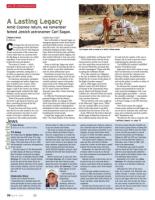
A Lasting Legacy
Amid Cosmos return, we remember
famed Jewish astronomer Carl Sagan.
Robert Gluck
I JNS.org
C
arl Sagan fans old and new have
been gazing at their televisions
in awe as host Dr. Neil Degrasse
Tyson's resurrection of the science epic
Cosmos takes them on a journey from
the Big Bang, to microscopic one-celled
organisms, to the ascent of man, to
beyond the stars and planets.
The return of Cosmos — which
launched in March and runs for 13
episodes on the Fox and National
Geographic networks, ending June 2 —
provides an opportune time to remember
Sagan, the show's Jewish creator.
An American astronomer, astrophysi-
cist, cosmologist and author, Sagan was
born to Reform Jews. Science writer
William Poundstone, author of Carl
Sagan: A Life in the Cosmos, has written
that Sagan's family celebrated the High
Holidays, and his parents made sure Carl
knew the Jewish traditions.
"Both of his parents instilled in him
this drive to get ahead in America, and
that is something he kept all his life
Poundstone told JNS.org .
"It may have been one factor in this
idea that he not only wanted to be a suc-
cessful astronomer, but [also] to write
books, to become a celebrity and an
entrepreneur. His mother particularly
Jews
iv
•17 I
instilled that in him!"
Born in Brooklyn to Samuel Sagan, an
immigrant garment worker from Russia,
and Rachel Molly Gruber, a housewife
from New York, Carl was named in honor
of Rachel's biological mother, Chaiya
Clara. Both Carl and his sister said their
father was not particularly religious, but
their mother believed in God, was active
in her synagogue and served only kosher
meat.
From an early age, Sagan was seized
with the mission of searching for life on
other worlds, a quest that would domi-
nate his entire professional career.
Poundstone recounts how this quest
continuously drove Sagan, from his ado-
lescent chemistry-set accidents, to his
colorful academic career, to his profes-
sional work on the Viking and Voyager
NASA missions, nuclear disarmament,
his TV series Cosmos and Robert
Zemeckis' space film, Contact (starring
Jodi Foster).
In 1986, the World Jewish Congress
presented Sagan with the Nahum
Goldmann Medal. According to WJC
North American press officer Eve Kessler,
the medal is awarded to distinguished
individuals for their contributions to uni-
versal humanitarian causes and actions
benefiting the Jewish people.
At that time, Sagan gave an address
titled "The Final Solution of the Human
Nate Bloom
Special to the Jewish News
TV Notes
‘
12 On Friday, May 16, Barbara Walters, 84,
retires from her ABC show The View
41) and from regular on-air work for ABC
News. That same day, at 9 p.m., ABC
will broadcast a two-hour retrospective
CH I of her career.
The new season of The Bachelorette
on ABC debuts at 9:30 p.m. Monday,
May 19, before moving to its regular
time of 8 p.m. on Monday, May 26. Andi
Dorfman, 27, is the first Jewish woman
to be the star of the show. She is an
assistant district attorney in the county
that includes Atlanta. Look for an inter-
view with her in an upcoming issue of
the JN.
7:6
Cinderella Story
I know you've heard the term
"Cinderella story" bandied about for
some participant at every major sport-
ing event. But California Chrome, the
winner of this year's Kentucky Derby
38
May 15 • 2014
JN
(held on May 3), really is such a story
as are his owners and trainer.
The horse is owned and was bred
by Perry Martin and Steve Coburn,
who live, respectively, in a small city
in Northern California and in a small
Nevada town near Lake Tahoe. Neither
earns much money as an engineer and
press operator, respectively, but they
took a chance and bred two horses,
worth $10,000 together, and got a foal
(California Chrome) that showed early
promise.
When Chrome was 2 years old, they
told Alan Sherman, 45, a trainer based
part-time in the San Francisco area,
about the horse. He talked to his father
and boss, trainer Art Sherman, 77, and
they agreed to train
ict rue"
Chrome.
Like Chrome, Art
Sherman had modest
beginnings.
He was born in
Brooklyn, where his
father, the son of
Art Sherman
Russian-Jewish immi-
Problem: Adolf Hitler and Nuclear War:'
"If the United States and the Soviet
Union permit a nuclear war to break
out, they would have retroactively lost
the Second World War and made that
sacrifice meaningless:' Sagan said after
accepting the Goldmann medal.
"If we take seriously our obligation
to the tens of millions who perished in
World War II, we must rid the planet of
the blight of nuclear weapons:'
Also in 1986, Sagan received the
Shalom Center's first Brit HaDorot
(Covenant of the Generations) Peace
Award. Shared with Boston's Jewish
Coalition for a Peaceful World, the award
was presented to Jews who work to pre-
vent a nuclear holocaust.
"We had relatives who were caught up
in the Holocaust:' Sagan wrote. "Hitler
was not a popular fellow in our house-
hold. On the other hand, I was fairly
insulated from the horrors of the war:'
In his 1996 book The Demon-Haunted
World, Sagan included his memories of
this conflicted period, when his fam-
grants, scraped out a living in construc-
tion. Sherman told me that his father's
brothers were doing a bit better in Los
Angeles, so they moved there when
he was 7, in 1945. His father opened a
small Los Angeles barber shop.
The family wasn't religious, Sherman
said, but they sent him to Hebrew
school for a while. He left when a rabbi/
teacher hit him and never returned.
Meanwhile, Art was still only 5-foot-
2-inches when he was 15, so the bar-
ber-shop customers encouraged him to
become a jockey.
Nobody he knew rode horses, but he
found his way to a track and discov-
ered he could learn what he needed by
working at a nearby ranch that trained
jockeys.
Art had only modest success as a
jockey. In 1980, he became a full-time,
licensed trainer and gradually became
pretty successful. But until Chrome, he
never had had a really big-time thor-
oughbred.
Chrome won five big races in a row
before the Kentucky Derby and entered
ily dealt with the realities of the war in
Europe, but he tried to prevent it from
undermining his optimistic spirit.
"Carl fulfilled his mother's unfulfilled
dreams," Poundstone said.
Sagan spent most of his career as a pro-
fessor of astronomy at Cornell University,
where he directed the Laboratory for
Planetary Studies. He published more
than 600 scientific papers and articles
and was the author, co-author or editor of
more than 20 books.
He advocated for scientific skeptical
inquiry and promoted the search for
extra-terrestrial intelligence. But it was
perhaps Sagan's personality — not just
his scientific credentials — that popular-
ized his 1980 series TV series, Cosmos:
A Personal Voyage, on the PBS television
network.
"One of the reasons the original
Cosmos series worked was that Sagan was
one of the few scientists who could wear
jeans and a turtleneck and look comfort-
able Poundstone said.
"He did have this vibe as someone who
Lasting Legacy on page 41
the race a heavy favorite. Pundits say
that he has a good chance of being the
first horse since 1978 to win the Triple
Crown, the title accorded to a horse
that wins the Derby, the Preakness
Stakes (on NBC at 4:30 p.m. Saturday,
May 17) and the Belmont Stakes on
Saturday, June 7 (also on NBC, with
time to be determined).
Art Sherman was loath to predict
that he would win the Triple Crown. He
said he is just enjoying the attention
that is going to the oldest trainer, ever,
of a Kentucky Derby winner.
Meanwhile, Art's other son, Steve
Sherman, 47, is having a banner year
as a trainer at a Northern California
race track.
Although his wife of 53 years,
Faye, isn't Jewish, Art Sherman con-
siders himself a "pretty Jewish guy,"
mentioning how much he loves eat-
ing lox and eggs with one of the sev-
eral Jews who own horses he trains.
He also fondly recalled that he, his
wife and his nieces loved their trip to
Israel two years ago.