

arts & entertainment
Hannah
"905 - 1975
Ile
four year* attar th« do-
145
Riveting Biopic
Hannah Arendt will be revisited on screen
to open the DFT's fall season.
I
Robert Gluck
F
JNS.org
fifty years after Hannah Arendt
came out with her controversial
book, Eichmann in Jerusalem: A
Report on the Banality of Evil, a new film
from German director Margarethe Von
Trotta revisits the famed Jewish political
theorist and her views on the lieutenant
colonel of the Nazi SS.
Born to Jewish parents in 1906 in
Hanover, Germany, Arendt studied phi-
losophy, was briefly imprisoned by the
Gestapo, fled to Paris, was interned in and
escaped from the detention camp in Gurs
(France), immigrated to the United States
and achieved fame, if not notoriety, for her
coverage of the Adolf Eichmann trial for the
New Yorker.
Von Trotta's film Hannah Arendt, focus-
ing on four years surrounding the 1961
Eichmann trial, had one screening at
Cinetopia in Ann Arbor in June. Now, it
comes to the Detroit Film Festival at the
Detroit Institute of Arts (overlapping with
the High Holidays but with screenings
available to those who are observant).
"The film reasonably portrays a lot of
the personal situations Arendt found her-
self in when she started writing her book,
Eichmann in Jerusalem, and the intellectual
and political controversies around it:' said
Ron Feldman, co-editor of The Jewish
Writings of Hannah Arendt. "It portrays
how she developed her thinking. It's not a
documentary; it's a biopic:'
In an interview with her publicist made
available to JNS.org, Von Trotta talks
about her use of black and white archival
footage of the trial to capture Eichmann's
not - thinking" character. The now-famous
line — "the banality of evil" — that Arendt
used to describe Eichmann still reverber-
ates today.
"You can only show the true 'banality
of evil' by observing the real Eichmann,"
Von Trotta said. "An actor can only distort
the image, he could never sharpen it. As a
viewer, one might admire the actor's bril-
liance, but they would inevitably fail to
comprehend Eichmann's mediocrity. He
was a man who was unable to formulate a
single grammatically correct sentence. One
could tell from the way he spoke that he
was unable to think in any significant way
about what he was doing."
Arendt was no stranger to controversy,
and Feldman, having studied her work
for years, understands her more than
most. "There is still interest in these issues
that happened 50 years ago:' Feldman said
about the 20th-century intellectual and the
political controversy she engendered.
"When Arendt went to the Eichmann trial
and wrote about it, there were ways in which
she wrote about it that were provocative and
also critical of the way the trial was handled
by the Israeli government. Part of it was
simply that she wrote things provocatively
and could have been a little more subtle and
thoughtful. I don't hold her blameless:'
Feldman said Arendt's most controver-
sial assertion was her criticism of Jewish
leadership.
"The biggest issue was she wrote criti-
cally about the conduct of Jewish leadership
during the war and claimed that Jewish
leaders cooperated mostly inadvertently
with the Nazis:' he said. "She was not sym-
"
,ntamd
1951.
rm. 1945 ...As, ap-
ffnfts dena4cra of
621.1,
CD
aomsa ana she
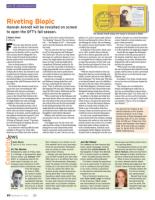
The Hannah Arendt stamp, first issued in Germany in 2006.
pathetic to it, and so many people claimed
that she was blaming the victims. She was
not blaming the victims. She was blaming
the conduct of some Jewish leaders. That is
a subtlety that escaped:'
In Eichmann In Jerusalem, which came
out in 1963, Arendt's thesis is that the
great evils in history generally, and the
Holocaust in particular, were not executed
by sociopaths but by ordinary people who
accepted the premises of their state, and
they therefore participated in those evils
with the belief that their actions were
normal.
"With her staunch refusal to obey any-
thing other than her own knowledge and
beliefs, Arendt could not be more different
from Eichmann," Von Trotta said. "His duty,
as he himself insisted, was to be faithful to
his oath to obey the orders of his superiors.
In this blind allegiance, Eichmann surren-
dered one of the main characteristics that
distinguish human beings from all other
species — the ability to think for himself'
In addtion to the black-and-white foot-
age from the actual Eichmann trials, Von
Trotta weaves a narrative that spans three
countries. The new film features Barbara
Sukowa as Arendt. Born in Berlin, Von
Trotta is one of the leaders of the New
German Cinema movement and one of the
world's best-known feminist filmmakers.
In a key scene, Arendt stands before a
lecture theater full of her students, insisting
that anyone who wishes to write about that
period in history has a duty to try to under-
stand what makes ordinary people into
tools of totalitarianism. American social
psychologist Stanley Milgram interpreted
Arendt's work as stating that even the most
ordinary of people can commit horrendous
crimes if placed in certain situations and
given certain incentives.
He wrote, "I must conclude that Arendt's
conception of the banality of evil comes clos-
er to the truth than one might dare imagine:'
Arendt did not suggest that Eichmann
was normal or that any person placed in
his situation would have done as he did.
According to her account, Eichmann had
abdicated his will to make moral choices,
and thus his autonomy.
"What Arendt was really claiming was
she saw in Eichmann that relatively normal
people could be drawn up into a movement
like that and act in evil and horrific ways,"
Feldman said.
According to Von Trotta, Arendt stayed
true to her views on Eichmann despite the
criticism.
"Her refusal to be overwhelmed by
despair and helplessness makes her, in
my eyes, an extraordinary woman whose
light still shines today:' Von Trotta said. "A
woman who can love and be loved and a
woman who can, as she put it, 'think with-
out banisters: That is, to be an indepen-
dent thinker:'
Jew - By - Choice
The JWeekly, the San Francisco Bay
me because everything comes from a
very spiritual place.'
"Accompanying Antonia on her spiri-
tual journey has been her husband,
Ronen Heimann, whom she married in
April. Heimann is Israeli, and the cou-
ple have visited Israel several times.
"When it came to becoming a Jew-
by-choice, Bennett said her family
has been nothing but supportive. Her
Catholic Italian-American father and
Christian mother left
it to her to find her
own spiritual path."
Bennett has formal
musical training and
has performed all
over the world. She
frequently does gigs
Bennett
with her father.
❑
The Detroit Film Theatre at the
Detroit Institute of Arts screens
Hannah Arendt at 7 p.m. Friday
(second day of Rosh Hashanah) and
Saturday, Sept. 6-7; 2 p.m. Sunday,
Sept. 8; 9:30 p.m. Friday (erev Yom
Kippur) and Saturday (Yom Kippur),
Sept.13-14; and 4:30 p.m. Sunday,
Sept. 15. $6.50-$7.50. (313) 833-
4005; tickets.dia.org .
J ews
Nate Bloom
Special to the Jewish News
At The Movies
Scheduled to open on Friday, Sept.
6, is Salinger, a documentary about
famous author J.D. Salinger (1919-
2010). A companion book of the
same name is already out, and
reviewers have latched on to this
potential literary blockbuster news
from the project:
As soon as 2015,
the author's estate
will start releasing
for publication five
unpublished Salinger
novels (including one
that may be a sequel
Salinger
to The Catcher in the
60
September 5 • 2013
Rye). Salinger's son refuses to con-
firm whether this is true, and many
think the documentary filmmakers
may be relying on shaky sources
about these releases.
Salinger, who was famously reclu-
sive and didn't publish any work after
1965, grew up in an affluent New York
family. The documentary filmmakers
cover the shocks in his life, including
finding out in his teens that his moth-
er was not Jewish (his father was
Jewish); brutal combat experiences
during World War II that included
liberating a death camp (which they
claim helped turn him into the artist
he was); and trying to find personal
peace later on via Eastern religions
(which they claim helped damper his
artistic impulse).
E
E
vPe g
tsahland
Area's Jewish newspaper, recently
reported that Antonia Bennett, 39,
the daughter of singer Tony Bennett,
87, is a recent convert to Judaism.
Here's an edited excerpt from the
article, quoting Antonia Bennett:
"'It's been a wonderful experience
for me on many levels. It's given me
a lot of confidence and spirituality
in my music. Having a connection
to God and the community has been
wonderful for me.'
"One of Antonia's teachers has
been Rabbi Yosef Langer of Chabad
of San Francisco. 'Rabbi Langer
was instrumental [in my conversion
process]. I don't consider myself a
Chabadnik, but they resonate with
❑