
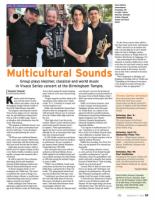

David Glukh's
International
Ensemble, left
to right: Yaacov
Mayman, Gennady
Gutkin, Deborah
Karpel and David
Glukh.
ilture. Sounds
Group plays klezmer, classical and world music
in Vivace Series concert at the Birmingham Temple.
I
Suzanne Chessler
Contributing Writer
K
lezmer travels the diaspora,
joins with the music of other
cultures and makes a stop at the
Birmingham Temple with the sounds of
the David Glukh Klezmer Ensemble.
The program, launching this season's
Vivace Series, begins at 8 p.m. Saturday,
Sept. 28, and will feature classical selec-
tions as well as Yiddish songs. There is
an afterglow with refreshments when the
music stops playing.
"The program is definitely diverse says
Glukh, 38, in a phone conversation from
his New York home. "It was developed
with the people planning the concert
series.
"We'll have some traditional klezmer
music, opera arias and jazz-related mate-
rial in conjunction with the Jewish music.
We'll even recall 'Bei Mir Bist Du Shein."'
Glukh plays piccolo trumpet, which is
half the size of a regular trumpet and has
a very distinct timbre, sometimes sound-
ing like a trumpet and sometimes like a
woodwind.
He will be joined by Yaacov Mayman
alternating clarinet and saxophone,
Gennady Gutkin playing accordion and
Deborah Karpel performing the vocals.
"A diverse program always is very
exciting for me," Glukh says. "My career
is marked by the variety of things I do,
whether classics, klezmer or world music.
I think absorbing many musical cultures
makes a musician even better:'
Glukh, making his first Detroit-area
appearance, appeared about eight years
ago at the Wharton Center for Performing
Arts in East Lansing. He started studying
music when he was 6 years old and living
in Russia.
"I began using the recorder, which is the
way Russian music studies start," Glukh
recalls. "At 11, I switched to trumpet with
several trumpets to use:'
Glukh, who attended the Gnesin Music
School in Moscow, immigrated to Israel
with his family when he was 15 and stud-
ied at the Thelma Yellin High School for
the Arts.
"After high school, I got the piccolo
trumpet, which is a more advanced instru-
ment mostly used for baroque music,"
he explains. "With experimentation, I
figured out that it can be used for klezmer
although it's not an instrument that's regu-
larly seen in klezmer bands:'
In 1995, Glukh received an award from
the Israeli Musicians Union for excellence
in performance. He was a recipient of
the America-Israel Cultural Foundation
Scholarship from 1990-2000.
After serving for three years with the
orchestra in the Israel Defense Forces,
Glukh applied to the Juilliard School and
was accepted, moving to the United States
in 1996 and earning his bachelor's degree
in music in 2000.
"While I was at Juilliard, I made some
connections and learned of an opening in
Dallas Brass, a group based in Texas," he
recalls. "The group played classical and
jazz and traveled about 100 days a year.
"I auditioned, was chosen and went on
the road with Dallas Brass for the next
three years. We played in more than 40
states. I told them about klezmer music
and arranged a klezmer tune.
"That's how my ideas of a klezmer band
were formed. I saw how the Jewish and
non-Jewish audiences reacted positively to
the music. Even in North Dakota, where I
didn't meet many Jewish people, they liked
klezmer."
Glukh, in his diverse interests, came
to lead a trumpet and string quartet,
Manhattan Soloists, and a brass quin-
tet, Wholly Brass. As a soloist, he has
appeared with the Louisville Orchestra,
Northeastern Pennsylvania Philharmonic,
Jupiter Symphony, Lyric Theater
Orchestra, Raanana Symphoniette,
Ulianovsk Symphony Orchestra and
Ensemble Melodia.
"I'm a big fan of traditional music," he
says. "Sometimes, it is not well-known
but is at the root of almost all good music.
I also collaborate in chamber music set-
tings with a lot of great musicians, such as
organist Anthony Newman:'
Glukh's first recording, Live! From New
York, was not planned to be released pro-
fessionally.
"We were playing a klezmer concert
as a trio, and one of our friends brought
a portable recording device," says the
entertainer, whose two grandfathers with
perfect pitch had to abandon their talents
because of World War II. "That recording
turned out to be pretty good:'
"Around 2006, we had two more mem-
bers in our group, and I had begun com-
posing for our performances. We got the
idea of klezmer traveling the world and
joining it with the music of other people.
"I wrote the tune `Klezmorim in Orient,
which is a mix of Chinese sounds with
klezmer. We also began doing Latin beats
with klezmer tunes. That all led to our sec-
ond album, Klezmer Travels the World'
For the Vivace concert, there will be a
tune that mixes Greek music with klezmer.
Glukh, married to an accountant and
with a second child due to arrive shortly
before his visit to Michigan, teaches
Hebrew and history at Temple Beth El of
Northern Westchester in Chappaqua, N.Y.
Also performing for lots of Jewish cel-
ebrations in America, Glukh tries to avoid
work when he visits Israel, where he wants
to devote time to his parents and brother
as they remain in the country. Any free
time in New York is devoted to his imme-
diate family.
"We're stopping by in Michigan and
bringing our heritage with us," Glukh says.
"Depending on the texture of each piece,
I can change the sounds of the piccolo
trumpet so they are appropriate:'
❑
Vivace Series Schedule
Four concerts have been scheduled
for the 2013-2014 Vivace season.
Season tickets are $80 per person/$70
seniors. In addition to the David Glukh
International Ensemble, performances
include:
Saturday, Nov. 9:
Yoonshin Song
The concertmaster of the Detroit
Symphony Orchestra will present works
by Brahms and Bartok, accompanied by
pianist Zhihua Tang.
Saturday, April 12:
Manhattan Piano Trio
The trio — Milana Strezeva (piano),
Wayne Lee (violin) and Dmitry Kouzov
(cello) — will perform selections by
Mozart, Tchaikovsky, Schumann and
Babadjanian.
Saturday, May 10:
Paul Vondiziano
The guitarist from Cyprus will play solo
compositions of classical and ethnic
music. He will be joined by his wife,
singer Kathleen MacKenna, for a group
of songs.
- Suzanne Chessler
David Glukh's Klezmer Ensemble
performs at 8 p.m. Saturday, Sept.
28, at the Birmingham Temple, 28611
W.12 Mile Road, in Farmington Hills.
$12-$23. (248) 788-9338; (248)
661-1348. vivaceseries.org .
September 5 • 2013
59