
5773 from page 98
7.7
I
of acts of sex abuse. When Y.U.'s chancel-
lor, Rabbi Norman Lamm, announced
he was stepping down, he apologized for
mishandling the allegations when he was
university president.
The Satmar Chasidic community in
New York became embroiled in its own
sex scandal when it lined up to support an
unlicensed therapist from Brooklyn charged
with the repeated sexual assault of a female
teenager in his care.
Even after Nechemya Weberman was
found guilty and sentenced to 103 years in
prison, the community's support did not
waver. Rather, Satmar leaders inveighed
against the victim and her supporters. A
few days after the trial, a Chasidic assailant
threw bleach in the face of a community
rabbi, Nuchem Rosenberg, who advocates
for victims of sex abuse.
But to extrapolate a storyline or trend
from these disparate events could be folly.
For one thing, the Orthodox sex scan-
dals might be more about the dawning of
a new age of reckoning on sex abuse than
the prevalence of sexual misdeeds among
Orthodox Jews.
And for all the triumphs that Jewish
liberals saw this year, demographic trends
suggest that the Jewish communities in the
United States and Israel are growing less
liberal.
Data released in January from the 2011
Jewish population study of New York
showed that two-thirds of the metropolitan
region's Jewish population growth over
the last decade occurred in two haredi
neighborhoods in Brooklyn. While there
hasn't been a national Jewish population
study in more than a decade, the data from
America's largest Jewish community suggest
that Orthodox Jews, with their high birth-
100 August 29 • 2013
JN
rates, will represent an ever-larger propor-
tion of the American Jewish community.
"The traditional population of American
Jews has high fertility and the non-Ortho-
dox population as a group is well below
replacement level," New York University
sociologist Steven M. Cohen, one of the
researchers who conducted the study, told
JTA. "So American Jewry, with no other
change, will become increasingly traditional
in the years to come."
While fertility rates among non-
Orthodox Israelis are not as low as those
of American Jews, they lag far behind
those of Orthodox Israelis. The relative
size of Israel's haredi community as a share
of Israel's total population is expected to
double by 2020, to 16 percent.
In Israel, the culture wars between haredi
and non-haredi have focused on the haredi
draft exemption and the Orthodox Chief
Rabbinate's monopoly over marriage.
The haredi establishment has mostly suc-
ceeded in protecting the status quo on both
those counts, notwithstanding changes in
the draft law. And when the 150 or so elec-
tors charged with choosing new Ashkenazi
and Sephardic chief rabbis went to the polls
in July, they rejected the reformist favorite
David Stay and instead elected two hare-
dim, David Lau and Yitzhak Yosef, the sons
of former chief rabbis.
In the American Jewish community, the
battle has not been between denominations
but over Jewish values.
Is it a Jewish value to support the right
of gays to marry or does the practice
contravene Jewish ethics? Should Jews be
advocating for greater government fund-
ing for private religious schools or fighting
the use of taxpayer money in non-public
schools? Should Jews press Washington to
w.
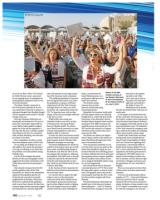
Women of the Wall
make a concerted push for
sides back to the negotiat-
members praying at
ing table in July. There
Israeli-Palestinian peace or is
the Western Wall plaza
was a mini-war in Gaza in
such pressure right now not in
to mark the beginning
Israel's best interests?
November 2012 that lasted
of the Hebrew month of
The divisions among
eight days and resulted in
Ay, July 8, 2013.
American Jews on these
the deaths of some 150
issues do not fall neatly along
Palestinians and six Israelis,
denominational lines.
but after that Israel's border with Gaza was
Meanwhile, the American Jewish politi-
mostly quiet.
cal divide appears slowly to be widening.
It was tragedy in the United States that
Though Jews as a whole still skew heavily
left the community with lasting scars. Late
Democratic, in last November's election
last October, a massive storm surge generat-
President Obama dropped at least 6 points
ed by Hurricane Sandy battered communi-
among Jews from 2008, winning an esti-
ties, synagogues and Jewish schools up and
mated 68 percent of the Jewish vote. The
down the Northeast coast. UJA-Federation
2012 election also ushered in a Congress
of New York convened an emergency meet-
ing to authorize $10 million for rebuilding
with fewer Jewish members than at any
time since the 1990s.
efforts, many of which continue today.
The divides over politics and religion
Outside of the United States and Israel,
stood in sharp contrast to the relative con-
the big Jewish stories included the ban-
sensus that held up through much of the
ning of Jewish ritual slaughter in Poland
year on international issues.
and a new German law regulating ritual
There was practical unanimity on con-
circumcision; a controversial exhibit at
cern that Syria's civil war not spill over the
Berlin's Jewish museum dubbed "Jew in a
border, that instability in Egypt not turn
Box:' a much-criticized deal between the
the Sinai Peninsula into a breeding ground
Argentinean and Iranian governments to
for Islamic militants, that Iran be prevented
investigate the 1994 AMIA Jewish com-
from acquiring nuclear weapons capability,
munity center bombing; sex abuse scan-
that the European Union enforce its deci-
dals in Australia; concerns about far-right
sion to designate Hezbollah's military wing
movements in Hungary and Greece; and
as a terrorist organization.
the appointment of a new chief rabbi in
England.
But external threats did not dominate
communal discourse in 5773. There wasn't
There was some good news here: None
the same public urgency on Iran as in past
of these stories were about major Jewish
years. The Egyptian coup in July was less
calamities.
concerning for Israel than the 2011 revolu-
To be sure, the Jewish people suffered
tion that overthrew longtime ally Hosni
tragedies in 5773 — from natural disasters,
Mubarak.
from Gaza rocket fire. But for a people
The Israeli-Palestinian relationship was
obsessed with survival and accustomed to
marked more by the absence of progress
attacks, the absence of mass casualty events
than anything else — until U.S. Secretary
in 5773 made it a remarkable year as much
of State John Kerry managed to coax both
for what did not happen as for what did.
❑
Scanned image of the page. Keyboard directions: use + to zoom in, - to zoom out, arrow keys to pan inside the viewer.
August 29, 2013 - Image 100
- Resource type:
- Text
- Publication:
- The Detroit Jewish News, 2013-08-29
Disclaimer: Computer generated plain text may have errors. Read more about this.