

arts & entertainment
Fill The Void
Israel's official Oscar submission
comes to the Maple Theater.
George Robinson
Special to the Jewish News
W
hen it played last fall's New York
Film Festival, Rama Burshtein's
debut feature, Fill the Void, was
one of the great surprises of the autumn, a
stunningly poised and mature first film that
heralded the first major talent to emerge
from the haredi film community in Israel.
Now that the film is opening theatrically, it
looks — if anything — even better.
Burshtein herself is the product of the
haredi world of Tel Aviv that this film intel-
ligently and warmly depicts. It's the kind of
community in which a panicky old woman
can ask her rebbe for advice on what kind
of stove she should buy (and she gets a deli-
ciously funny explanation from him, worthy
of any discount appliance store commercial),
but the rebbe will not exert pressure on a
young woman in the matter of whom she
should marry.
The plot of Fill the Void is downright
biblical. When her sister dies in childbirth,
18-year-old Shira (Hadas Yaron) consid-
ers the possibility of putting aside her own
dreams of marriage to an eligible bachelor
in order to marry her brother-in-law Yochay
(Yiftach Klein).
The internal dynamics of family and
friends are complicated. Her mother Rivka
(bit Seleg) is fearful that Yochay will marry
a Belgian woman and disappear with her
grandson, her only living tie to her late
daughter. Aunt Hanna (Razia Israely, in a
performance that combines dignity with
deeply hidden malice) is concerned that her
matchmaking efforts will have been fruitless.
Shira seems to be balancing her concern for
Yochay and the child against her attachment
to the unmarried Frieda (Hila Feldman).
Everyone has secrets, many of which
Burshtein reveals slowly in a cunningly
orchestrated series of communal events.
Others are only implied, which makes their
potential power to shape the future all the
more unnerving.
Burshtein's script is clever, moody and
thoughtful, but her direction is even more
than that. The film is a complex choreogra-
phy of framing that reveals the inner states
of the characters more fully than they can
possibly know. Each of the pivotal scenes
between Shira and Yochay is a carefully
orchestrated blend of visual elements that
Superhero Scribe
Ann Arbor native pens new Superman
film and a TV series with a fictionalized
Leonardo Da Vinci.
Curt Schleier
Special to the Jewish News
D
avid S. Goyer readily admits that
growing up, he was a comic-book
nerd. That worked out well for him
in a couple of ways. First off, "I'm fortunate
that my mother never threw mine away,' he
says. As an adult, he sold his collection for
$10,000. More important, the comics pro-
vided sufficient expertise to make him the
go-to guy for superhero movies.
It started with the Blade films. He wrote
all three and directed the last. The Ann
Arbor native went on to write the story
and/or the screenplay for the three suc-
cessful Christopher Nolan Batman films
("I do have an affinity for darkness, but I
think I was a darker person before I had a
family. I've got young kids now, and that
definitely changes you.).
And now, there is his script for the
upcoming Man of Steel, opening June 14.
There is a veil of semi-secrecy around the
52
June 13 • 2013
JN
film, a reboot of the Superman story. In it,
a young Clark Kent recognizes he's differ-
ent from others and sets out on a journey
to find himself.
"I grew up in a home with a single
mom in Michigan in a working-class
neighborhood," says Goyer. "I attended
temple. But I was conscious that I was
somewhat of an outsider. I grew up as a
Cub Scout and Boy Scout not having my
dad participate. So I can identify with
Clark Kent being an outsider."
Goyer is less reticent about his new
TV project, eight episodes of Da Vinci's
Demons, which premiered in April on
the Starz Network and is currently avail-
able for viewing On Demand. The series,
filmed in Wales, has been renewed for a
second season.
Goyer envisions Leonardo as a young
crime-fighting, opium-smoking, hedo-
nistic genius searching for the Book of
Leaves, which contains mankind's forgot-
ten knowledge. The concept originated
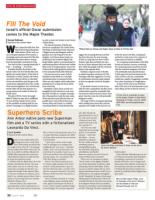
Yiftach Klein as Yochay and Hadas Yaron as Shira in Fill the Void
suggest the increasing attraction and fear
that drives the pair; the most stunning
of these is a long-take two-shot in which
Yochay's white shirt and black vest echo
the line of Shira's elaborate black-and-white
dress while they grapple with the emotional
distance that separates them.
Burshtein composes much of the film
in similar long takes, reminiscent of Otto
Preminger with their suggestion of a series
of confrontations between people trapped
in their own agendas, driven by divergent
needs.
As she slowly connects a series of care-
fully off-center compositions, the film moves
unobtrusively toward the remarkable final
movement in which everyone seems to have
gotten what they want, but with profoundly
ambiguous results.
The image of Shim, wearing her glistening
white wedding dress almost like a shroud,
squarely in the middle of the frame for one
of the few times in the film, rocking back
and forth in what seems to be a mixture of
prayer and near-hysteria, is indelible.
It is a stunning consummation of the film's
formal and thematic concerns, combining
the visual progression toward this moment
with the emotional ambiguity at the heart
of its profoundly nuanced performances.
In that respect she has been blessed in her
choice of Yaron, who has a remarkably
mobile face, capable of suggesting a veritable
fever-chart of emotions in a single glance.
In short, Fill the Void is one of the best
films of the year so far and represents a pow-
erful calling card for its director and star.
❑
Fill the Void is scheduled to open
at the Maple Theater in Bloomfield
Township on Friday, June 14. (248)
855-9091; www.themapletheater.
corn.
after BBC Worldwide
approached him to see if
he could come up with
a historical series that
would work both in the
U.K. and the U.S.
"Da Vinci was a poly-
math and a bit of a strange
person. If you read his
journals — and I read
all of them — he was
definitely an odd duck.
He was socially awkward,
something common
Actor Tom Riley and David S. Goyer on the set of
among brilliant people.
Da Vinci's Demons
For polymaths, drug abuse,
schizophrenia and alcohol
frontal nudity.)
abuse are common, [so my Da Vinci] is
Goyer adds that "although I grew up in a
clearly not that much of a stretch."
very liberal environment, [anti-Semitism]
That's not to say Leonardo is realistic:
is something I experienced. In the first
"Was he really a crime fighter? Probably
episode of the show, a Jew is hanged, and
not. On the other hand, he did have a bad
I guess [part of the subtext] on the show is
relationship with his birth father. And he
how minorities and slaves are dealt with.
was put on trial for sodomy. He was some-
I do think that given that Leonardo was a
thing of a flamboyant dresser. Did he try to
bastard, he would have had a slightly more
sell himself as a war engineer throughout
open mind."
his life? Absolutely. He made a lot of money
selling weapons of destruction, which a lot
Man of Steel opens Friday, June
of people don't know. He made more money
14. Episodes of Da Vinci's Demons
as an engineer than he did as an architect.
can be viewed on Starz on
You have to remember, I wasn't making this
Demand through July 13.
for PBS." (Warning: The show contains full-
❑