

arts & entertainment
Honor
:Albanian
Muslims keep
Holocaust-
ra 'promise'
in terrific ,
documentary.
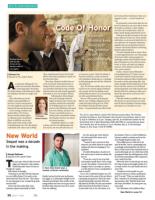
Rexhep Hoxha
and his son
Ermal at the
Western Wall in
Jerusalem
Glass, simultaneously honors the broader
efforts of the entire population to protect its
Jews from the Nazis.
These days, Albania is looked down on
n important challenge for 21st-
as the most broke, backward province in
century documentary filmmakers
Europe, but the country deserves a better
is connecting what is becoming
rep. Just before Mussolini's troops invaded
the distant history of the Holocaust to today
and drove him into exile, King Zog granted
and making it relevant for younger audi-
citizenship to every Jew living in Albania.
ences.
Following their beloved king's
More often than not, it's the
lead, and in keeping with their
children and grandchildren of
highly developed code of honor, the
survivors, rescuers and perpetra-
populace assumed the responsibil-
tors who supply the necessary link
ity of sheltering its Jews. Some 70
between the past and the present.
percent of the Albanians who saved
In her riveting, revelatory and
Jews were Muslim, and Besa: The
profound Besa: The Promise,
Promise is intended in part as a
director Rachel Goslins depicts
rebuke of the conventional wisdom
Filmma ker
an Albanian man's extraordinary
Rachel Goslins that Muslims and Jews are natural
efforts to fulfill the vow his late
and eternal enemies.
father made to the Jewish couple
Admittedly, Albania is a small
he hid during the war. This marvelously
country, and we're not talking large num-
crafted film, with a fine score by Philip
bers of Jews, but every life and every act
Michael Fox
Special to the Jewish News
A
New World
Sequel was a decade
in the making.
George Robinson
Special to the Jewish News
T
en years ago, when his film Yossi and
Jagger was released to wide acclaim,
Israeli filmmaker Eytan Fox had no
thought of a sequel.
Well, almost no thought.
"It dawned on me that I left this character
in a very difficult place," Fox said in a tele-
phone interview from Tel Aviv. "This charac-
ter was important to me. I wanted to go back
and save him:'
At the end of the earlier film, Yossi
Gutmann, played memorably by Ohad
In Yossi, Ohad Knoller plays a
closeted, conflicted cardiologist.
Knoller, had just lost his lover and lieuten-
ant, Jagger, in a catastrophic firelight on the
Lebanon-Israel border. Since neither of the
young soldiers had come out as gay, none of
the film's other characters knew how much
Yossi was suffering.
of conscience counts. That's the attitude of
Norman Gershman, a tireless American
who embarked a decade ago on a campaign
to find, photograph and extol the Albanians
who aided Jews.
Besa: The Promise artfully weaves the his-
torical overview and the aging Gershman's
solo crusade with the fascinating, nearly
unbelievable persistence of an unassuming
toy seller named Rexhep Hoxha.
Born in 1950, he grew up hearing his
father's story of hiding a Bulgarian Jewish
couple and infant during the war. When
the Abadjens fled, they left three prayer
books —treasured family items that would
have betrayed their Jewishness if they were
stopped en route — in their benefactor's
care.
He promised to return them after the war,
but to his dismay he was never able to locate
the family nor did they or their children
ever show up to reclaim them. After his
father's death, Rexhep inherited the "besa."
What gives the film its tension is the mys-
terious behavior of the Jews, whose inexpli-
cable failure to seek out and thank their res-
cuers after the war (of greater importance,
arguably, than recovering their property),
contrasts with Rexhep Hoxha's unwavering,
Internet-aided persistence.
The trail eventually leads to Israel, where
we watch apprehensively to see if the people
of the book will be embarrassingly and
insultingly cavalier about Rexhep's remark-
able commitment to return their precious
books, or if they will match the singular
character of the Albanian (and his son)
we've come to admire.
Goslins, a lawyer-turned-filmmaker
who graduated from UC Santa Cruz and
is married to Federal Communications
Commission chairman Julius Genachowski,
has made a terrific, galvanizing film. One
wishes, though, that she hadn't gone all Ken
Burns with slow zooms in on Gershman's
mesmerizing black-and-white portraits and
had the faith in her audience to allow us to
absorb the quiet power and beauty of his
compositions.
That's the smallest of quibbles for a rare
film that lets us spend an hour and a half
awed by the best qualities of human beings
and inspires us to manifest our own.
❑
The JCC's Lenore Marwil Jewish Film Festival screens Besa: The Promise,
preceded by Belarus, local filmmaker Alex Gorosh's documentary about a fam-
ily trip of a lifetime, at 3 p.m. Tuesday, April 16, at the Berman Center for the
Performing Arts in West Bloomfield; (248) 661-1900 or www.jccdet.org . Besa:
The Promise also will be shown at 2 p.m. Monday, May 6, at the Michigan
Theater in Ann Arbor; (734) 971-0990.
Fox, the openly gay writer-director
who had created him, knew, and it
nagged at him.
"I wanted to start a process for him
where he can realize where he is and start
dealing with that and changing it; Fox
explained.
It took the filmmaker a decade to do
that, and he says it wasn't an entirely self-
less act.
"It was also a way for me to go back
and examine myself when I was a young-
er man; Fox admits, "to look at how I've
changed, where I am today as a person,
as a film director. It was a manipulation I
used on myself'
If so, it was a relatively harmless one. The
Yossi we meet at the outset of the new film is
a promising young doctor, still in the closet
and still emotionally repressed. (He's also
still played by Knoller, the only cast member
still around from the first film.) If Yossi is
10 years older and, at 34, a bit calmer, so is
his situation. There is a world of difference
between combat in wartime and even the
most fraught hospital cardiac unit.
Those differences are reflected in the
style of the film. Yossi is a surprisingly and
rewardingly understated film, the kind of
film in which much of the emotional stress is
conveyed through our view of the back of the
protagonist's head, the stolid glumness of his
face and the extraordinary effort required to
coax a smile from him.
Where the Yossi of a decade ago was stoic,
the Yossi of today is downright somber. It is
no small credit to Fox and Knoller that he is
never dull.
"I wanted to revisit myself, on a per-
sonal level and on an artistic, professional
lever Fox said. "When we made the first
film, I wanted to do something rough and
documentary-style. This film looks more
self-aware, formalistic. It's more grown-up,
more adult.
As a filmmaker, I have different films
New World on page
50
April 11 • 2013
53