

points of view
>> Send letters to: letters®thejewishnews.com
Editorial
Obama's Optimism Must Be Tempered
p
resident Obama certainly laid
the groundwork for renewed
Israeli-Palestinian peace talks.
During his March visit to the Middle
East, he gave both sides cause for
hope, urging a clean slate to re-engage
in conversation and negotiation.
He insisted that
the Palestinians, rep-
resented by Hamas
in the Gaza Strip and
Fatah in the West
Bank, must renounce
violence, accept
Israel as the Jewish
President
state and acknowl-
Obama
edge Israel's right to
defend itself. And he
called on Israel to see the "peace part-
ner" it has, at least in the Palestinian
Authority (P.A.), which governs the
West Bank.
He affirmed age-old Jewish religious
and historical ties with Eretz Yisrael,
the Land of Israel, which includes
present-day Israel and the West Bank.
But he challenged Israel's democrati-
cally elected Netanyahu government
to re-imagine giving the Palestinians,
with dubious leadership in the West
Bank and terrorists manhandling Gaza,
a sovereign homeland free of military
occupation.
Obama reiterated that America was
Israel's strongest ally and best friend.
And he urged Israelis to see the world
through the eyes of Palestinians,
including restricted student move-
ment, limited access to farmlands and
displacement of families (ignoring that
such actions are security precautions).
"Peace is possible," Obama said. "I
know it doesn't seem that way. There
will always be a reason to avoid risk
and there's a cost for failure. There will
always be extremists who provide an
excuse not to act. And there is some-
thing exhausting about endless talks
about talks, the daily controversies
and grinding status quo."
But, he added, while negotiations
are central to getting there, "there is
little secret about where they must
lead: two states for two peoples."
How true.
In reality, lack of a peace process
stems not so much from increased
Israeli settlement activity, occasional
settler violence or Israel's military
presence in the West Bank (allowed by
the Oslo Accords), problematic as all
of this is, but from a Palestinian mind-
set that continues to incite hatred and
terror against Israel via RA.-controlled
news media, mosques, schools and
youth camps. The same mindset oblit-
erates existence of the Jewish state
on official P.A. maps and demands full
right of return for Palestinian refugees
and their descendants.
And why hasn't the P.A., if it's the
peace partner Obama believes it to
be, dismantled Fatah's known terrorist
wing, the Al Aksa Martyrs Brigades?
This overarching mindset has led to
the P.A. refusing to negotiate for much
of the past four years and also reject-
ing generous offers of statehood from
Israeli prime ministers Ehud Barak
(2000) and Ehud Olmert (2008). We
know by the infrastructure it has built
and the security it has installed that
the P.A. has the ability to lead – when
it wants to.
Final-status issues such as borders,
security, settlements, water rights,
the fate of Jerusalem and the right
of return will take a backseat as long
as P.A. President Mahmoud Abbas
envisions Hamas as a player in a
Palestinian state; Hamas' charter calls
for Israel's destruction. Israel's 2006
withdrawal from Gaza has been met
by almost unabated rocket attacks
on Negev towns. And Israel's security
barrier was the top reason West Bank
suicide attacks diminished.
Until Arab nations normalize rela-
tions with Israel, the unbreakable
bonds between America and Israel
won't be enough to allow the Jewish
people, despite remarkable and var-
ied achievement in many parts of the
diaspora, to realize what Obama called
"full expression in the Zionist idea – to
be a free people in your homeland."
The president stood tall in reminding
Israel's anti-Zionist neighbors, Arab
or otherwise including nuclear bomb-
minded Iran, that America stands
staunchly with the Jewish state.
In theory, a two-state solution to
the Israeli-Palestinian conflict is the
ideal answer to a stifling standoff
dating back to Israeli statehood in
1948. In practice, a Fatah/Hamas-
led Palestinian state, as the Zionist
Organization of America warns, would
be a racist, terrorist state – the last
thing we need in the Middle East. ❑
Guest Column
To Serve Or Not To Serve
I
srael faces many challenges — the
Israeli-Palestinian conflict, Iran's
nuclear program, the rise of Radical
Islam in Egypt, Turkey and Syria, and the
high cost of living in the country.
After the latest elections, one topic
dominates the Israeli political agenda:
the conflict over the coun-
try's military draft. The rise
of a new Israeli political
party, Yesh Atid (there is a
future), and its partnership
with the modern Orthodox
party, HaBayit Heyehudi (the
Jewish Home), have promised
to draft thousands of ultra-
Orthodox students who are
currently exempt from mili-
tary service because they learn
Torah in yeshivah (religious
school). The public debate has set the
stage for an even bigger division between
secular and ultra-Orthodox Israelis.
A couple of weeks ago, my family and I
traveled to Jerusalem to attend my sister's
wedding. My stay overlapped the national
elections, and I had the opportunity to
meet up with friends after the votes came
in. The first, Avi, served four years in the
IDF as a paratrooper and officer. Daniel,
34
April 4 • 2013
who now learns in kollel (Torah learning
center), did not serve in the army. I myself
served for three years in a combat unit.
After meeting, our conversation shifted
quickly to politics.
"Everybody has to serve in the army:'
Avi said. "This is Israel. We live in a very
difficult situation, and everybody
needs to do his part to defend the
state
"We are doing our part:' Daniel
retorted. "Learning Torah is the
reason why the Jewish people
have not disappeared over the
centuries. The Roman, Babylonian
and Persian empires all had
powerful armies and yet they all
disappeared. Countless nations
have tried to destroy us, but we
survived. How? Because of our
faith and because we learned Torah for
thousands of years:'
He continued, "We have an outstanding
army; but without God's help, the Arabs
could easily occupy Israel. By all logical
reasoning, the Arabs could have annihi-
lated us in 1948, in 1967, in 1973 and they
could do it today:'
Avi replied, "You know as well as I do
that there are young men who use the
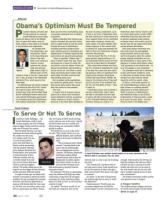
A haredi Orthodox man watches Israeli soldiers at an army ceremony at the
Western Wall in Jerusalem, Feb. 22, 2012.
yeshivah only as a way to get out of joining
the army:'
"Yes:' Daniel said, "and those who do
not truly want to learn Torah should serve,
but for the majority of others who genu-
inely want to learn? They deserve the right
to continue:'
Avi noted, "In the time of King David,
the Jewish people had an army, so what's
the difference?"
Daniel answered, "David's army was
run under religious law and held the
Jewish religion to be the cornerstone of its
strength. Unfortunately, the IDF has not
kept this tradition. But what you didn't
mention was the 21 percent of secular
Israelis who don't serve in the army or
the Arab Israelis who are not even will-
ing to consider national service in their
own communities:'
The heated conversation ended, and the
only agreement was to disagree.
A Deeper Conflict
The conflict between religious and secu-
lar Israelis did not begin with the debate
Serve on page 35