

points of view
>> Send letters to: letters@thejewishnews.com
Publisher's Notebook
Editorial
Golan: Off Limits
To Negotiations
I
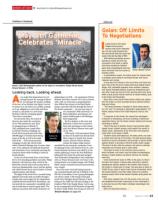
Nearly 1,300 Michanganders gather on the steps to Jerusalem's Temple Mount during
Miracle Mission I in 1993.
Looking back. Looking ahead.
A
s we make final preparations for wel-
coming Passover the evening of March
25, we anticipate the timeless retelling
of the story of our Exodus from Egypt. It serves
to anchor us in our history as a people, reminds
us of our obligations to each other and those
around us, and points to a more hope-
ful future with the concluding appeal
"Next Year in Jerusalem:"
For the Jewish News, the arrival of
Passover also marks the conclusion
of our 70th anniversary year. Since
its inaugural issue on March 27,
1942, published from a small office
in Detroit's Penobscot Building, the
Jewish News has generated more than
260,000 pages of content about the big
issues of the day as well as the small
stuff of life ... birth announcements,
synagogue socials, day school model
seders, Mumford Musings and, of course, obitu-
aries. It has captured and analyzed the growth
and maturation of our community pursuing the
American dream while wrestling to retain its
Jewish identity.
At the core of the Jewish News is the Zionist
fervor of its founding publisher and editor, Philip
Slomovitz. His advocacy, deep-rooted in the
belief that a Jewish state in the ancient land of
Israel was fundamentally correct and fair, guided
and rallied Detroit Jewry and its leaders to Israel's
ongoing support and defense.
The pages of the Jewish News, currently being
digitized and made easily accessible through a
Google-style search engine by the independent,
nonprofit Detroit Jewish News Foundation, cap-
ture and tell our community's remarkable story
and its dedication to Israel in great detail. The
euphoria associated with Israel's declaration of
independence in 1948 ... the excitement of Prime
Minister David Ben-Gurion's 1951 visit to Detroit,
with a 200-car motorcade accompanying him
from Willow Run Airport to the Hotel Statler,
along a route that took him through the heart of
the Jewish community ... the size and scope of
our community's 60th anniversary of
Israel celebration, attracting an esti-
mated 16,000 people to the Michigan
State Fairgrounds.
But few chapters in this story and
dedication to Israel were as grand in
their scale and impact as the commu-
nity's first Miracle Mission from April
18-28,1993.
With nearly 1,300 participants flying
on three El Al jumbo jets directly from
Metro Airport to Israel's Ben-Gurion
Airport, Detroit's Miracle Mission
remains the largest single mission
assembled by any American community. From
the planting of trees with Shimon Peres in a new
Jewish National Fund forest near Modi'in to the
somber gathering at Latrun for Yom HaZikaron
(Memorial Day); from the joyful and energetic
Yom HaAtzmaut (Independence Day) celebration
with our Project Renewal sister city Yavne to the
closing dinner in an airplane hangar with Yitzhak
Rabin, unique communal and personal memories
were created.
One of the most vivid and lasting memories
was created during the lead-up to Shabbat in the
Old City of Jerusalem. It was a group photograph
(see above), nearly 1,300 strong in their gray
Jewish News Michigan Miracle Mission T-shirts
sitting on the 2,000-year-old stairs leading to the
Southern Wall of the Temple Mount. Led in song
by the incomparable David Hermelin and greeted
by Mayor Teddy Kollek, this throng was truly one
Miracle Mission on page 44
sraelis living in the Golan
Heights have become
anxious that Syria's intensify-
ing civil war could encroach into
the once-Syrian land that Israel cap-
tured in the Six-Day War of 1967.
With fighting escalating around
Damascus, Israeli security has
increased in the Golan, a tightly
knit haven marked by national
parks and archaeological sites two
Syria's Bashar Assad
hours removed from the country's
bustling center.
A mountainous region, the Golan gives the Jewish state
a strategic asset along its northeast border with Syria,
Lebanon and Jordan.
A long way from Hamas in the Gaza Strip, the Golan has
been free of the terrorist rockets that have pelted Israel's
Negev. Still, Hezbollah operates from southern Lebanon.
And Syrian President Bashar Assad has threatened repri-
sals after Israel was forced to fire warning shots into Syria
when a stray Syrian mortar shell hit an Israeli military post
in the Golan last November.
Since then, more Syrian-fired mortar shells have spilled
into the Golan; so have wounded Syrians seeking medical
help and refuge.
"The chaos presents a situation in Syria where there's
no rule" and "no national or diplomatic responsibility," Ori
Kalner, deputy head of the Golan Regional Council, told
JTA.
In response to the threat, the council has developed
a network of emergency services, including a reinforced
separation fence, but the Golan remains vibrant and secure,
according to Kalner.
There's the fear of another Gaza in Syria should rebels
topple Assad. Islamist groups could exploit the unrest to
target Israel, reminiscent of the terrorists who attacked
Israel after it left Gaza in 2005.
Southern Syria and Damascus, 40 miles north, are clear-
ly visible from the top of the Golan. The high ground allows
tracking of Syrian movements and provides a natural buffer
against attack. It provides a third of Israel's water supply.
The land is fertile, with the volcanic soil used to cultivate
vineyards and orchards and to raise cattle.
The Golan is home to the Hermon nature reserve,
which includes a ski resort, and the Golan Archaeological
Museum. Israeli soldiers use Mount Hermon for training
exercises.
Israel annexed the Golan in 1981. In the past, its return
has been the subject of peace talks with Syria, notwith-
standing the obvious desire of the 14,000 Jews living in
the Golan to remain part of Israel. The area also is home to
17,000 Druze, most of whom claim Syrian citizenship. Given
the Assad regime's uncertain state, there's no scenario
brewing under which Israel should consider giving back the
Golan.
One Golan resident told JTA the Syrian crisis not only
has awakened the Golan community to how vulnerable it
is, but also has put the Golan's strategic advantages into
sharp focus.
Both are important lessons.
❑
March 21 • 2013
43