

metro >> 70th Anniversar
Remembering
The Retailers
7
STOY op
4
13
". .A
—.
mt:
7;0,
3
E
n
Jewish Detroiters certainly left their mark
on regional shoppers.
Bill Carroll
Contributing Writer
D
etroit was a whole different city
back then',' recalled Margaret
"Peggy" Winkelman, "and I was
always proud to be associated with the
Winkelman stores and be part of the
Winkelman family."
The name Winkelman seems to stand
out more than any other when people talk
nostalgically about the Jewish retailers and
store owners 70-75 years ago — Jacobson's,
Himelhoch's, B. Siegel, Kay Baum and others.
Besides these retail specialty stores, there
were Jewish-owned larger retailers such
as the Israel Davidson family's Federal
Department Store, Henry Wineman's
People's Outfitting Co., Sam Osnos' Sam's
Cut Rate and more.
And all of them had to battle the giant
J.L. Hudson Co., which tried to monopo-
lize the business and lock out Jews in
overt and covert ways, according to the
book Harmony & Dissonance; Voices of
Jewish Identity in Detroit, 1914-1967 by
Sidney Bolkosky of Oak Park. He's a retired
University of Michigan-Dearborn professor
known for his work with Holocaust survi-
vors.
Jews Need Not Apply
"In the 1920s and 1930s, Hudson's want
ads for clerks frequently made it clear
that Jewish girls need not apply," writes
Bolkosky.
Survivors of the retailer families are
scarce and some memories are fuzzy, but
Peggy Winkelman, now in her 80s and
living in Bloomfield Hills, painted a glam-
orous word picture of life in the Detroit
stores and travels around the world in the
mid-1960s.
Her husband, Stanley, was president and
CEO then of the multi-store chain founded
by his father, Isidor, and uncle, Leon, in
1928; the first Detroit store was at Fort and
Junction streets.
"We offered ladies ready-to-wear clothes,
and they flocked to our Downtown store,"
66
dune 14 . 2012
Peggy recalled. "My husband and I had a
wonderful time traveling to Paris, Italy and
other parts of the world to see and buy
the latest fashions for the stores. We were
friendly competitors with other Jewish store
owners. It was a great era in Detroit:'
The last Winkelman store closed in 1988,
and Stanley Winkelman died at 76 in 1999.
"He was always positive, generous and very
kind to the Winkelman employees," Peggy
said. "People remember us to this day
because the customers always were treated
well."
Another big Jewish retailer was
Jacobson's, a department store chain fondly
known as "Jake's" It was founded by Abram
Jacobson in Reed City, Mich., in 1838. Later,
brothers Zola and Nathan Rosenfeld bought
the company and expanded it in Michigan
and other states, finally closing last year.
Trolleys And Dresses
Wolf Himelhoch established that upscale
chain of stores on Washington Boulevard
Downtown in 1907, spreading throughout
the Metro area. The last store closed in
1978 after a bankruptcy filing. The former
Woodward store area now houses 72 apart-
ments and 40,000 square feet of new retail
space.
"I remember taking the trolley
car Downtown and buying a dress at
Himelhoch's at the outrageous price of
$29.95 just before my wedding in 1955,"
recalled Janet Rosman of West Bloomfield.
"It was too expensive, and I really couldn't
afford it, but I did it anyway."
It was a weekend ritual for many Jewish
shoppers in those days to take the streetcar
or bus Downtown to hit the stores, usually
capping off the shopping spree with a hot
fudge sundae at a Sanders ice cream parlor
or standing behind counter stools, waiting
their turn for an ice cream soda at a Kresge
"five and dime" store.
"We all went with a parent to
Winkelman's, Himelhoch's, Hudson's, Kern's,
Crowley's," said Gloria Flanders of West
Bloomfield. "The chains hadn't expanded to
the suburbs yet"
Reflections On
Broadway
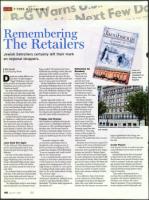
Cover of a
book about
Calling itself the
Jacobson's by
"finest and most
Bruce Allen
complete cloak
Kopytek
and suit store in the
United States," B. Siegel's
heritage goes back to 1881
when Benjamin Siegel came
to Detroit via Germany
and Alabama to open a
Downtown store. The chain
closed in 1981.
Kay Baum's clientele
consisted mainly of high
school and college girls
buying sweaters, blouses,
skirts and shoes in six
stores around Detroit
and Ann Arbor. Meyer
Kershenbaum opened the
first store in 1932, shorten-
ing his name to just Kay
Baum. His brother, Belmont,
FT'
now 92, of Bloomfield
Himelhoch's Downtown Washington Street building,
Township, joined him after
now condos
World War II. "The young
women of that era kept our
Eugene Applebaum's Arbor Drugs, now
stores humming," Belmont
CVS, and Jack Robinson's Perry Drugs, now
reflected. "We couldn't have been a success
Rite Aid.
without them:'
Broadway Street Downtown acquired the
Credit Pioneer
nickname of the "street of Jewish dreams"
Over the past 70 years or so, there were also
— a takeoff on New York's Broadway —
many individual success stories of Jewish
with many stores operated by Jews. Engass
merchants.
Jewelers was started by Clarence Engass
Colonial Department Store was opened
in 1865; Serlin's Jewelry and Radio Supply
on State Street in the 1930s, and became
(an odd combination) was operated by Bill
the first store of any kind in Detroit to issue
Serlin and Jacob Ressler; Henry Komrofsky
credit to customers. In the pre-credit card
gave his first name to Henry the Hatter, but
age, founders Harry Shapiro and Bennett
it was taken over later by Seymour, Jack
Fenberg, former jewelers, used a Burroughs
and then Paul Wasserman; Paul's Cut Rate
automated bill processing system to keep
Drugs was a beehive of activity at lunch
track of customers.
hours, with customers calling Joe Deutch
"They made a down payment on a
"Mr. Paul."
purchase, then monthly payments on the
It was difficult to find a Detroit inter-
remainder with interest," explained Larry
section without one of Nate Shapero's
Friedman, now of Stuart, Fla., who is
Cunningham Drug Stores. He began the
Shapiro's grandson. "It was revolutionary
chain with a store called Economical
because people needed holiday gifts and
Number One. His business successors were
a In