

Robert Schefman's large-scale paintings explore
the effects of ever-changing waves of technology.
Suzanne Chessler
Contributing Writer
T
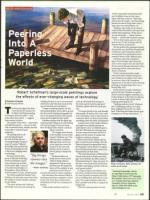
he boy at the edge of the dock
is not dressed for summer fun
in Robert Schefman's painting
Learning to Swim. His outfit — dark
pants, white shirt and tie — suggests
more serious activities.
The contents of the water — open books
and faded documents — also are at odds
with recreational visuals, whether assorted
boats, rafts or anchored sports
equipment.
The painting, done in oils
and extending beyond 4
feet wide by 5 feet tall, is to
encourage thought, not play. It
is part of a series, "Collected
Knowledge that questions the
destiny of valued papers in the
rr:dst of ever-changing waves
of technology.
The series, joined with a
group of charcoal renderings
based on Schefman's experi-
ences during a trip to Israel,
will be shown May 12-June 23
Robert
at the Robert Kidd Gallery in
Birmingham. There will be an
artist's reception 5-8 p.m. on opening day.
"My shows usually have themes:' says
Schefman, 59, who took a year's leave from
the College of Creative Studies to prepare
for this exhibit.
"The whole reference for 'Collected
Knowledge' came from my noticing the
changing formats we use to save personal
information and what that means for the
way we maintain personal history.
"I began wondering whether my chil-
dren's grandchildren will be able to go into
the attic and find family photographs, let-
ters or documents that have been passed
down, and I decided that they won't."
Schefman explains that the digital age
requires people willing to do reformatting
over and over again. In his own home,
there are floppy disks without a machine
able to read them.
"The images speak directly
to the inability to access infor-
mation:' Schefman says. "The
water becomes a metaphor;
although items can be seen
in the water, they cannot be
accessed in the same way.
Putting a book in water is
forever going to change that
book."
Schefman holds on to
family letters written in the
1930s by Polish relatives
desperate for help to escape
the Holocaust. He doubts the
Schefman letters will be available to later
generations even if they are
scanned and saved on today's computers.
And what about the emotions linked to
touching actual letters, snapshots or docu-
ments, even if just their content can be
maintained and only for a certain period
of time?
"I take an idea, consider it and try to
"Big brings
viewers into
the images."
come up with visuals that are open to
the viewer and the viewer's experience
Schefman explains about his artistic pro-
cess.
"I try to get specific in my work through
what people call realism, but I don't want
to be controlling. I want to take viewers in
a direction, like a one-frame movie where
everything is there for others' consideration:'
A small section of the exhibit will have
seemingly more playful paintings by
exploring the nature of children's games,
like Clue. Ultimately, the paintings ques-
tion the connection between the fun of
games and the essence of murder and
mayhem as subjects of games.
Fifteen works fill the exhibit with six
done in charcoal and reaching 5 feet tall.
Charcoal seemed the appropriate choice
for the group "Carbon Issues," an explora-
tion of environmental topics, such as the
disappearance of fresh water.
"The Jewish Federation of Metropolitan
Detroit took artists to Israel seven years
ago," says Schefman, the 2004 winner of
Federation's Benard L. Maas arts prize. "At
the time, I was struck by the intersection
of politics and religion and how it all cen-
tered around carbon."
In Kings of Industry, for instance, car-
bon issues manifest in the surroundings
of a man dressed in a business suit as he
sits on a folding chair and looks at a com-
puter. The scene is outdoors, where the
land is parched and smoke is rising in the
background.
"I like the visual experience of scale,
and the way people respond physically,"
says Schefman, whose artistic career
began with large sculpture. "Big brings
viewers into the images. I started painting
because the idea of being drawn into a
large visual was captivating for me."
Schefman, who works out of a home
studio in West Bloomfield, calls upon both
models and imagination. All the charac-
ters are real people — family, students,
friends — placed within devised settings.
"A lot is observation, and a lot is fan-
tasy," he says. "In the paintings with the
dock, the dock is an invention."
Oils are preferred for paintings because
they provide more flexibility through both
translucency and transparency. Recent
canvases have been painted from black
instead of white to add a different layer.
Schefman, who holds a bachelor's
degree from Michigan State University
and a master's degree from the University
of Iowa, moved through watercolors before
connecting with the richer and darker
shades of oil paint.
Private commissions have comple-
mented the public displays through the
time Schefman has taught at CCS, where
he serves as chair of the Foundation
Department. In the fall, he will be showing
paintings at Timothy Yarger Fine Art in
Beverly Hills, Calif.
Family interests energize Schefman's
artistry. His wife, Christine, is a gallery
director, and his daughter, Samantha, is a
jewelry designer in New York. Son Nicolas,
a senior at Groves High School, will be
studying advertising at CCS.
"Teaching reinforces focus:' Schefman
says. "Challenging students on a daily
basis challenges the teacher on a daily
basis. Delivering information means ques-
tioning the use of that information."
Kings of Industry, 2011, charcoal, 60
inches by 40 inches
"Collected Knowledge" will be
on view May 12-June 23 at the
Robert Kidd Gallery, 107 Townsend,
Birmingham. Hours are 11 a.m.-5:30
p.m. Tuesday-Saturday. Opening
reception: 5-8 p.m. Saturday,
May 12. (248) 642-3909; www.
robertkiddgallery.com .
May 10 • 2012
43