

Controversy
on Campus
A growing number of pro-Israel events
are disrupted by demonstrators.
Robin Schwartz
I Contributing Writer
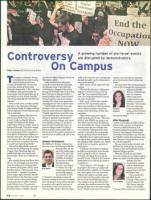
he images are dramatic. Dozens
of demonstrators, many wearing
hijabs (Muslim female head-
scarves), sat silently with red duct-tape
across their mouths at Wayne State
University during a Nov. 1, 2011, visit from
Gil Hoffman, chief political analyst for
the Jerusalem Post. The group then got up
and walked out of the lecture chanting,
"We will not stand idly by!" and "Free, free
Palestine!"
About a week earlier, a similar incident
took place at the University of Michigan
when Ishmael Khaldi, the highest-ranking
Bedouin diplomat in Israel's history, paid a
visit to Ann Arbor.
"A group of protesters filled the room
almost an hour before the event was
to start," recalls Leo Nayfeld, Midwest
Campus Coordinator for the Zionist
Organization of America (ZOA), which co-
sponsored the event. "Less than a minute
into the lecture, all the protestors stood
up in unison, opened their sweatshirts to
reveal photos of Palestinian children [to
represent innocence], showing their backs
to the lecturer. They also took out signs
that read 'End the occupation!' Your boss
is a racist!' and 'Israel is Apartheid."
After a short delay, Khaldi continued
his talk, but was disrupted by the rustling
of paper. Then, Palestinian flags were
unfurled and signs were waved as the
demonstrators slowly and noisily left the
room.
More recently, during Israel Peace Week
(Feb. 21-29) at Michigan State University,
about 40 students from Students Allied
for Freedom and Equality (SAFE), which
describes itself as a "diverse group of stu-
dent activists ... organized to promote
justice, human rights, liberation and self-
determination for the Palestinian people
left their seats in a silent protest during
a presentation by two soldiers from the
Israeli Defense Forces. The protesters
had signs taped to their chests and backs
bearing the names of children who they
14 March 15 • 2012
say had been killed during the Israeli and
Palestinian conflict.
Similar incidents have taken place
across the country from the University
of California, Irvine to the University
of Pittsburgh, to Rutgers in New Jersey.
During one of Khaldi's other visits at Kent
State University in Ohio last October, a
history professor yelled "Death to Israel!"
during a question-and-answer session,
touching off a debate about appropriate
and inappropriate ways to express views.
"Unfortunately, extremist views and
disruptive tactics are commonplace
from anti-Israel advocates:' Nayfeld says.
"Student organizations around the coun-
try are repeating these vile tactics in an
attempt to demonize Israel instead of
working to promote dialogue and respect
in an academic setting. It is my sincere
hope that anti-Israel groups will act to
promote dialogue instead of stifling it.
However, history unfortunately shows us
that we must be the greatest champions of
our own cause as nobody will come to our
rescue:'
Student Involvement
Max Heller, a U-M junior studying busi-
ness, was in the crowd during the Khaldi
demonstration. He was
one of the student orga-
nizers of the event and
a member of the group
CAMERA (Committee
for Accuracy in Middle
East Reporting in
America). According to
its website, the media-
Max Heller
monitoring, research and
membership organiza-
tion, founded in 1982,
is "devoted to promoting accurate and
balanced coverage of Israel and the Middle
East." The group is non-partisan and takes
no position with regard to American or
Israeli political issues, but asserts that
"because public opinion ultimately shapes
public policy, distorted news coverage that
misleads the public can be detrimental to
sound policymaking"
Heller says he was not surprised by the
walkout.
"This isn't the first time a walkout was
staged at U-M since I've been here he
says. "But, I was surprised there wasn't
more of a strong representation from the
pro-Israel community:'
Heller says he noticed right away the
crowd was full of protesters, many of
whom were members of SAFE. He believes
a more balanced audience would have
countered the effectiveness of their dem-
onstration.
"These are the same tactics they've
employed in the past:' he says. "They were
afraid of what [Khaldi] was going to say.
They didn't want his words and opinions
to be absorbed by the campus community
because people like him endanger their
very movement. What perpetuates their
existence is spreading their propaganda,
their lies and inaccuracies about Israel."
Still, Heller says he supports the protest-
ers' right to their opinions and free speech.
He's calling on fellow students who support
Israel to turn out in greater numbers at
future events.
"I think part of it is there's a tendency
for folks in my generation to just assume
Israel is going to be OK; the existence
of Israel is something they just take for
grantee he says. "A lot of us don't have an
appreciation for the difficult spot Israel is
in sometimes.
"That's a big part of the struggle — to
get people to show they care and get edu-
cated about this. I wouldn't say its laziness,
but I think apathy is the real reason why
students don't make it a priority. I guess
its just important that people understand
this is not just something happening on
a few campuses across the country. More
and more, these incidents seem to be hap-
pening. For those of us who want to defend
Israel, it should create more of a sense of
urgency to get educated, get informed,
get involved and put those feelings into
action:"
The Israel Peace Week demonstration by
SAFE at MSU prompted this response from
sophomore Danielle
Brickner of Walled Lake,
who was a Hasbara
Fellow (a pro-Israel
campus activism orga-
nization) in Israel last
December. "This was the
first time I have expe-
rienced anything anti-
Danielle
Israel, and this furthered
Brickner
my desire to continue to
advocate for Israel."
Hillel Responds
Leaders of U-M Hillel and Hillel of Metro
Detroit (with a presence at Wayne State
University, Oakland University, U-M
Dearborn, Oakland Community College,
Lawrence Technological University and
University of Detroit Mercy) say while the
local Muslim student demonstrations have
been disruptive, they've also been "peace-
ful, civil and respectful."
They say student leaders involved with
Hillel and pro-Israel groups on campus
continue to plan and implement program-
ming and bring in speakers.
While the ZOA believes universities
across the country are not doing enough to
protect the rights of Jewish and pro-Israel
students, local lead-
ers say they're satisfied
with the administrative
response and level of
support from U-M, MSU
. and Wayne State.
"[The protests] have
not stifled the rich
exchange of ideas around
Tilly Shames
Israel on campus:' says
Tilly Shames, executive
director of U-M Hillel.
"The most effective advocacy on campus is