
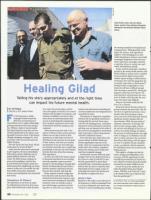

Gilad Shalit walks with his father,
Noam, beside Prime Minister Benjamin
Netanyahu and Defense Minister Ehud
Barak.
Healing Gilad
Telling his story appropriately and at the right time
can impact his future mental health.
Dr. Irit Felsen
Special to the Jewish News
or five long years, a media
campaign swirled around the
abduction and internment of
Israel Defense Forces soldier Gilad Shalit,
gaining momentum with every passing
day. Without a doubt, it was the media
that helped keep his story alive and con-
tributed significantly to his release, creat-
ing public pressure in favor of the historic
(though unsettling) exchange Oct. 18 of
more than 1,000 convicted terrorists for
Shalit's freedom.
But now that he has been freed, will the
media claim its "pound of flesh"?
Aside from the interview he was forced
to give Egyptian television immediately
following his release, Shalit has not yet
spoken publicly about his 1,941-day
ordeal. His father, Noam, continues to
serve as his mouthpiece, and his fam-
ily and friends have formed a protective
shield around him, disallowing any media
contact. As they see it, the media can only
harm Shalit at this point, slowing his
recovery and reintegration into normal life
and society.
'Conspiracy Of Silence"
The experiences of survivors of captiv-
ity, maltreatment and torture from many
parts of the world teach us that the phase
36
November 24 • 2011
of re-entry into society plays a critical
role in the quality of recovery. The societal
attitudes and the degree of acceptance and
assistance available to survivors as they
return from an ordeal determines their
success in psychologically reintegrating
their traumatic experiences into a sense
of themselves that feels continuous and
consistent.
When survivors are met with a "con-
spiracy of silence:' where society and even
relatives are not able to listen to their
experiences, as with many survivors of
the Holocaust, the survivors do not speak
of their trauma. And when war veterans
and prisoners of war are met with nega-
tive attitudes toward the war in which they
participated, as was the case with Vietnam
veterans, they also refrain from sharing
their experiences.
In such cases, where the trauma cannot
be discussed and shared in an accepting
and truly empathic context, survivors
attempt to cope by hiding or denying their
distress. Paradoxically, the more dissoci-
ated the traumatic experiences become,
the more they interfere with daily life.
Newly acquired scientific insight into
brain functions and structures have illu-
minated much about how trauma is regis-
tered, stored and remembered. Extremely
traumatic events are initially stored in
non-verbal images, sensations and feel-
ing states. As such, they can continue to
remain vivid and timeless, disturbing the
survivor's habituation and integration into
normal life for years.
The presence of supportive, empathetic
listeners who are genuinely interested in
hearing what the survivor has to say is
critical to the healing process. Such listen-
ing must be truly motivated by sensitivity
and deep care and attuned to the needs of
the survivor. Listening that is motivated by
other voyeuristic or self-serving interests
will lead to additional trauma.
From what they have stated, this is the
concern shared by Shalit's family and
friends regarding his exposure to the
media. There are no guarantees that the
media will be the sensitive, empathetic
listeners he requires, and it simply isn't
worth the irreparable damage.
Furthermore, because Shalit was only a
teenager when he was abducted, he has a
lot to learn to catch up with his 25-year-
old self, a great deal to re-learn about
normal life and a tremendous amount to
unlearn from his years in captivity. Most
importantly, he has to regain a sense of
ownership and control over his life, and
the freedom to explore who he is.
the message intended was hijacked and
misrepresented. While generally irritat-
ing for the masses, such experiences
might be truly damaging for an indi-
vidual attempting to achieve a personally
meaningful integration of his own trau-
matic experience, and might constitute
a repetition of loss of control over one's
words, self-definition and life.
It goes without saying that a relentless
pursuit by the media would interfere with
Shalit's ability to explore and re-establish
his personal life. Many bereaved indi-
viduals express feeling an added burden
of having to live with the image that oth-
ers project upon them as "the bereaved?'
Having become recognizable to every
Israeli, he will have a difficult enough
task returning to normal life. Having the
paparazzi chase him and "experts" vol-
unteering their interpretations for every
move he makes will only make the tran-
sition that much more difficult.
However, the media could play the
hero, if it so chooses.
It has been shown that the method of
giving testimony has particular value for
survivors of captivity and torture. Even
decades after their traumatic experi-
ences, survivors of the Holocaust showed
significant positive changes after giv-
ing testimony. While the processing of
traumatic experiences in therapy and
other private settings might confront
the survivor with feelings of fear, loss of
control, irreversible damage and shame,
the process of testifying restores the right
order of things, as it establishes who did
what to whom, and places the moral bur-
dens where they belong, with the aggres-
sor. Due to its public format, testimony
creates a social and cultural context for
the individual trauma and accelerates the
healing process.
This might be a benign role that the
media can play, providing Shalit, at his
own pace, with the opportunity to heal
and add his personal story to Israeli soci-
ety's collective narrative about the painful
cost paid by everyone's children in war.
So, now it's up to the media, the very
entity that helped bring about Shalit's
release. Will they move in for the "scoop,"
or do whatever they can to help free him
from his painful past? II
Media's Role
Exposure to the media, even in the best of
circumstances, is often accompanied (true
or not) by a feeling that one's words were
"twisted" to mean something else and that
Dr. Irit Felsen, Ph.D. is a clinical psychologist
and trauma specialist, and an adjunct profes-
sor at Yeshiva University's Ferkauf School of
Psychology.
K