
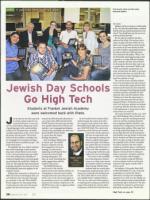
FJA faculty check out the newly
delivered tablets.
Jewish Day Schools
Go High Tech
Students at Frankel Jewish Academy
were welcomed back with iPads.
ust in time for the kids to go back
to school, a photo made its way
around the Internet. It was a pic-
ture of a smart phone sitting atop a piece
of graphing paper with a math problem
written on it. The phone has a scientific
calculator application on the screen. Above
the picture was the quote: "You need to
learn to do this without a calculator. You
are not going to be carrying a calculator
around with you everywhere you go!" -4th
grade math teacher.
It's laughable, but true. Today's students
have more technology in their pockets
than entire school districts once owned.
In fact, a few generations ago, one would
never have imagined the possibility of
students bringing battery-powered graph-
ing calculators into math class. Today, stu-
dents are still using the Texas Instruments
graphing calculators, but they are the least
technologically impressive gadgets in the
students' arsenal.
Walking from classroom to classroom at
Hillel Day School in Farmington Hills, one
can't help but notice the large white gad-
gets attached to the wall. These SMART
Boards might not be what people think
of when they hear the term "educational
gadget:' but these devices have revolu-
j
28
At the Frankel Jewish Academy (FJA),
tionized the field of Jewish education in
students began this school year with a
a very short time. Hillel introduced the
SMART Boards a few years ago and they
nice surprise. Each student in the West
were quickly embraced by teachers and
Bloomfield-based high school received a
students. Local congregational religious
new 16GB WiFi iPad2. The school-wide
distribution of the iPad to each student
schools in the community also have inte-
is the result of both a generous
grated SMART Boards thanks
gift from an angel donor and
to a grant from the Legacy
the advantageous timing in the
Heritage Foundation.
school's computer lease agree-
Steve Freedman, Hillel's head
ment with Apple. Patti Shayne,
of school, said, "the SMART
the school's director of technol-
Board is a fantastic tool. Its
best integration is the active
ogy, believes the iPad project is
in line with FJNs reputation as
learning. I see the teacher
a cutting-edge institution, espe-
explaining something and there
cially in the area of technology.
is interactive instructional
"The move to this incredible
learning taking place. The
Rabbi Jason
new technology gives teachers
kids can create something that
Mil ler
access to so many more sources
really engages them with the
Jewish News
and enables students to leverage
teacher's instruction:'
Colur nnist
The SMART Boards are
their learning. With the iPad,
students have one central place
used in each of the school's
for assignments, communications and in
grades based on the students' abilities. In
many cases, textbooks and reading mate-
a kindergarten classroom each student
rial. They will be able to access sources
virtually moves her name from one side
not available before,' explained Shayne.
of the screen to the next to participate in
the attendance process. In a middle school "Our job is to make sure that learning is
as inspiring and exciting as possible and
classroom the students collaborate on the
SMART Board to solve an algebra problem prepare FJA students for a future where
competency with all web-based devices is
or learn to read Torah.
-
the norm.
Matthew Orel's son Aaron is a ninth grader
at FJA. The West Bloomfield father remarked
that the iPad was Aaron's introduction to the
school. "You should have seen the ear-to-ear
smile on his face that day."
It's not only the students who have
embraced the iPads. The teachers had a
chance to play with them before the stu-
dents even returned from summer break.
One teacher at FJA was already an iPad
pro. Robert Walker, a government teacher,
has had an iPad since 2009 when they
were released to the public. "Where I see
the iPad really impacting learning is that
it appeals to so many different learning
styles. Students will have more freedom
in choosing the direction they want to go
to master their coursework," Walker said.
"While meeting the requirements, stu-
dents will also have the ability to go above
and beyond what they are required to do.
It's a powerful tool that will support learn-
ing in any number of ways."
One way the device will help students
learn is by giving them the opportunity to
review a lecture they might not have fully
understood the first time. FJA!s chemistry
teacher videotaped himself going through
a problem and then uploaded the infor-
mational video onto the students' iPads.
"Students now have the opportunity to
watch his demonstration several times:'
explained Shayne. "Sometimes you don't
catch it all and some students are hesitant
to speak up. With the iPad they can listen
to the explanation as many times as they
need at home or at school:'
That same chemistry teacher uses a free
app called Mahjong Chem, which his stu-
dents use to practice matching elemental
names to symbols, naming polyatomic
ions, assigning oxidation numbers, earn-
ing electronic configurations and under-
standing metric prefixes. Other apps that
are being used include Pages (for word
processing), Keynote (for presentations)
and Numbers (an app similar to Microsoft
Excel). Students are allowed to purchase
their own apps, as long as the apps meet
the standards of the school's Acceptable
Use Policy. Teachers may even require
students to purchase apps; a requirement
explained to parents in a document from
Shayne as the equivalent to asking stu-
dents to purchase a calculator, notebook
or other necessary school supplies.
Are the students using the iPads for
serious academic work or are they just
expensive video game consoles with a
pretty screen?
According to 12th grader Shira Wolf
of West Bloomfield, it's a mix. "In Jewish
Leadership, our teacher, Mr. [Marc]
Silberstein, is trying to be completely
paperless so we went over the syllabus on
our iPads and got to play around with the
neuAnnotate app to annotate it." She also
noted that it's common to see her peers
playing the popular game "Words with
High Tech on page 30
September 15 2011
Scanned image of the page. Keyboard directions: use + to zoom in, - to zoom out, arrow keys to pan inside the viewer.
September 15, 2011 - Image 28
- Resource type:
- Text
- Publication:
- The Detroit Jewish News, 2011-09-15
Disclaimer: Computer generated plain text may have errors. Read more about this.