

metro >> on the cover
I tz
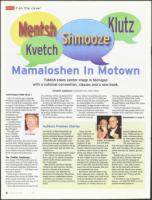
Mamaloshen In Motown
Yiddish takes center stage in Michigan
with a national convention, classes and a new book.
Elizabeth Applebaum I Special to the Jewish News
CONTINUED FROM PAGE 1
Some 11 centuries ago, a language
developed among Ashkenazi Jews that
came to be called the mamaloshen (moth-
er tongue). Later known as Yiddish, it
became the everyday language of millions
of Jews throughout Eastern Europe. Yet,
with the Holocaust,
assimilation and
immigration, Yiddish
nearly vanished.
A handful of Jews
are doing their best
to make certain that
doesn't happen.
Through a new
book of Yiddish
Jerry Gerger
stories (including
"Comatose" above)
retold by local writers Alva Ann Dworkin
and Jack Boxer, Yiddish language classes
and an international Yiddish convention
set to open next week in Novi, Detroit Jews
want to make it clear that Yiddish is com-
pletely oisergevaynlich (awesome).
The Yiddish Landscape
Jerry Gerger of West Bloomfield grew up
in a home he says was "a bit tinged in red,
a free-thinking family." Neither he nor his
wife "had much Yiddishkeit [Jewishness],
so we made our own" — including a corn-
mitment to Yiddish.
Today, Gerger is treasurer of the
International Association of Yiddish Clubs
(IAYC), and he can hardly wait for the
group's 14th annual conference Aug. 26-29
at the Sheraton Detroit in Novi.
About 300 participants are expected for
2011
the conference, which is meeting for the
first time in Michigan. "The interest has
been really, really good," Gerger says.
It's where the Old World meets new. It is,
after all, Yiddish, and many of its greatest
proponents, from writers to singers, are
long since dead. Most of those who grew
up speaking Yiddish and many members
of the IAYC, are older.
At the same time, conference informa-
tion is online (www.derbay.org ) and on
Facebook. Also, the IAYC is hardly just
about the good old days. Among its goals
are taking Yiddish "out of isolation:'
encouraging "younger people to take class-
es" and increasing the number of Yiddish
courses at schools and universities.
The IAYC conference will include vari-
ous sessions, with quite
a collection of guests:
Detroiter Eugene Driker, incoming chair
of the National Yiddish Book Center;
Michigan State University professor
Kenneth Waltzer; and Michael Wex, author
of Born to Kvetch.
"And we've got plenty of entertain-
ment, which in some people's mind is the
highlight of the conference," Gerger says.
Mamaloshen on page 9
Authors Freshen Stories
Jack Boxer of West Bloomfield has
just helped prepare a collection of
stories, Gefrishte Mayses (Freshened
Stories), in Yiddish and English. He
writes, edits and "works them over,"
leaving just enough mistakes so that
his co-author Alva Ann Dworkin will be
able to catch them and feel she's con-
tributed, too.
Gefrishte Mayses will make its debut
at the Yiddish convention and also
be for sale at the Jewish Community
Center's 60th Annual Jewish Book
Fair in November.
Both Dworkin and Boxer learned
Yiddish from their parents. Dworkin
became a teacher and an educa-
tion consultant who attended the
Workman's Circle/Arbeter Ring; Boxer
taught science, rehabilitated homes,
volunteers as a mediator in several
local court districts and likes watching
hawks.
Today, the two
entirely different story.
teach Yiddish at the
Also, Yiddish syntax fol-
JCC in Oak Park,
lows a complex pattern
where they decided
of "Old English and High
Authors Alva Dworkin
to write a book
German," Dworkin says.
and Jack Boxer
together. (It was
The book took more
self-published by their company, A Bi
than two-and-a-half years to com-
Gezunt.) Dworkin describes the class
plete, and it includes a CD so listeners
as diverse, both in terms of age and
cannot only see the Yiddish, but also
ability, but always "a lot of fun."
hear it.
Most students have some familiar-
Though many of the stories in the
ity with Yiddish, but are not fluent,
book are funny, Dworkin notes that
she says. They remember parents or
Yiddish also was the language of
grandparents speaking the language,
great writers like Peretz Markish and
Sholom Asch – men whose names
and in class they find that they recall
may not be especially well-known
much more of the language than they
today, yet their talents were extraor-
ever imagined they knew.
dinary, Dworkin says, and their words
Working on Gefrishte Mayses was
are not really lost: "They're all still
both a pleasure and a challenge. The
there, in books."
authors love Yiddish, but it can be dif-
To purchase a copy of Gefrishte
ficult to translate from English, with
Mayses, call (248) 557-8599 or email
its relatively simple adjective-noun
alvadworkin®sbcglobal.net .
agreement, to Yiddish, which is an