

Rabbis Encourage
Genetic Testing
Before Marriage
of families, and it's nice to help
people who are trying to expand
their families and have healthy
children."
The lab also is helping develop
lines of embryonic stem cells
with the University of Michigan
to study disorders including Tay-
Sachs disease, which causes the
central nervous system to degen-
erate and often leads to death by
age 4. Approximately one in 25
Ashkenazi Jews are Tay-Sachs
carriers. In 2008, voters across
Michigan approved the use of
embryos discarded in fertility
procedures for stem cell research.
The Florida-based group
StemCellRegenMed announced
in April that three children born
with Tay-Sachs in Peru showed
signs of improvement after
receiving the groundbreaking
gene therapy treatment.
efore they even agree to date or develop any kind of emo-
tional connection, Orthodox Jews typically undergo genet-
ic testing. The results are then used to determine whether
or not the relationship should even be pursued in the first place.
"You don't want to get into a relationship that will not have
such good endings," said Chaya Stein, 30, of Oak Park.
She and her husband are busy raising five children ages 6, 4,
2-year-old twins and a 9 month old. "I think it's imperative for
everyone to check before they have children. It's very painful
to watch a child who's born healthy deteriorate. What could be
worse for a marriage?" she said.
Stein, like thousands of others, underwent anonymous test-
ing through Brooklyn, N.Y.-based Dor Yesharim ("Generation of
the Righteous" in Hebrew), also known as the Committee for
Prevention of Genetic Diseases. The organization has offices in
Israel and other countries.
"They basically give you a number," she explained. "When two
people want to date, you call and find out if your numbers are
compatible or not. It's almost like protocol; that's just what you
do."
Dor Yeshorim tests for nine disorders, including Tay-Sachs,
Familial Dysautonomia, Cystic Fibrosis, Canavan, Glycogen
Storage Disease, Fanconi Anemia, Bloom Syndrome, Neimann-
Pick and Mucolipidosis. It also tests for Gaucher's disease by
request only, a source of controversy according to a 2008 arti-
cle published by the New York-based Jewish Week. In the arti-
cle, Dr. Stuart Ditchek, director of the nonprofit Jewish Genetic
Diseases Consortium, accused Dor Yeshorim's founder, Rabbi
Joseph Eckstein, of "playing God" because he dissuades people
B
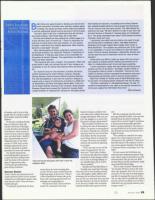
Thad and Hannah McCollum with their 1-year-old
daughter, Molly
Success Stories
Closer to home, the anonymous local
couple referenced earlier can be counted
among the pre-implantation genetic diag-
nosis success stories. They now have a
healthy baby girl.
"I would give myself shots for three
weeks and go for early-morning ultra-
sounds',' the new mom recalled about the
beginning stages of the process. "There's
a silent sisterhood of women who go for
these early-morning appointments and
exchange encouraging glances.
"We had more than a dozen embryos
tested',' she continued. "Some had
from testing for Gaucher's. According to the article, Ditchek
also claimed Eckstein failed to inform people who tested posi-
tive for Gaucher that they were carriers. The rabbi denied the
assertion, but said, "We don't believe it's right to say 'don't get
married' because of Gaucher's" because there are treatments
for it. The group reportedly tests about 17,000 people (primarily
Orthodox Jews) each year.
"I personally have eight married children who went through
the testing before scheduling a date," said Rabbi Elimelech
Silberberg of the Sara Tugman Bais Chabad Torah Center in
West Bloomfield. "This negates any emotional pain if the couple
is not compatible. It's much more difficult to deal with these
issues if they've already developed a relationship. Genetic test-
ing has been the norm in observant circles for close to three
decades."
Conservative and Reform rabbis we spoke with also encour-
age couples to undergo genetic testing, but generally do so
later in a relationship as part of pre-marriage counseling.
"I once counseled a couple who were tested and found to be
positive carriers of Tay-Sachs," said Rabbi Joseph Krakoff of
Congregation Shaarey Zedek in Southfield. "Having this infor-
mation in advance, doctors managed the pregnancy and every-
thing worked out perfectly when it came to having children."
Rabbi Paul Yedwab of Temple Israel in West Bloomfield says
he has been encouraging genetic testing for the last 25 years.
"Tay-Sachs especially is a devastating disease," he said. "It
would be irresponsible for any rabbi or pre-marital counselor to
fail to give couples the information they need."
Gaucher's disease, and there were
some where they couldn't determine
enough information. We're not sure
yet if our daughter is a carrier. But
the genetic testing is phenomenal?'
The procedures involved are cost-
ly, often in the tens of thousands of
dollars. The genetic screening blood
test alone is typically not covered by
insurance and can cost several hun-
dred dollars. But the new parents
say, for them, there's no money bet-
ter spent. They have some healthy
embryos left, and they're planning
to try again.
"This is one way we can end the
chain of transmission',' the new
mom said. "That's why it bothers
me when people talk about couples
using labs to make 'designer babies:
For us, this technology helped cre-
ate a healthy baby, and we will be
forever grateful."
Hannah and Thad McCollum of
Ferndale also count their blessings
when they look at their healthy, growing,
1-year-old daughter, Molly. Without this
technology, the two Metro Detroit attor-
neys are not sure what their lives may have
been like. Hannah is Jewish; her husband
is not. She has a brother who is develop-
mentally disabled and requires 24-hour
— Robin Schwartz
care.
After the couple got married several
years ago, Hannah's mother is the one who
insisted she go for genetic testing. She
suspected her son has Fragile X syndrome,
a chromosomal abnormality that often
leads to mental retardation. The disease is
not specifically tied to the Jewish commu-
nity. Hannah was tested and found to be a
Fragile X carrier.
"The condition is caused by too many
repeats of a certain sequence on your X
chromosome,' she explained. "I have more
than 600 repeats of the sequence. I have a
very serious genetic disorder. I had about
a 50 percent chance of passing it on to my
child:'
For that reason, the McCollums also
underwent pre-implantation genetic diag-
nosis. After a long, emotional process, they
welcomed their baby girl last year. Both
the McCollums and the anonymous couple
were treated by Mersol-Barg.
"This is truly a miracle,' Hannah said.
"It's stressful. We had a team in the room
when I got pregnant. Parts of it are scary,
and parts of it are kind of weirdly depress-
ing. But it's amazing that you can do this.
You can take what's essentially this organic
process and you can defeat it so you have a
child that's not carrying the disease you're
trying to avoid?' II
30
s
2011
25