

health & fitness
Carrier Father
these 'typos," he continued, "and help pro-
duce healthy babies."
Mersol-Barg, who is Jewish, is a repro-
ductive endocrinologist who assists
countless couples navigating the medical
and emotional pitfalls of infertility. He's a
member of numerous medical societies,
president of the Michigan Reproductive
Endocrinology and Infertility Society
and serves as chair of the state's Fertility
Advisory Committee. He's also an enthusi-
astic advocate for genetic testing, impor-
tant for Jewish couples who may unknow-
ingly be carriers for various genetic
disorders like Cystic Fibrosis, Tay-Sachs,
Canavan, Familial Dysautonomia and sev-
eral other illnesses prevalent among Jews
of Ashkenazi (Eastern European) descent.
According to the New York-based Jewish
Genetic Disease Consortium,"approxi-
mately one in four individuals is a carrier
of a gene for a condition that could be
severe and may result in the early death
of a child. Until we learn how to correct
inherited genetic mutations, every genera-
tion of Ashkenazi Jews is at risk for pass-
ing on a gene for one of several diseases."
Carriers are healthy; their families may
or may not have any prior history of dis-
ease. A simple blood test, which can be
ordered by any physician, is all it takes to
determine a person's carrier status.
"It can be a silent assassin," said Mersol-
Barg."These disorders are recessive so
they're sneaky. Someone can be a carrier
and not know it and fall in love with anoth-
er carrier and have a one-in-four chance of
having a child with the illness."
While he works with many couples
struggling with infertility, Mersol-Barg
points out that fertile couples, who may
have no trouble conceiving at all, are really
the best candidates for genetic testing.
"They're the ones who are going to get
hurt because they have babies easily,"
he said. "This is a great opportunity to
inform the community so they don't get
blindsided. It's my mission to let people
know about the technological advances
available to assist them."
A 'Perfect' Match
So what happens when a person finds out
he or she is a carrier?
It's an emotional rollercoaster a local
couple in their 30s experienced firsthand.
They asked not to be identified, but agreed
to talk to the Jewish News with the hope of
helping other families. Their story starts
out like so many others — they met, fell
in love, got married and began trying to
have children. Because of a prior blood
test, performed when she was single, the
wife already knew she was a carrier for
Gaucher's disease, an inherited disorder
that affects many of the body's organs
and tissues. The disease afflicts one in
24 June 30 2011
GG
Normal
Carrier Mother
Gg
Gg
Gg
Gg
Carrier
Carrier
gg
Affected
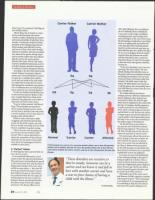
If both parents are carriers of a recessive genetic defect, one in four (25 percent)
children will be healthy and will not carry the genetic defect, two of four (50 per-
cent) will be healthy, but will be carriers, and one in four (25 percent) will have the
disease.
"These disorders are recessive so
they're sneaky. Someone can be a
carrier and not know it and fall in
love with another carrier and have
a one-in-four chance of having a
child with the illness."
— Dr. Merso!-Barg
500-1,000 Ashkenazi Jews, according to
the U.S. National Library of Medicine.
It can cause a wide range of problems,
including anemia, easy bruising, bone
pain and fatigue. In the most severe cases,
life-threatening complications start before
birth or in infancy, and most babies die
a few days after birth. But both parents
must be carriers and each must pass on
their defective gene for a child to be affect-
ed. So you can imagine the local couple's
surprise when the husband was tested
and they learned he's also a carrier for
Gaucher's disease. It's rare for two people
to have the exact same genetic mutation,
but they do.
"It was very shocking to us; it was very
upsetting:' the wife recalled. "We were
already dealing with infertility issues at
this point, and we were already emotional
and feeling overwhelmed. Now we had a
25 percent chance of having a child with
Gaucher's. We didn't want to take that
chance. We didn't think it was fair for us
to roll the genetic dice and possibly have a
sick child when the science exists for us to
have a healthy one."
The couple made the decision to
undergo a process called pre-implantation
genetic diagnosis, where embryos are
screened in a lab for the defective gene
before they're implanted in the womb with
the hope of creating a healthy pregnancy.
It works much like in-vitro fertilization
(IVF), where a woman's eggs are removed
and fertilized in a lab. But once the embry-
os begin to grow, doctors have figured out
a way to gather critical information about
the baby-to-be as the cells are dividing in
the earliest stages of development.
"On the third day, we use a laser to
zip open the outer shell of the embryo:'
Mersol-Barg explained. "We remove one
cell. That cell will represent the others to
answer the question we want to know"
The microscopic cells are then sent to a
lab for testing to determine whether the
baby will have the disease, be disease-
free or be a carrier (but not affected by
the illness). Embryos that test positive
for the defective gene are discarded; only
those found to be disease-free or potential
(unaffected) carriers are implanted.
As it turns out, one of the leading labs
in the world specializing in this type of
testing is right here in Detroit. The sci-
entists at Genesis Genetics Institute pio-
neered pre-implantation genetic diagnosis
almost 20 years ago. They're now able to
screen for specific genetic disorders and
get results back within 24 hours.
"We handle some of the rarest cases:'
said Shannon DeWall, a genetics counselor
with Genesis Genetics. "This [technology]
is not foolproof, its not guaranteed; but
it is something to help stack the odds in
their favor. It's a positive thing for a lot