

New art installation at Holocaust Memorial Center explores
victimization through tragic chapter in Armenian history.
Robyn GoreII
Special to the Jewish News
R
obert Barsamian is a Dallas-
based artist with a unique
focus. His traveling installation
in response to the Armenian genocide,
"Barsamian: 20 Years-Searching for the
Answer," recently opened at the Holocaust
Memorial Center in Farmington Hills and
runs through July 10.
Barsamian tells stories through his art,
seeking an intense form of language that
evokes a visceral response from the audi-
ence. His style defies categorization as it
evolves and changes, often using familiar
materials to create dramatic environments
and imagery.
"My life's journey has resulted from lots
of circumstances, including the social and
political influences of the time and the
fact I grew up in a small town. I realized
I had to go elsewhere to pursue oppor-
tunities," said Barsamian, who was born
in 1947 in an Armenian community in
Whitinsville, Mass., the son and grandson
of genocide survivors. After being mugged
in Dallas, he understood on a personal
level about victimization and changed his
creative direction.
"As someone of Armenian descent,
becoming interested in the genocide
seemed a natural position for me',' he
explained. "Many years ago, there was an
anger behind what I did, and I hoped to jog
memories of the past. My later pieces are
more esoteric with universality about them.
"This installation is a collection of
some 50 pieces that represent my 20-year
journey seeking voice for the Armenian
genocide and similar horrific events in
contemporary history that were — and
still are — perpetuated on innocent vic-
tims. I am not a historian, but an artist
telling a story"
In this particular exhibit, Barsamian
incorporates visual clues from his
heritage: the colors of the Armenian flag,
Byzantine-style Christian crosses and
large letters from an antique folk art based
on bird forms. On the golden walls hang
large, evocative paintings of stories told to
him by his grandmother Luco with nar-
rative text, poetry by a poet of Armenian
descent and ceremonial objects. He uses
lace as a background in some pieces, sens-
ing that it appeals on a comfort level to
many viewers before they focus on the
message expressed with it.
Also included are a few interactive
pieces — one where viewers write and
place messages and another, a "demi-
tasse" lace drawing with a mirror, where
attendees can see themselves. Soft lighting
helps make the viewer part of the memory
process.
Beginning in 1915, Turkish soldiers mas-
sacred more than 1.5 million Armenian
men, women and children at the instiga-
tion of the Turkish government. This had
followed deliberate persecution and unfair
taxing of the Armenian population.
David Weinberg, director of the Cohn-
Haddow Center for Judaic Studies at
Wayne State University and a professor
of history there, notes, "While there are
many differences between the Armenian
genocide and the Holocaust, there also
are commonalities, as there are with any
genocide. Extremely important is the
general issue of genocide — how and
why they happen and what can be done to
prevent them. The notion of mass killing
needs to be addressed, and we must look
more closely at perpetrators and victims."
Dyana Kezelian, the preschool, elemen-
tary and middle school principal at the
A.G.B.U. Alex & Marie Manoogian School
in Southfield, is the granddaughter of
Armenian genocide survivors.
"Hitler said that nobody remembered the
Armenian genocide. For him, that justified
conducting the Holocaust — because there
was no punishment or repercussions for
participating in the Armenian genocide at
the time," says Kezelian.
"That is an important dissimilarity with
the Holocaust. Even today, we still are try-
ing to get official acknowledgement that
the genocide occurred. On the other hand,
the fact that both these tragic events were
planned and deliberate and the killings were
targeted at people because of their religion
and ethnicity — those are similarities."
Barsamian hopes the exhibit teaches
about victimization in general, not just
about what happened to the Armenians. I I
See a related story on page 24.
Robyn Gorell is vice president at Marx Layne
and Co. in Farmington Hills.
"Barsamian: 20 Years-Searching For The Answer" is on display through July 10 at the Holocaust Memorial Center
Zekelman Family Campus, 28123 Orchard Lake Road, Farmington Hills. Hours: Sunday-Thursday, 9:30 a.m.-5 p.m. (last
admission at 3:30 p.m.) and Friday, 9:30 a.m.-3 p.m. (last admission at 1:30 p.m.). Admission fees: $8 adults, $6 senior
adults and college students, $5 students, free for HMC members and members of the uniformed services.
(248) 553-2400; www.holocaustcenter.org .
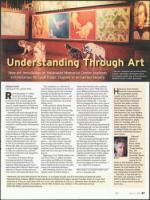
"I am not a historian, but an artist telling
a story," says Robert Barsamian about
his traveling exhibit now at the Holocaust
Memorial Center in West Bloomfield.
olocaust and Armenian
Genocide Commemoration,"
a presentation and dis-
cussion at the University of
Michigan-Dearborn co-sponsored
by the Voice/Vision Holocaust
Survivor Oral History Archive
(UM-Dearborn), the Armenian
Research Center (UM-Dearborn),
the Armenian Studies Program
(UM-Dearborn), the Cohn-Haddow
Center for Judaic Studies (Wayne
State University) and the Mardigian
Library (UM-Dearborn), begins
6:30 p.m. Thursday, April 11, in
dining room D at Fairlane Center
South, located on the north side
of Hubbard Road, just east of the
University of Michigan-Dearborn
main campus.
Featured
speaker is
Steven K.
Baum, whose
talk is titled,
"Understanding
Why: The
Psychology of
Genocide." Baum
Baum
is the editor of
Journal for the
Study of Anti-Semitism and the
book editor for the Journal of Hate
Studies. He is the author of The
Psychology of Genocide (2008)
and Antisemitism Explained (2011).
The event is free and open to
the public, but seating is limited.
RSVP to (313) 593-5236 or by
e-mail to library-event-rsvp@umd.
umich.edu .
H
rii 7 2011
47