

I
World
THE
HAGGADAH
More Roar!
A few new Passover Haggadahs
and a facelift for an old favorite.
Sue Fishkoff
Jewish Telegraphic Agency
San Francisco
N
earing its 80th birthday, perhaps
it was time the most printed
Passover Haggadah in history
had a major facelift.
The Maxwell House Passover Haggadah,
which has had more than 50 million
copies published, hit the shelves — and
supermarkets — this spring featuring its
first new English translation since 1934,
the year it was originally printed.
Banished are the awkward "thee" and
"thou," replaced by the more conversa-
tional "you." The Eternal One no longer
"deliverith" but "delivers:' and seder par-
ticipants are not invited to "eat thereof"
but simply to eat.
While American Jews of the early 20th
century might have accepted the original,
archaic language, "it makes the Haggadah
more clumsy for contemporary readers,"
said Elie Rosenfeld, CEO of Joseph Jacobs
Advertising. The firm has represented
Maxwell House from the beginning and
spearheaded the new translation, which
took nearly a year to complete.
"We wanted to make sure everyone who
uses it feels comfortable with it',' Rosenfeld
said.
That meant political as well as linguistic
changes. The Higher Power in this Haggadah
isn't a He, Lord or King, but is referred to
by the gender-neutral monikers God, the
Eternal and Monarch of the Universe.
The impetus for the new translation was
not to address gender issues but to retell
the old tale in contemporary language.
Still, using gender-neutral language for
God is indicated by modern theological
understanding, Rosenfeld says. "The fact
of the matter is, God doesn't have a gen-
der."
The original Maxwell House Haggadah
was created as a marketing tool to promote
the company's coffee, which was certified
kosher in 1923. There had been controver-
sy for years over whether coffee beans were
legumes, and thus forbidden for Passover
according to Ashkenazic norms, or whether
they were in fact a berry — a fruit — and
therefore permitted.
Joseph Jacobs, founder of the ad agency,
got Orthodox Rabbi Hersch Kohn to cer-
tify the coffee kosher for Passover. The
publication 11 years later of the Haggadah,
still distributed free in supermarkets with
the purchase of the coffee, cemented the
dominance of Maxwell House and its
Haggadah at American seder tables ever
since.
Over the years, the cover design has
changed, from the original bronze
through various blue-and-white versions
to this newest iteration, which features a
Yemenite-style silver kiddush cup.
The inside illustrations are more sub-
tly rendered than in previous versions
but have not changed significantly, with
FAS5ACheek
rroe t," rr-xt
41r.,~0, .1kA‘ne
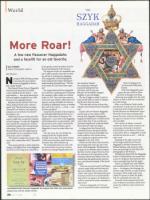
The Maxwell House Passover Haggadah: the original from 1934, the recent photo
collage cover and the newest version.
26
April - 201"i
one exception: Instead
of a young boy, a little girl
is pictured asking the Four
Questions. And not just any
little girl: It's Rosenfeld's youngest
daughter, 6-year-old Abigael.
The text is bigger to make it easier to
read, and the layout is easier to navigate.
But the story stays the same.
"The Jews don't end up in Boca; they
still get to the Promised Land," Rosenfeld
says.
Another old-new Passover Haggadah
out this year is a new edition of the
famous Szyk Haggadah, featuring the
magnificent illustrations of Polish-Jewish
artist Arthur Szyk. It has a newly com-
missioned English text written by Rabbi
Byron Sherwin with Irvin Ungar.
A refugee from Nazi Europe, Syzk
embedded Eastern European Chasidic
imagery in his intricate and highly emo-
tional rendition of the Exodus narra-
tive, creating the original version of his
Haggadah in the mid-1930s.
Jewish survival, which Szyk viewed as
the pressing need of his age, also is the
theme of his Haggadah: The illustration
on page 26, for example, depicts empires
that have tried to conquer the Jews, from
the Assyrians to the Inquisition to Nazi
Germany, with the two tablets of the Law
astride them all, signifying the persever-
ance, and ultimate triumph, of the Jewish
people.
"Szyk was an activist artist," said Ungar,
a former pulpit rabbi and San Francisco
Bay Area resident who is curator of the
Arthur Szyk Society. "He believed the Jews
of Europe needed to be rescued immedi-
ately, and he was going to do whatever he
could to motivate the world community to
take action:'
A Passover Haggadah: Go Forth and
Learn by Rabbi David Silber, with Rachel
Furst, is being put out
by the Jewish Publication
Society.
If the Szyk Haggadah is gor-
geous, this new work by Silber
and Furst is thought-provoking,
delivering new insights into the seder
themes as well as first-rate commentar-
ies on the liturgy.
Silber is an Orthodox Torah scholar
and educator of wide renown, the found-
er and dean of the Drisha Institute for
Jewish Education on Manhattan's Upper
West Side. He has been teaching these
lessons for years, and puts them down on
the page in a manner at once scholarly
and accessible.
Furst teaches at Matan, a women's
institute for Torah studies in Israel, and
is pursuing a doctorate in medieval
Jewish history at the Hebrew University
in Jerusalem. This is a Haggadah to study
and discuss, but also to use — with the
right crowd.
Speaking of the right crowd, kids
are the target audience for Passover
Haggadah in Another Dimension by
Michael Medina, with artwork (sculp-
tures and paintings) by Emi Sfard and
photographs by Eli Neeman.
Published by Kippod3D, this Haggadah
boasts 3-D illustrations and comes with
a pair of 3-D glasses that make the char-
acters seemingly leap from the pages.
There's an English text, some Hebrew
and transliterations of the main attrac-
tions — the plagues, the blessings, the
favorite songs. But this is really all about
the images, which might make some
adults too queasy to tackle the gefilte
fish. It's a gimmick, but a fun one.
Proceeds will be donated to the chil-
dren of Hayim Association, which raises
money for pediatric cancer research in
Israel.