

Arts & Entertainment
Crafts representative of the kinds
of projects in which Jews were
heavily involved in Islamic lands
include glassmaking, silk weaving
and goldsmithing.
"The DIA now has an interest
in developing a collection of
Judaica, an interest we have
not focused on in the past."
- Curator of Islamic Art Heather Ecker
Suzanne Chessler
Special to the Jewish News
T
hree religious manuscripts on
loan from the Jewish Theological
Seminary (JTS) will be at the cen-
ter of an upcoming program at the Detroit
Institute of Arts (DIA).
The program, "Jews, Judaism and the
Arts: Past and Present;' co-sponsored by
the DIA and JTS, has been planned to
include talks and a tour of the Gallery of
Islamic Art 2-5 p.m. Sunday, March 6.
"The yearlong loan of the manuscripts
is coming to an end, and we wanted to cel-
ebrate their exhibit with members of the
community and seminary," says Heather
Ecker, who will lead the discussion and
tour. She is curator of Islamic Art and
department head of the Arts of Asia and
the Islamic World at the DIA.
"As I show people the holdings of the
gallery, I will stop at each section to dis-
cuss some aspect of Jewish history. Until
1600, most of the Jews in the world lived
in Islamic lands so the Jewish relationship
with Islamic culture and the countries that
comprised the Muslim world is very deep."
Supplementing Ecker's talk will be a
presentation by text artist Lynne Avadenka
of Huntington Woods, who will give an
illustrated presentation, "Classic Texts/
Present Tense." She will speak on several
of her works housed at the DIA, including
Root Words: An Alphabetic Exploration, a
collaborative project with Islamic calligra-
pher Mohamed Zakariya.
One seminary manuscript to be dis-
cussed involves pages from a Hebrew
Bible (selections from the Pentateuch and
Psalms) completed about 1400 in parch-
ment and ink by an unknown artist in
Yemen.
"The text has the Masoretic interpreta-
tions, developed by rabbis to correct what
they believed were faults that appeared
during the Babylonian captivity of the
Jews," says Ecker, who opened the new
Gallery of Islamic Art at the beginning of
2010.
"The Masoretic determinations of the
reading of the canonical text goes back to
the 10th and 11th centuries, and that will
be explained. We also will review how the
manuscript shows minute Hebrew writing,
often done in an ornamental pattern, serv-
ing as commentary on the text."
Another manuscript to be discussed is
Hebrew Poetic Hymns to Accompany Daily
Prayers (Pizmonim) (1810), an ink on-
paper document by an unknown artist in
the Kurdistan area.
"These were important to Eastern
Jewish communities, and they were writ-
ten in Hebrew with a long, narrow, hori-
zontal format used in Iranian culture for
writing poetry," Ecker explains.
The third seminary manuscript, Yusuf
and Zulaykha in Judeo Persian (1853), an
ink and opaque watercolor document on
paper, was copied by the scribe Eliyahu
ben Nissan ben Eliyah in northeast Iran.
It tells the story of Joseph (Yusuf) as it
appears in Qur'anic and biblical stories.
"The manuscript is written in Persian
with Hebrew letters:' Ecker says. "It con-
tains the writings of the Persian poet Jami,
who lived between 1414 and 1492.
"Jami's poetry is cast as a romance
between two reconciled lovers, Yusuf
and Zulaykha (the wife of Potiphar). In
one illustration, Yusuf is mistreated by
-
-
his brothers and pulled from a pit by
Midianite merchants.
"The poetry draws on some talmudic
sources so it's not the story as written
in the Torah, and this gives a different
emphasis. The illustrations are in the style
that was prevalent in Iran and shows the
extreme level of acculturation of Iranian
Jews."
Tile panels from the 1840s, which show
episodes from the story of Joseph, also
will be discussed.
As Ecker tells about the DIA Islamic
holdings, she will explain that most of
the art is anonymous. Still, certain crafts
are representative of the kinds of proj-
ects in which Jews were heavily involved.
Glassmaking, silk weaving and goldsmith-
ing, which are seen in the gallery, were
specialties of Jewish artists. Display cases
also contain many examples of tableware.
"We have nice examples of early Islamic
glass from across the Islamic world:'
says Ecker, who received her doctorate
in Islamic art and archaeology at the
University of Oxford in England.
"For a long time, glass coin weights
were used to maintain standards in com-
mercial transactions in the marketplace,
and we have some of those."
Among the objects to be seen at the DIA
will be glass from Syrian and Palestinian
regions, textiles from Spain and Turkey
and gold jewelry from Egypt and Iran.
"Acquisitions for our Islamic collec-
tion began in the 1890s," says Ecker, who
is teaching an art history course at the
University of Michigan.
"Some of the most important objects
in the collection came in the 1930s and
1940s, and there is a continuing rotation
of manuscripts, textiles and carpets to
preserve them."
One important work in the collection
is a 15th- century Qur'an written in Iran
using colored Chinese paper. Only four or
five examples exist worldwide with this
being the only one in the United States.
Another significant object is a large
velvet floor covering from Ottoman Turkey.
Made of silk and silver-wrapped threads,
it is the largest surviving example of its
kind from the early 17th century.
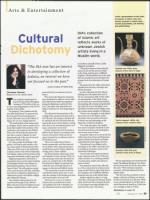
Spouted ewer, 1100s, glass,
unknown artist, Syria or Egypt
Textile fragment, 1400s, silk,
unknown artist, southern Spain
Glft of Mrs. Roscoe B. Jac kson
Cultural
Dichotomy
DIA's collection
of Islamic art
reflects works of
unknown Jewish
artists living in a
Muslim world.
Bracelet, 1000-1100, gold,
unknown artist, Syria or Egypt
"We are negotiating a new loan from the
Jewish Theological Seminary," says Ecker,
who has been with the DIA for more than
five years. "We're striving to maintain
a presence of Jewish manuscripts from
Islamic lands.
"The DIA now has an interest in devel-
oping a collection of Judaica, an interest
we have not focused on in the past. While
we are considering how to do that and in
which direction we should go, I think that
one can begin to look at context.
Dichotomy on page 32
February 17 2011
31