

21st Annual Belin Lecture in American Jewish Public Affairs
Playing the Blame Game:
American Jews Look Back at the Holocaust
Deborah Lipstadt, Dorot Professor of Modern Jewish History and Holocaust Studies, Emory University
Wednesday, March 16, 2011, 7pm
Palmer Commons, Forum Hall, 100 Washtenaw Avenue
Over the years since World War II, scholars and popular writers have
closely analyzed Franklin D. Roosevelt's policies regarding the rescue
of European Jewry during the Holocaust. Most have severely criticized
FDR while others have defended him and his policies. This lecture will
explore to what degree these analyses have become intertwined with
contemporary issues facing the Jewish community. After tracing both
the scholarly and popular historiography of America and the Holocaust,
we will ask: when are we reading history and when is history being used
as a metonym for what is really a conversation about contemporary
political issues facing the Jewish community? When is this conversation
about the 1930s and 1940s and when is it really about what is happening
in the 21s1 century?
With the publication of Arthur Morse's While Six Million Died: A
Chronicle ofAmerican Apathy in 1967, American Jews began to recognize
that there were grounds to criticize the policies of the Roosevelt
administration for "failing" to rescue European Jews during the 1930s
and 1940s. (There had been, of course, criticism during the war by
such groups as the Bergson Boys but in the postwar period this critical
approach had been muted.) Morse's popular account was followed by
serious historical studies by Henry Feingold (The Politics of Rescue), David
Wyman (Paper Walls, The Abandonment of the Jews) and Richard Breitman
and Alan M. Kraut (American Immigration Policy and European Jewry
193345). Most of these authors criticized to varying degrees American
immigration policy and the behavior of the American Jewish community
Beginning in the 1990s, a "pushback" of sorts evolved with strong briefs
penned in defense of the Roosevelt administration. Authors such as
W.D. Rubenstein (The Myth of Rescue) and Robert Rosen (Saving Jews:
Roosevelt and the Holocaust) argued the White House did absolutely
everything that could have been done and that its policies resulted in
saving countless lives.
Finally, most recently, a third "school of thought" has made its voice
heard. It emanates, not just from scholars, but from the ranks of the
American Jewish community. It is harshly critical of Roosevelt and those
Jews who supported him (the vast majority of American Jews voted for
FDR in all four presidential elections) and argues that they could have
saved multitudes of Jews but did not because they were uncomfortable
with the "type" of Jew who would be saved. This school of thought
claims that these American Jewish supporters of Roosevelt did not want
"those kinds of Jews" here in America.
Rather than analyze who is "right" and who is "wrong" about the
Roosevelt administration, this lecture asks to what degree are these
debates a metonym for more contemporary issues. In other words,
when American Jews severely criticize or defend FDR and his policies
are they talking about FDR or, in reality, are they talking about
contemporary issues?
Voices of the Italian Holocaust:
A Recital of Vocal Music
Sunday, January 30th, 2011, 5 pm
Britton Recital Hall, Moore Buildhig
Soprano Caroline Helton and pianist Kathryn Goodson, who
recently released their first CD of solo vocal music by Jewish
composers, Voices of the Holocaust, will be performing a new
program of music exclusively by Italian Jewish composers. With
the help of Italian musicologist Aloma Bardi, Helton and Goodson
have prepared a program that displays these composers' astonishing
stylistic variety in the period before and during World War II.
.
"It is an extreme privilege to have my very own personal musi-
cologist, Aloma Bardi, finding these gems for Kathryn and me
to perform," explains Helton. "Given the state of publishing and
archives in Italy after World War II, music by obscure composers
(made all the more obscure by the fact they were Jewish) is terribly
difficult to find. Aloma actually found a piece that was thought
to be lost Vocalise (Chant Hebraigue) in our own Library of Con-
gress. Not only has Aloma done years of research, but she has also
matched the repertoire to my voice, so that Kathryn and I were able
to compile a musically diverse program very easily out of the pieces
she provided us."
The pieces on the program have very rarely been performed in Italy.
The recital will mark the American premiere of many of them,
including Mario Castelnuovo's Vocalise (Chant Hebraigue), which
until recently was believed to be lost. The texts are variously drawn
from the great Italian poets Dante, Giosue Carducci, and Giacomo
Leopardi, as well as the French Jewish poet Max Jacob.
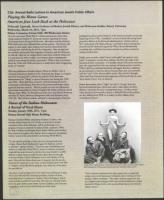
Irving Penn, "Ballet Society," New York, 1948. Left to right: Corrado Cagli, Vittorio
Rieti, Tanaquil Le Clercq and George Balanchine, National Gallery ofArt
"Each composer represented on this program has a completely
unique voice in his harmonic vocabulary, piano writing and text
setting," Helton continues. "The subject matter ranges from the
most lighthearted settings of folk tunes in the Piedmontese dialect
(spoken by Primo Levi) to the most profound poetry by beloved
Italian masters.."